
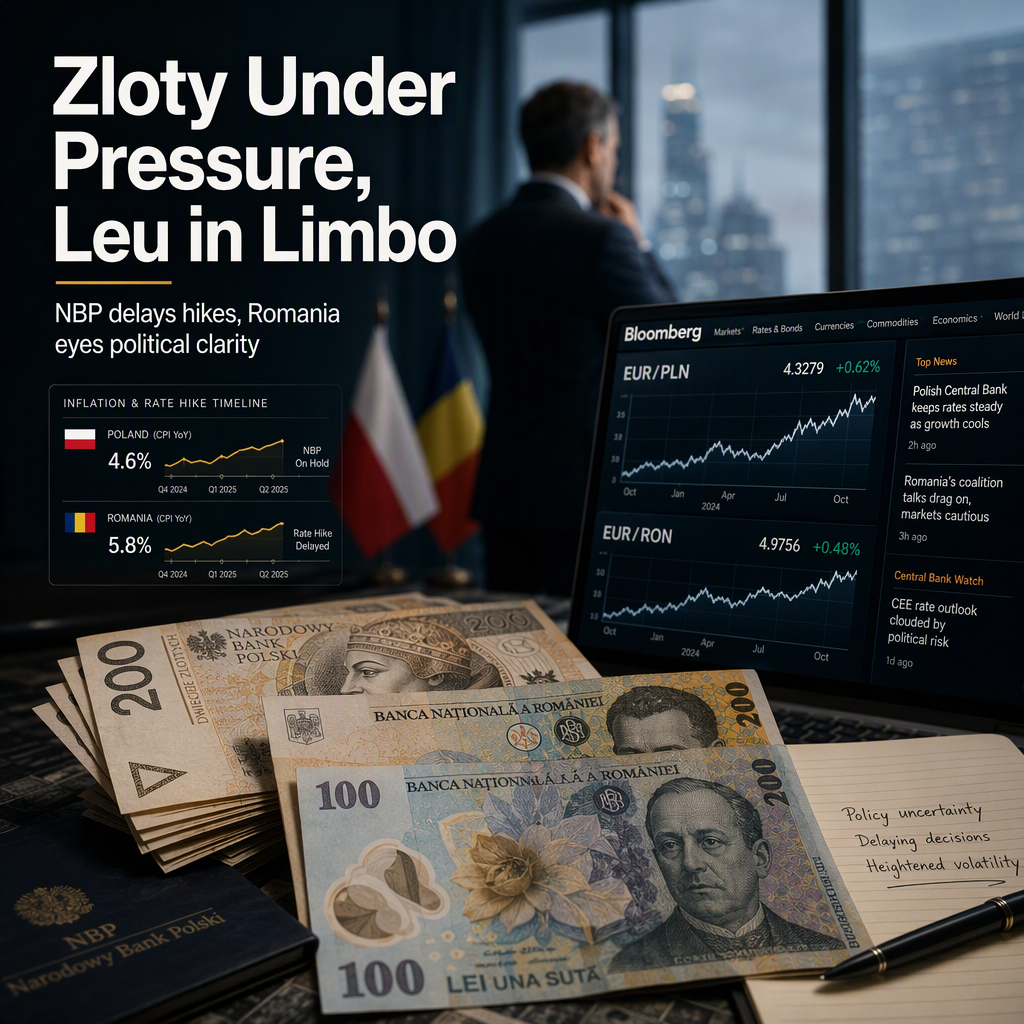
ING strategist Frantisek Taborsky expects the National Bank of Poland (NBP) to delay interest rate hikes until early 2027, citing the government's new fuel-price measures as a factor allowing policymakers to remain patient in the face of inflation risks and rising energy prices [1]. During the NBP's press conference, Governor Adam Glapiński initially adopted a hawkish tone, emphasizing inflation concerns and the impact of higher energy prices, but ultimately indicated that a rate hike in November is unlikely [1]. Unless there is a significant inflation surprise in November, ING's baseline scenario is for rate hikes to be postponed until the first quarter of 2027 [1].
In the foreign exchange market, ING sees the EUR/PLN trading range shifting higher from 4.360–4.380 to 4.380–4.400, driven by a strong US dollar, rising energy prices, and increased risk aversion in the eurozone [1]. The EUR/PLN rate remains unchanged for now, but downside pressure on the zloty is expected to persist [1].
In Romania, the National Bank of Romania kept its policy rate steady at 6.50%, with few new comments in its statement [1]. Political uncertainty remains a key focus, as EUR/RON drifted lower following headlines suggesting the possibility of a new government under technocratic leadership backed by the original coalition parties [1]. Despite this, EUR/RON remains above 5.340, significantly higher than late September levels when pressure on the currency began [1]. ING expects EUR/RON to stabilize at current levels if a new parliamentary majority is formed, rather than seeing a rally in the leu [1].
CONCLUSION
The National Bank of Poland is expected to keep rates on hold until early 2027, maintaining downside pressure on the zloty, while the Romanian leu's outlook hinges on political developments. Market participants should monitor inflation data and political negotiations for further direction in CEE currencies.