
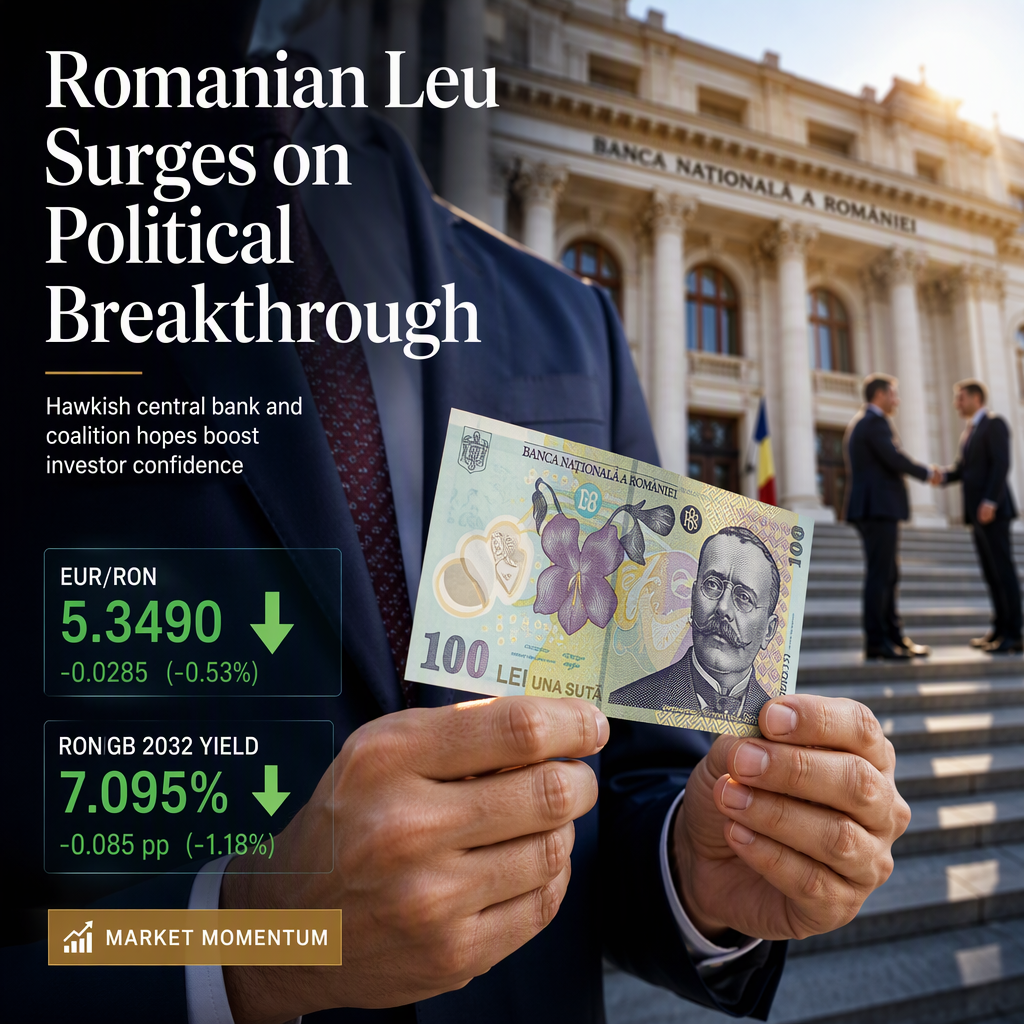
The National Bank of Romania (NBR) maintained its policy rate at 6.50% and reinforced a hawkish stance, with earlier inflation risks such as higher commodity prices, drought-related food inflation, and RON depreciation now incorporated into its baseline outlook [1]. Societe Generale strategists highlighted that the political environment improved after Prime Minister-designate Luca Niculescu secured conditional support from the Social Democrats, Romania's largest parliamentary party [1].
This political development has raised hopes for the formation of a broad coalition government with the Liberals and the ethnic Hungarian party, which could help resolve the ongoing political deadlock. The deadlock has been a concern for fiscal consolidation efforts and has posed a threat to Romania’s investment-grade rating [1].
Market optimism following these events led to the EUR/RON exchange rate dropping below 5.35 and the yield on 10-year Romanian government bonds (RONGB) falling below 7.10% [1]. These movements reflect increased investor confidence in Romanian assets amid the improved political and monetary policy outlook [1].
CONCLUSION
The combination of a hawkish central bank stance and improved political prospects has strengthened the Romanian Leu and lowered government bond yields. Market sentiment is positive as investors anticipate greater fiscal stability and a potential resolution to the political deadlock.