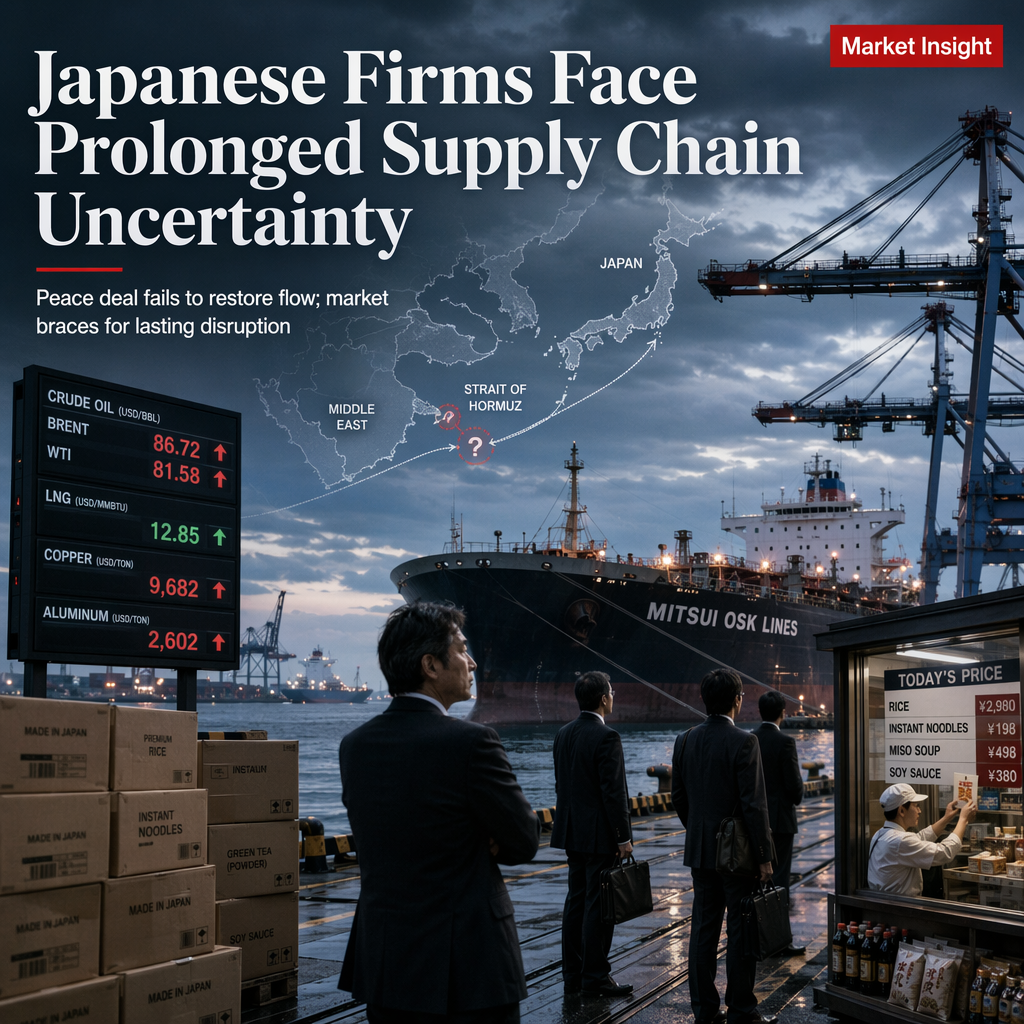
Japanese companies and analysts are warning that supply chain disruptions caused by the Iran conflict are unlikely to ease quickly, even after the recent US-Iran peace deal, and may never fully return to pre-conflict norms. Mitsui OSK Lines, the world's largest tanker operator, stated that navigation through the Strait of Hormuz would only resume when safety is fully assured, underscoring ongoing uncertainty for Japanese businesses dependent on Middle Eastern shipments [1]. This uncertainty is prompting industry leaders to advocate for diversification away from traditional supply sources [1].
The disruption to oil and commodity flows through the Strait of Hormuz has already led to higher prices across several sectors, with the food, daily goods, and energy industries being the most affected. An industry analyst noted that rising prices and stripped-down packaging are direct results of the Iran conflict, and even with the peace deal, there is no guarantee of regional stability sufficient to restore supply chains to their previous state [1].
Recent commodity data shows that Japanese naphtha imports have recovered to 80% of pre-Iran war levels, indicating partial normalization but not a full recovery. Malaysia has pledged to provide Japan with the maximum possible LNG and naphtha to help offset shortfalls, but market sentiment remains cautious [1]. Food and beverage companies in Japan are considering further price hikes as the lingering effects of the war continue to impact the industry, which is described as facing a 'shrinking, monochrome future' due to sustained supply chain challenges [1].
Industry leaders and market analysts are advising Japanese firms to accelerate diversification strategies and invest in supply chain resilience. Trading sentiment remains cautious, with support levels for commodity prices expected to stay elevated as long as Middle Eastern tensions persist. Technical analysis suggests limited downside risk for key import commodities, with resistance levels maintained by ongoing disruptions and uncertainty around the Strait of Hormuz [1].
CONCLUSION
The US-Iran peace deal has not alleviated Japanese supply chain concerns, with companies and analysts expecting prolonged disruptions, higher prices, and a shift toward alternative sourcing. Market sentiment remains cautious, and industry leaders are urging accelerated diversification and resilience investments as Japan adapts to a new supply chain reality.