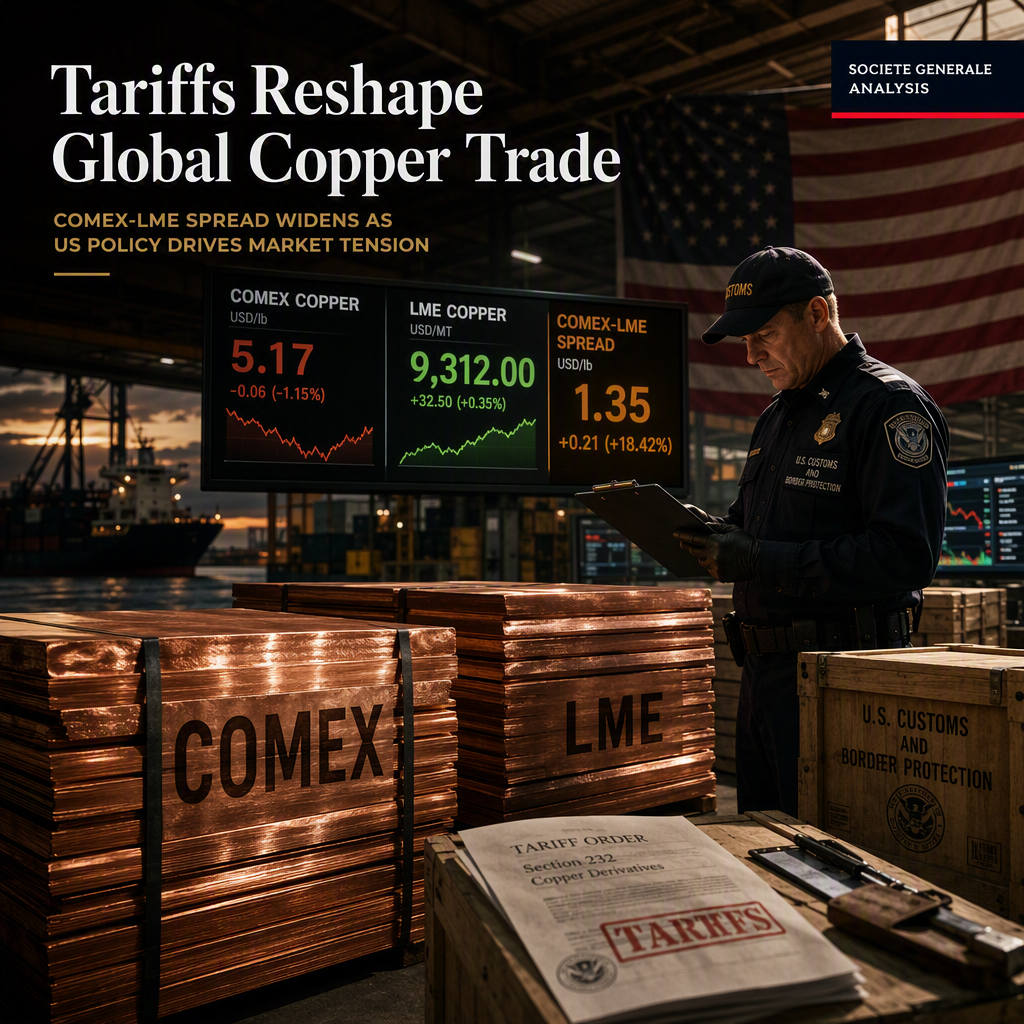
Societe Generale analysts Michael Haigh and Jeremy Sellem report that copper trading has become increasingly policy-driven, with Section 232 tariffs significantly altering the arbitrage dynamics between COMEX copper in the US and LME copper in the rest of the world [1]. The US has implemented a 50% duty on semi-finished and derivative copper products since 2025, while tariffs on refined cathode copper remain deferred, pending a Commerce review that could introduce a 15% duty in 2027 and a 30% duty in 2028 [1].
The analysts highlight that these tariffs have led to a structurally wider COMEX premium and renewed physical arbitrage opportunities, with the spread between COMEX and LME copper now a central concern for traders and hedgers [1]. Historically, LME inventories have been about 65% higher than COMEX due to its larger warehouse network, and the price spread is described as mean-reverting, with a long-run bias of approximately $33/mt in favor of COMEX over 28 years [1]. Dislocations in the spread tend to correct quickly, with a half-life of around 3.5 days, and the arbitrage typically flows from LME to COMEX due to cost structures [1].
Using their model, Societe Generale estimates that the market is currently pricing in a 14.6% probability of a 15% US tariff on refined copper by January 2027 and a 37% probability of a 30% tariff by January 2028 [1]. These probabilities are inferred from the COMEX premium over the fully delivered LME CIF cost, after adjusting for historical non-tariff factors [1].
The report underscores that policy risk is now a key factor in copper market pricing, with the potential for future tariffs influencing both physical and futures markets [1].
CONCLUSION
Societe Generale's analysis indicates that US tariffs have fundamentally changed copper market dynamics, making policy risk a central driver of the COMEX-LME spread. Market participants are now closely watching tariff developments, with significant probabilities assigned to future duties that could further impact arbitrage and pricing.