
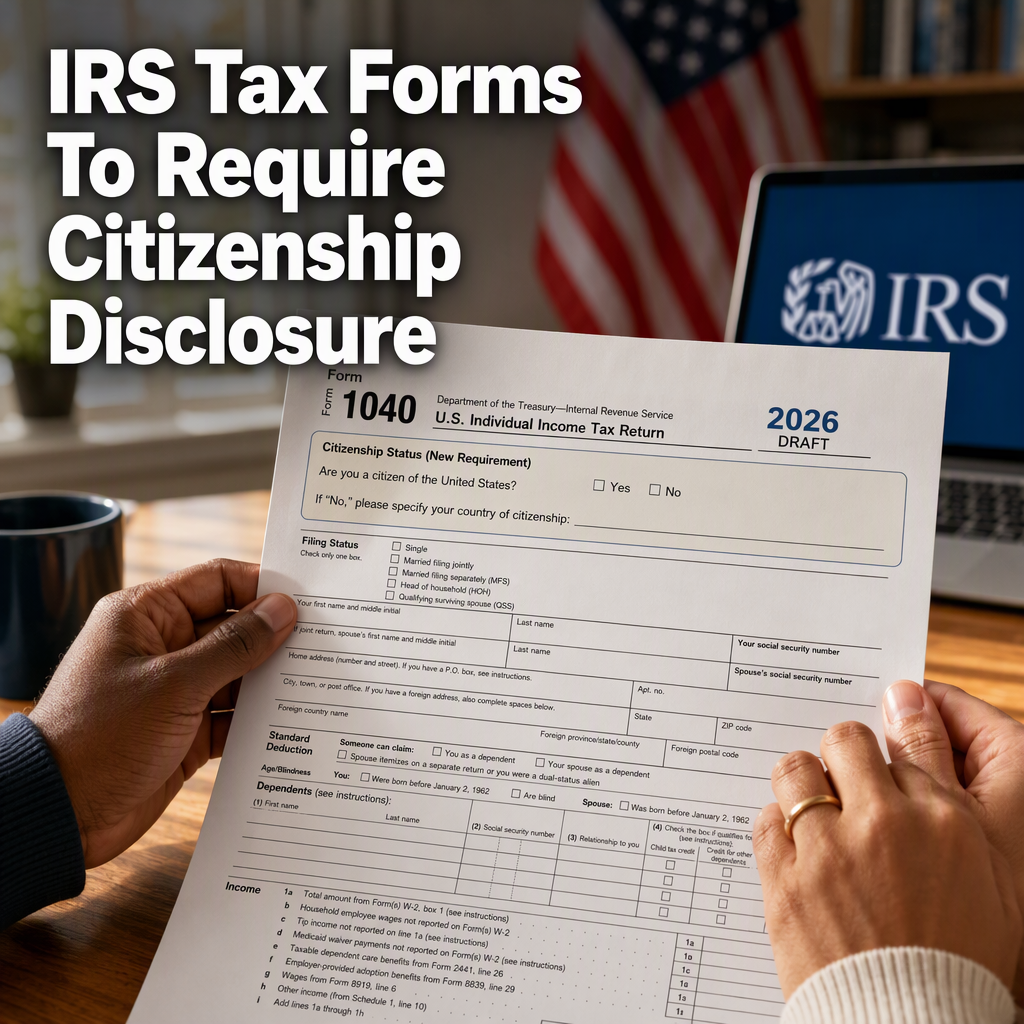
The Trump administration has proposed a new requirement for U.S. taxpayers to disclose their citizenship and work authorization status on annual IRS tax forms, beginning with the draft 1040 form for 2026, which was posted in late August. The draft form includes a question asking, 'At the time you file your return, are you, and your spouse if filing jointly, a U.S. citizen, U.S. national, or an alien lawfully authorized to work in the U.S.?' with 'Yes' and 'No' checkboxes for both the filer and their spouse. A similar question appears on the draft Schedule 3-A, used to claim refundable tax credits [1].
The administration asserts that this measure will help federal officials prevent illegal migrants from collecting federal benefits they are not eligible for, potentially saving taxpayers up to $2 billion. Under the proposal, every tax filer would be required to certify their immigration or citizenship status to the IRS under penalty of law in order to file their return [1].
The Treasury Department stated that the new question is intended to prevent ineligible individuals from claiming refundable tax credits such as the Earned Income Tax Credit (EITC) or the Additional Child Tax Credit, which are designed for low- and middle-income workers and families and often result in refunds for eligible taxpayers. The Treasury also emphasized that the information collected would be protected by privacy, disclosure, and other legal safeguards, but did not specify whether it would be shared with federal immigration enforcement agencies [1].
According to the National Taxpayer Advocate, in 2024 there were 3.8 million tax returns filed using an Individual Tax Identification Number (ITIN), which is often used by undocumented workers who cannot obtain a Social Security number. IRS data shows that these nearly 4 million returns accounted for $14.4 billion in income taxes and $6.5 billion in Social Security and Medicare taxes. However, a valid Social Security Number is required to qualify for the Earned Income Tax Credit, and the IRS checks Social Security Numbers against Social Security Administration records for each EITC claim. Illegal migrants are generally not eligible for federal benefits, and eligibility for refundable tax credits depends on federal tax law and immigration status [1].
CONCLUSION
The Trump administration's proposal to require citizenship disclosure on IRS tax forms aims to prevent ineligible individuals from claiming federal tax credits, with projected taxpayer savings of up to $2 billion. While the measure introduces new certification requirements for all filers, the Treasury Department has stated that privacy protections will be in place for the collected information. The market impact is medium, as the proposal could affect tax administration and compliance for millions of filers.