
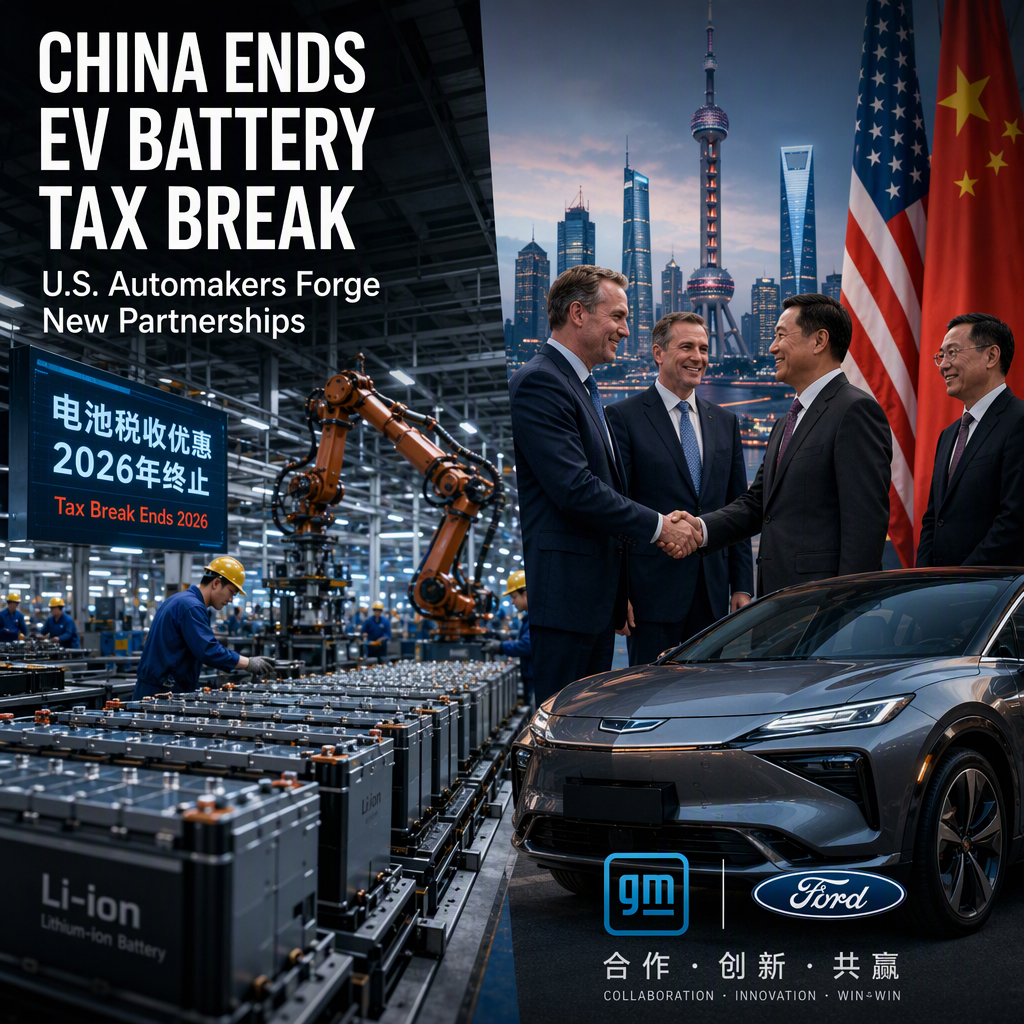
China has ended its 11-year-long tax break on lithium-ion batteries for electric vehicles, reinstating the consumption tax in September 2026 and planning to terminate vehicle purchase tax exemptions in 2028 [1]. This policy shift comes as China continues to lead global sales of new energy vehicles, including EVs and hybrids, for the 11th consecutive year [1]. Analysts suggest that the reduction in government support may pressure weaker players in the auto industry and accelerate consolidation among automakers and battery suppliers, potentially triggering a shakeout in the crowded market [1].
Meanwhile, despite escalating U.S.-China trade tensions and new restrictions on technology transfer, major American automakers Ford Motor and General Motors are maintaining and even strengthening their partnerships with Chinese EV companies [2]. Earlier in 2026, GM and SAIC Motor renewed their joint venture agreement, which is crucial for GM's continued access to the Chinese market—the world's largest for electric vehicles [2]. Buick, a GM brand, relies heavily on Chinese manufacturing and sales to sustain its global competitiveness [2]. Ford CEO Jim Farley emphasized that partnership and competition with Chinese automakers "aren't mutually exclusive," underscoring the complex dynamics between the two countries' auto industries [2].
Industry analysts note that Chinese automakers have advanced significantly in battery technology and supply chain efficiency, making them attractive partners for U.S. companies seeking to accelerate electrification and maintain market share [2]. U.S. automakers face the challenge of complying with domestic regulations while leveraging global expertise to remain competitive [2]. The ongoing partnerships reflect a pragmatic approach to global competition and the realities of the EV supply chain, with analysts stating that "the Chinese market is simply too big to ignore" for GM and Ford [2].
No specific trading advice, price levels, or technical analysis are provided in either article. Both sources highlight the strategic importance of the Chinese EV market and the evolving landscape shaped by policy changes and international collaboration [1][2].
CONCLUSION
China's decision to end tax incentives for lithium-ion EV batteries signals a shift toward industry consolidation and heightened competition, potentially impacting weaker players. Despite geopolitical risks, U.S. automakers are doubling down on their Chinese partnerships to maintain access to the world's largest EV market and leverage advanced battery technology. The market takeaway is a cautious optimism, with industry players adapting to new regulatory and competitive realities.