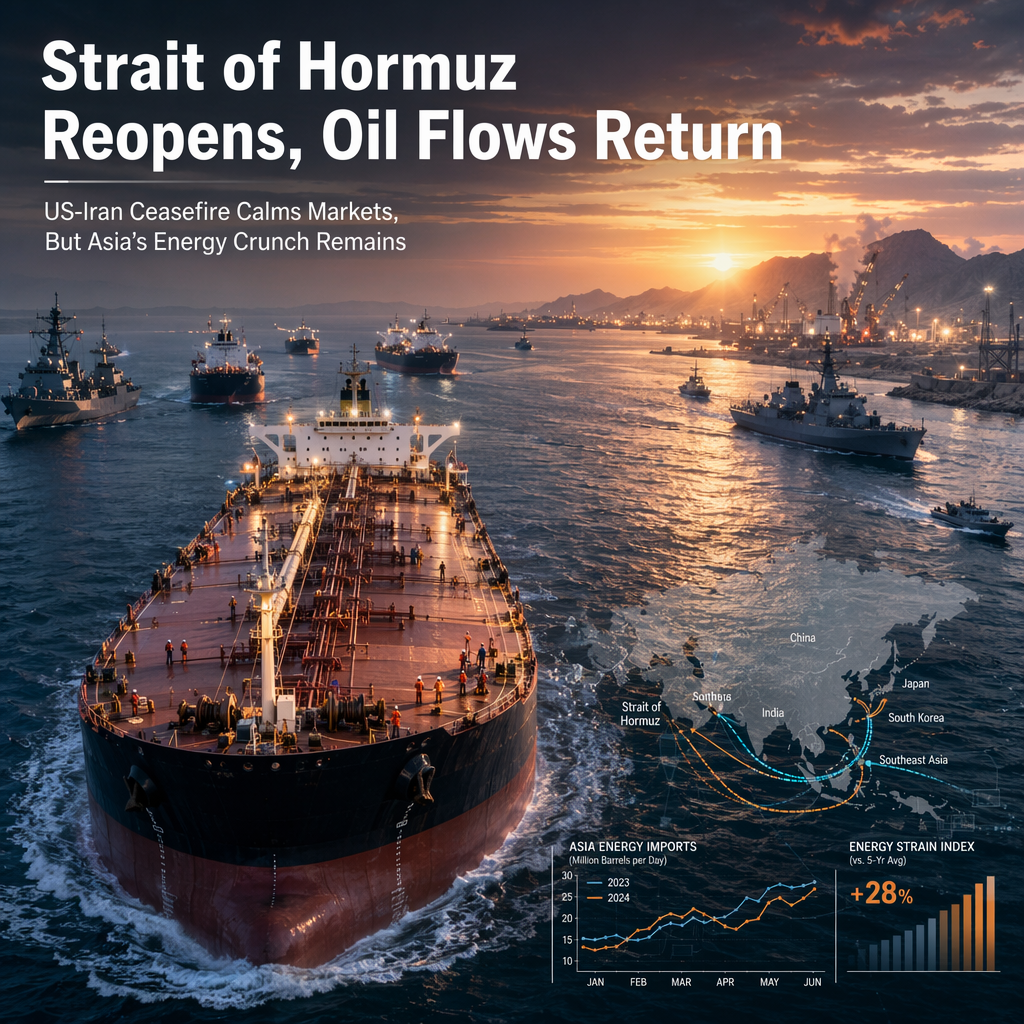
The United States and Iran have signed a preliminary agreement to end the 3-1/2 month-old war in the Persian Gulf, with both sides confirming renewed oil flows through the critical Strait of Hormuz following the deal's announcement by US President Donald Trump [1][2]. According to Deutsche Bank, Brent crude oil prices initially fell after the memorandum of understanding was signed, as investors faded war-related economic fears, but later reversed to close 0.38% higher at $79.85 per barrel, after touching an intra-day low of $76.45 [2]. US and Iranian officials confirmed that 12.5 million barrels of oil passed through the Strait the previous night, with nearly a dozen ships traversing the US blockade, and a 60-day period of free safe passage for commercial vessels was established, with no charges during this window [2]. However, governance and potential future fees for passage remain unclear, as Iran is set to negotiate with Oman regarding future administration and maritime services in the Strait [2].
President Trump emphasized the positive aspects of the interim deal, stating that "oil is flowing" and expressing expectations for a complete ceasefire on all fronts, including Lebanon, Hezbollah, and Israel [2]. Despite the ceasefire, Nikkei Asia notes that it will take months for Asia's inflation-suffering economies to fully recover, as the region continues to face energy shortages and supply constraints, especially with the summer peak demand season underway [1]. The process of clearing mines, resuming normal vessel operations, and repairing damaged infrastructure is expected to be time-consuming, delaying a return to pre-conflict energy conditions [1].
Asian equity markets responded positively to the ceasefire, with Japanese and South Korean stocks reaching record highs [1]. However, some central banks, such as Indonesia's, are struggling to defend their currencies amid ongoing uncertainty and a weakening rupiah [1]. The situation remains fluid, as intensive negotiations over Iran's nuclear program are only just beginning, and the gap between the US and Iran on this issue remains wide [1].
Nikkei Asia also highlights early signs of structural shifts in Asian economies, such as rising electric vehicle sales in India, which may be influenced by the ongoing energy situation [1]. Both sources agree that while the ceasefire and reopening of the Strait of Hormuz have provided immediate relief and tempered oil market fears, significant challenges and uncertainties persist for the region and global energy markets [1][2].
CONCLUSION
The US-Iran ceasefire and reopening of the Strait of Hormuz have eased immediate oil market fears and boosted Asian equities, but energy supply constraints and economic uncertainty remain, especially in Asia. While oil prices stabilized and flows resumed, the path to full recovery is expected to be slow, with ongoing negotiations and infrastructure challenges likely to influence markets in the coming months.