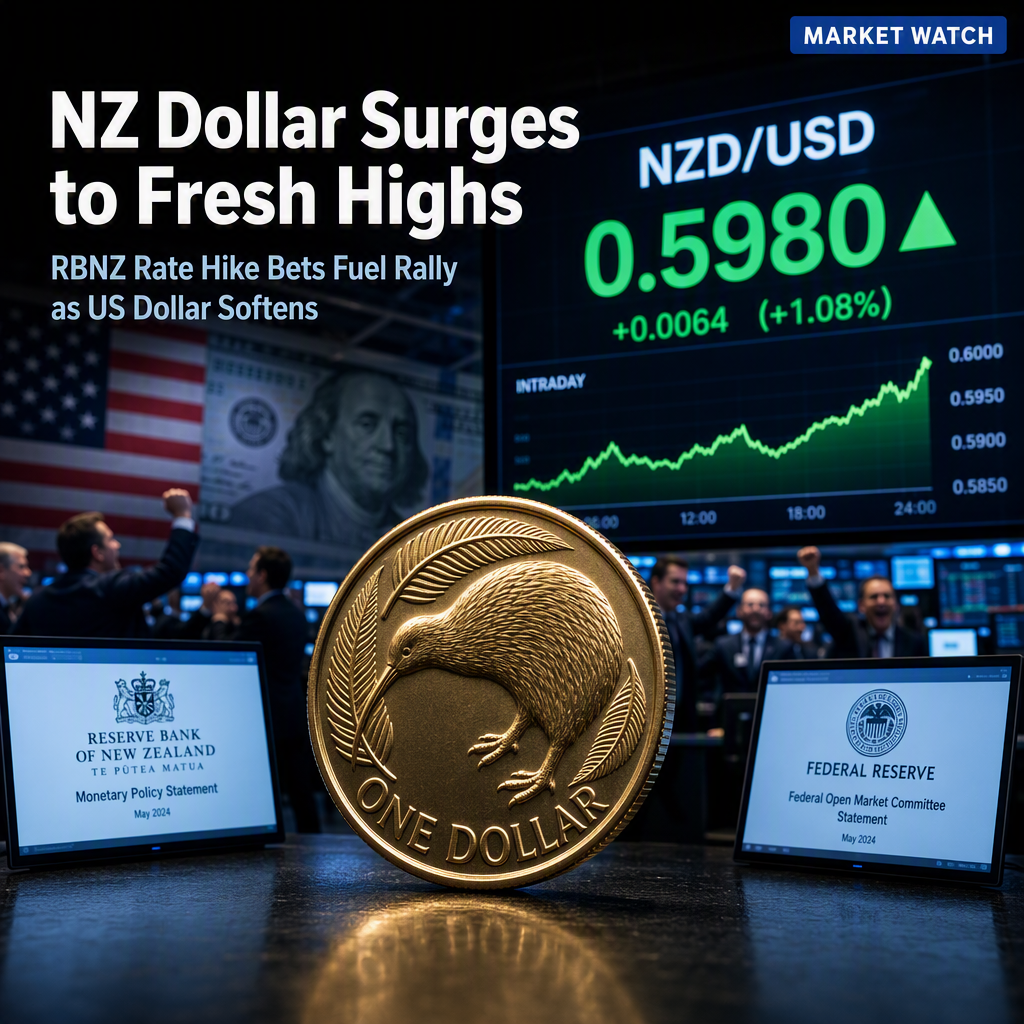
The New Zealand Dollar (NZD) climbed to approximately 0.5980 against the US Dollar (USD) on Tuesday, reaching its highest level since June 1. This upward movement was driven by a combination of a softer US Dollar and firm expectations for a rate hike from the Reserve Bank of New Zealand (RBNZ) [1]. The US Dollar remained under pressure due to the US Treasury's plan to expand its buyback of longer-dated bonds, with US Secretary Scott Bessent reportedly able to access up to $1 trillion from the Treasury General Account to fund these purchases. This scheme has put downward pressure on US yields, and the fading of a safe-haven bid—previously linked to Middle East tensions—also contributed to the Greenback's weakness after the US declared the Strait of Hormuz free of mines [1].
From a technical perspective, NZD/USD was trading at 0.5977, maintaining a bullish near-term bias as it consolidated above both the 20-period Simple Moving Average (SMA) at 0.5967 and the 100-period SMA at 0.5900. The pair was positioned just below immediate horizontal resistance at 0.5983, with the Relative Strength Index (RSI) near 62 indicating constructive, but not yet overbought, momentum. This suggests that dips may continue to attract buyers while the current short-term structure remains intact [1].
A clear break above the 0.5983 resistance level could pave the way for further gains, with only distant resistance levels above the current market. On the downside, initial support is identified at 0.5971, followed by the 20-period SMA and horizontal support clustered at 0.5967–0.5965. A deeper pullback could see the pair retest 0.5944, with the broader uptrend context anchored by the 100-period SMA at 0.5900 [1].
Market participants are also awaiting Federal Reserve Chair Kevin Warsh's address at the Jackson Hole symposium on Friday, which could provide further direction for the USD and, by extension, the NZD/USD pair [1].
CONCLUSION
The New Zealand Dollar's rise to fresh highs is supported by a weaker US Dollar and strong RBNZ rate hike expectations. Technical indicators suggest continued bullish momentum, with key resistance and support levels in focus. Upcoming remarks from the Federal Reserve Chair may influence future market direction.