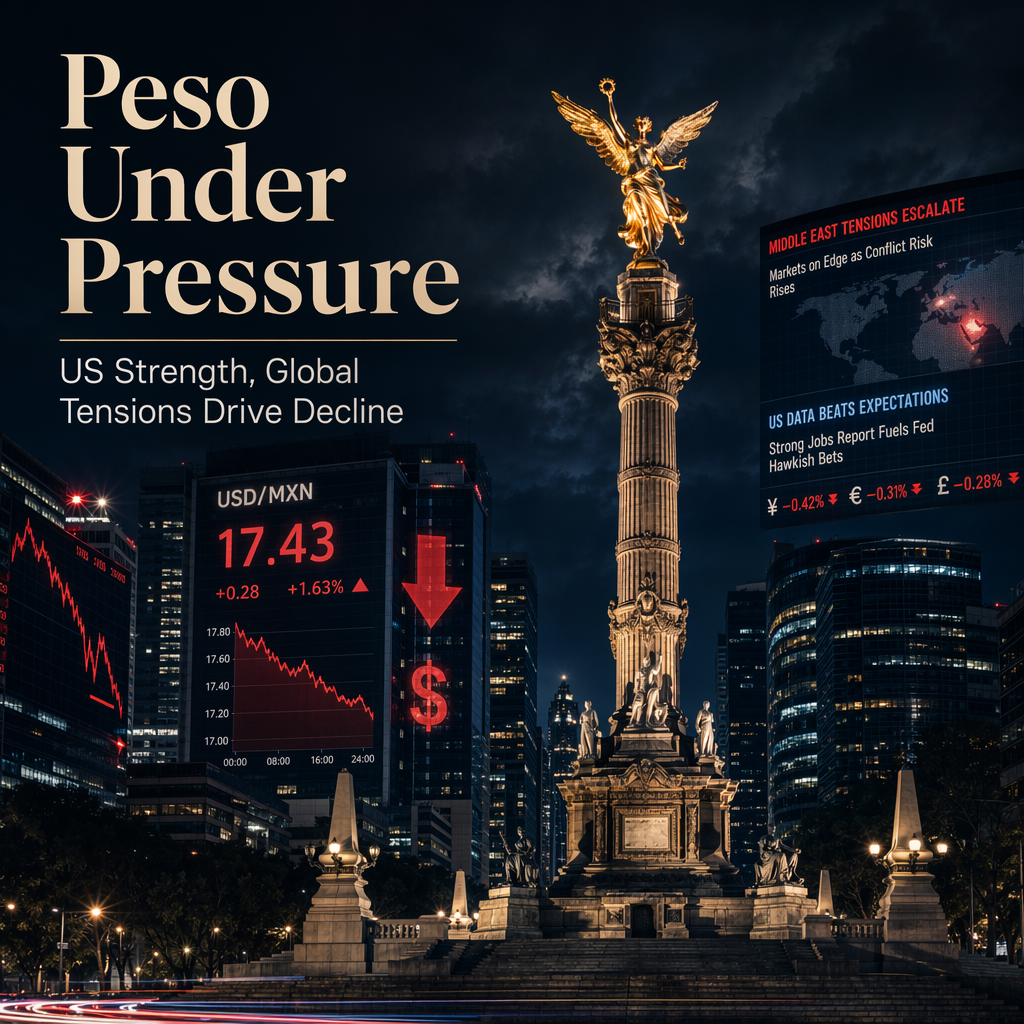
The Mexican Peso depreciated by approximately 0.30% on Thursday, driven by increased risk aversion among market participants following an escalation in the Middle East conflict, which has also led to higher energy prices [1]. The USD/MXN currency pair rebounded, trading at 17.43 after reaching a low of 17.37 earlier in the day [1]. The US Dollar strengthened, supported by a rise in US Treasury yields, with the 10-year note yielding 4.569%, up 2 basis points, and the US Dollar Index (DXY) climbing 0.27% to 100.76 [1].
Positive US economic data contributed to the Greenback's recovery. Retail Sales increased by 0.2% month-over-month in June, though this was below May's 1% growth, largely due to higher gasoline prices. The Control Group Retail Sales, which is used for GDP calculations, slowed from 0.8% to 0.5% as expected. Initial Jobless Claims for the week ending July 11 were 208,000, beating forecasts of 217,000 [1].
Federal Reserve officials expressed hawkish views, with Dallas Fed President Lorie Logan advocating for a slightly higher policy rate to balance risks, and Kansas City Fed President Jeffrey Schmid highlighting a stable labor market but ongoing concerns about persistent inflation [1]. The swaps market anticipates the Federal Reserve will raise rates by 25 basis points, which would narrow the interest rate differential with Mexico to 250 basis points, as the Bank of Mexico is expected to keep rates unchanged at 6.50% [1].
On the bilateral front, formal trade talks between the US and Mexico are progressing, according to US Trade Representative Jamieson Greer, who described the discussions as pragmatic but noted the US trade deficit with Mexico remains a challenge. The third round of USMCA negotiations is scheduled for next week in Mexico City, and a positive outcome could support the Mexican Peso, which is currently under pressure due to the narrowing rate differential [1].
Technically, USD/MXN is trading slightly above a cluster of simple moving averages around 17.3786, which serves as near-term support and maintains a mildly constructive outlook for the pair, though it remains capped by a descending resistance trend line [1].
CONCLUSION
The Mexican Peso's decline reflects heightened risk aversion and stronger US economic data, which have bolstered the US Dollar. While ongoing US-Mexico trade talks and upcoming USMCA negotiations could provide future support for the Peso, the narrowing interest rate differential and persistent inflation concerns suggest continued pressure on the currency in the near term.