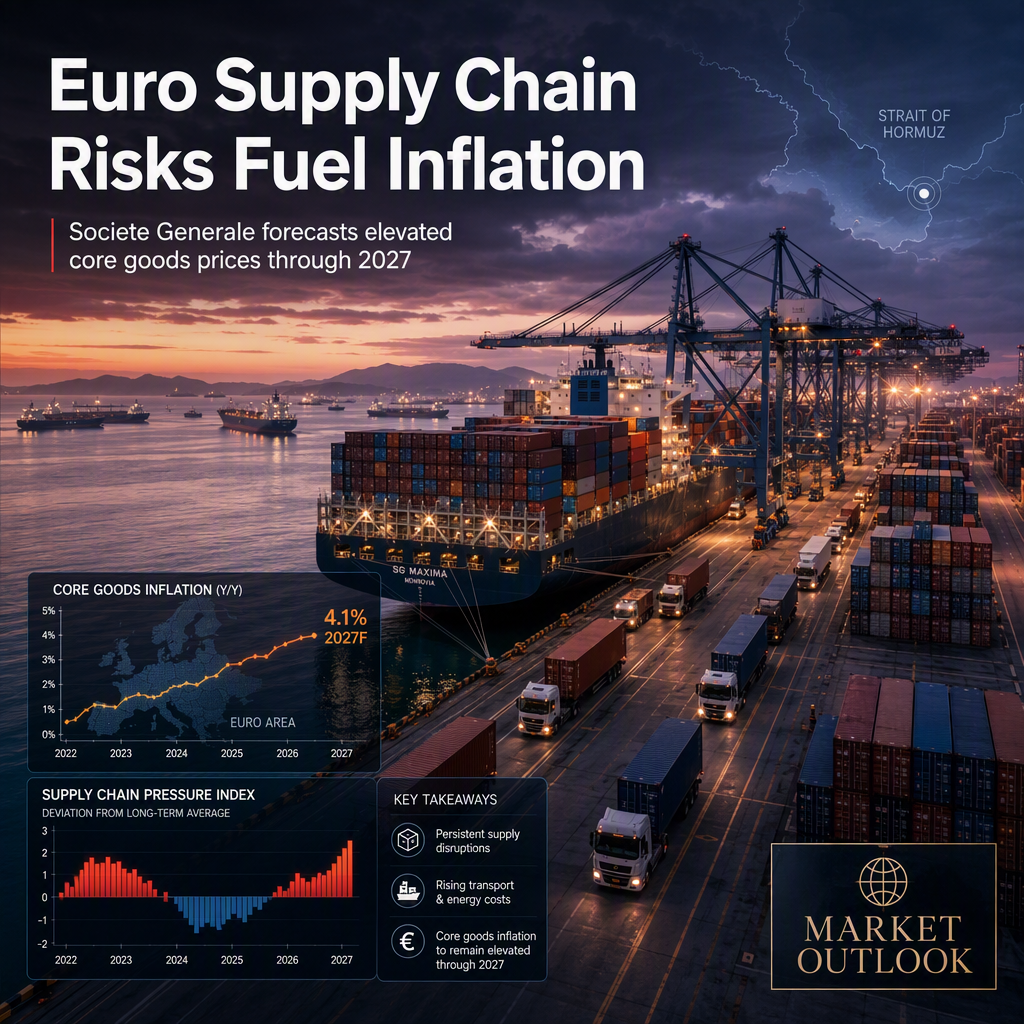
Societe Generale economists Sam Cartwright and Michel Martinez have analyzed the impact of renewed supply chain disruptions, including the recent conflict in the Middle East, on Euro Area prices. They note that while supply chain pressures have been easing during the summer, they remain elevated and are expected to continue influencing inflation in the Euro Area throughout this year and the next [1].
The economists utilized an adaptation of the New York Fed’s Global Supply Chain Pressure Index (GSCPI) to create separate indices for Europe and Asia. Their analysis reveals a distinct response to disruptions in trade flows through the Strait of Hormuz, a key global shipping route. Despite some easing, the elevated supply chain pressures are projected to feed through to inflation, particularly in non-energy industrial goods [1].
Societe Generale forecasts that Euro Area non-energy industrial goods inflation will peak at 1.8% in the second half of 2027, even under scenarios where supply pressures continue to subside in the coming months. After this peak, inflation is expected to normalize [1].
The report highlights that the resilience of European supply chains remains a concern following the Covid pandemic and the war in Ukraine, with the recent Middle East conflict adding to these risks. The economists emphasize that firmer demand and ongoing supply strains are likely to keep inflationary pressures elevated in the near term [1].
CONCLUSION
Societe Generale's analysis suggests that persistent supply chain pressures, exacerbated by geopolitical conflicts, are likely to keep Euro Area core goods inflation elevated through at least 2027. Market participants should remain alert to ongoing supply risks and their potential impact on inflation dynamics.