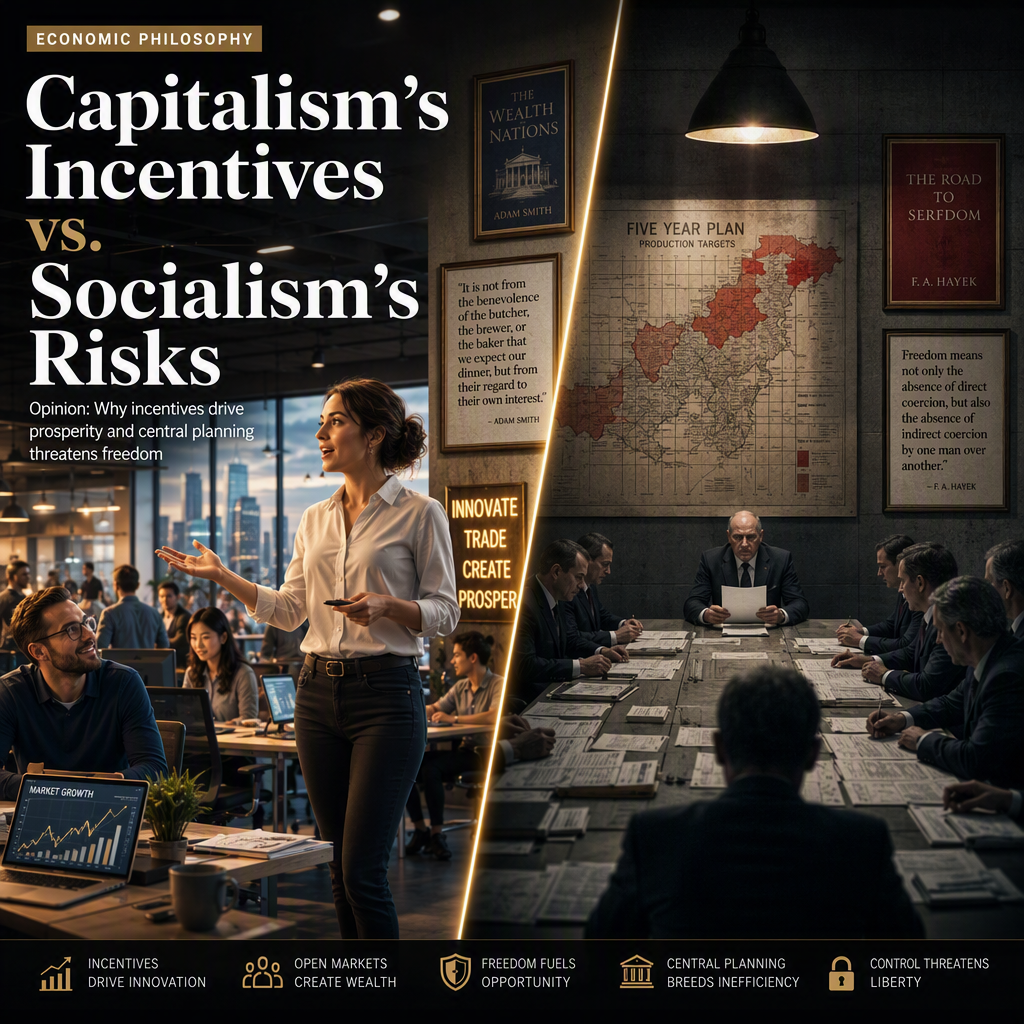
The article discusses the fundamental differences between capitalism and socialism, focusing on the role of incentives in economic systems. Citing economist Friedrich Hayek, the author warns that central planning and increased government intervention, as advocated by socialism, can lead to a loss of individual freedom and ultimately to 'serfdom' [1]. Hayek's 1944 book, 'The Road to Serfdom,' is referenced as a key warning against the dangers of collectivism and government control over economic decision-making [1].
The piece emphasizes that capitalism thrives on individual freedom, property rights, and the ability for people to pursue their own interests within the rule of law. These conditions, according to the article, unleash powerful incentives for work, investment, innovation, and risk-taking, which collectively benefit society [1]. The author also references Adam Smith's 'The Wealth of Nations,' highlighting the idea that individuals acting in their own self-interest inadvertently contribute to the greater good through market mechanisms [1].
No specific market data, ticker symbols, or immediate market reactions are mentioned in the article. The discussion is framed as an opinion on economic philosophy rather than a response to a particular market event or policy change [1]. There are no forward-looking statements or analyst opinions regarding market implications in the article [1].
CONCLUSION
The article presents an opinion favoring capitalism's incentive-driven system over socialism's central planning, warning of the risks to individual freedom posed by increased government intervention. No direct market impact or specific financial data is discussed, making the piece primarily philosophical in nature.