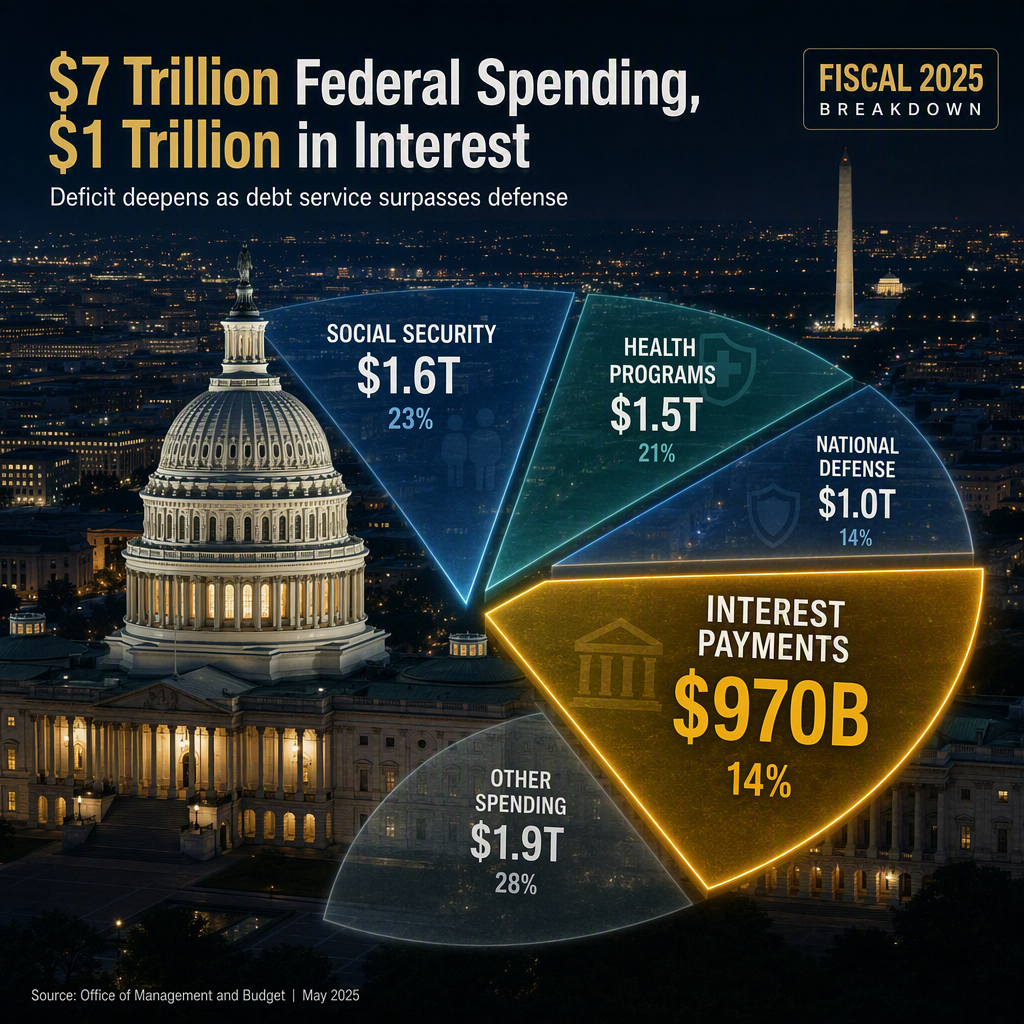
In fiscal year 2025, the U.S. federal government spent approximately $7 trillion, according to an analysis that breaks down the numbers into relatable terms for taxpayers. Of this total, Social Security accounted for about $1.6 trillion, while major federal health programs, including Medicare and Medicaid, represented another significant portion. National defense spending approached $900 billion during the same period [1].
A particularly notable figure is the $970 billion spent on net interest payments on the national debt, which equates to roughly $14 out of every $100 spent by the government. This interest payment surpasses the amount allocated to national defense and highlights the growing burden of servicing existing debt [1].
The breakdown of every $100 spent by the federal government in 2025 is as follows: approximately $23 went to Social Security, $26 to major health programs, $13 to national defense, and $14 to interest on the debt. The remaining funds were distributed among veterans' benefits, income-security programs, transportation, education, federal agencies, and various other government programs [1].
Despite this high level of spending, federal revenues were only about $5.2 trillion, resulting in a deficit of roughly $1.8 trillion for fiscal 2025. This means that for every $100 spent, the government collected only about $74 in revenue and borrowed the remaining $26, further increasing the national debt [1]. The article emphasizes that this pattern of deficit spending is not sustainable and likens it to a household continually spending more than it earns and relying on credit to make up the difference [1].
CONCLUSION
The U.S. government's $7 trillion spending in 2025, with nearly $1 trillion going to interest payments, underscores the growing fiscal challenges facing the nation. Persistent deficits and rising debt service costs highlight the urgent need for fiscal reforms, as current spending patterns are not matched by revenues and may have significant long-term market implications.