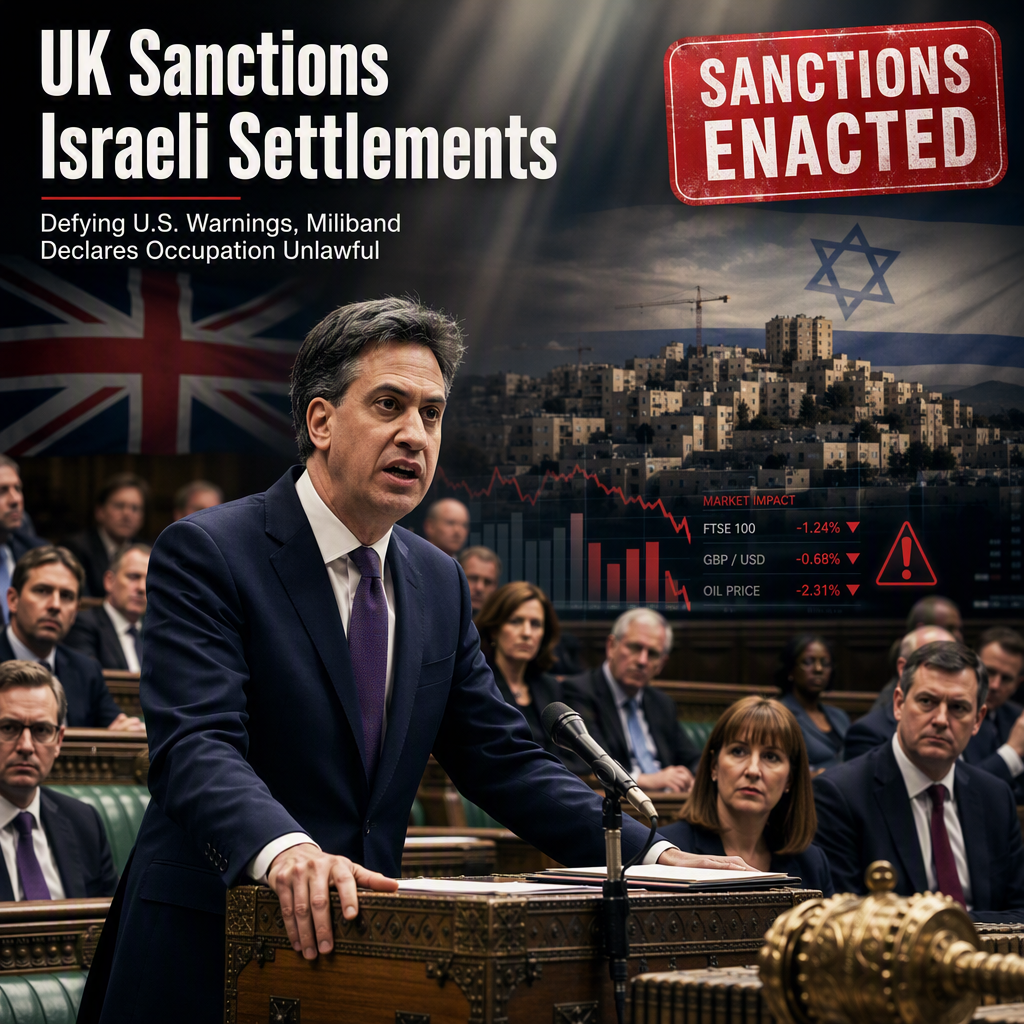
The United Kingdom has announced a series of sanctions targeting Israeli settlements in the occupied West Bank, moving forward with the measures despite explicit warnings from U.S. officials and lawmakers about potential economic consequences for doing so [1]. U.K. Foreign Secretary Ed Miliband, speaking in parliament, declared that Britain will ban imports from Israeli settlements built on land internationally recognized as Palestinian territory, with the measures expected to take six to nine months to come into force [1].
Miliband stated, "Today I announce that the official view of the British government is that the occupation [of the West Bank] is unlawful," and emphasized that the unlawfulness should be reflected in the U.K.'s economic relationships with the occupied territories [1]. He further accused the Israeli government of turning a blind eye to, and in some cases supporting, the displacement of Palestinians by settler groups, which he described as ethnic cleansing [1].
The sanctions regime will include actions against specific companies and individuals providing services such as construction, infrastructure, or financing for real estate expansion by settlers, as well as a ban on advertisements related to the settlements [1]. Miliband warned, "To those who finance or facilitate illegal settlements, let me say this: you will face the full force of U.K. sanctions," but clarified that the U.K. will continue to trade with Israel in support of a two-state solution [1].
Additionally, the U.K. will extend its ban on arms exports to include all license applications for arms and other goods and services that materially contribute to the occupation, creating what Miliband called a "double lock against arms sales" after the suspension of over 30 arms licenses used by the Israel Defense Forces in Gaza [1]. The ban will remain in place as long as the occupation exists [1].
The U.S. has responded with warnings, as U.S. Ambassador to Israel Mike Huckabee told the BBC that "without a doubt there will be" a response from the U.S. regarding the U.K.'s sanctions [1].
CONCLUSION
The U.K.'s decision to impose sanctions on Israeli settlements marks a significant policy shift, drawing strong warnings from the U.S. about possible economic repercussions. The measures, which include bans on imports, arms exports, and actions against companies and individuals linked to settlement expansion, signal heightened tensions and potential market volatility in U.K.-Israel and U.K.-U.S. relations.