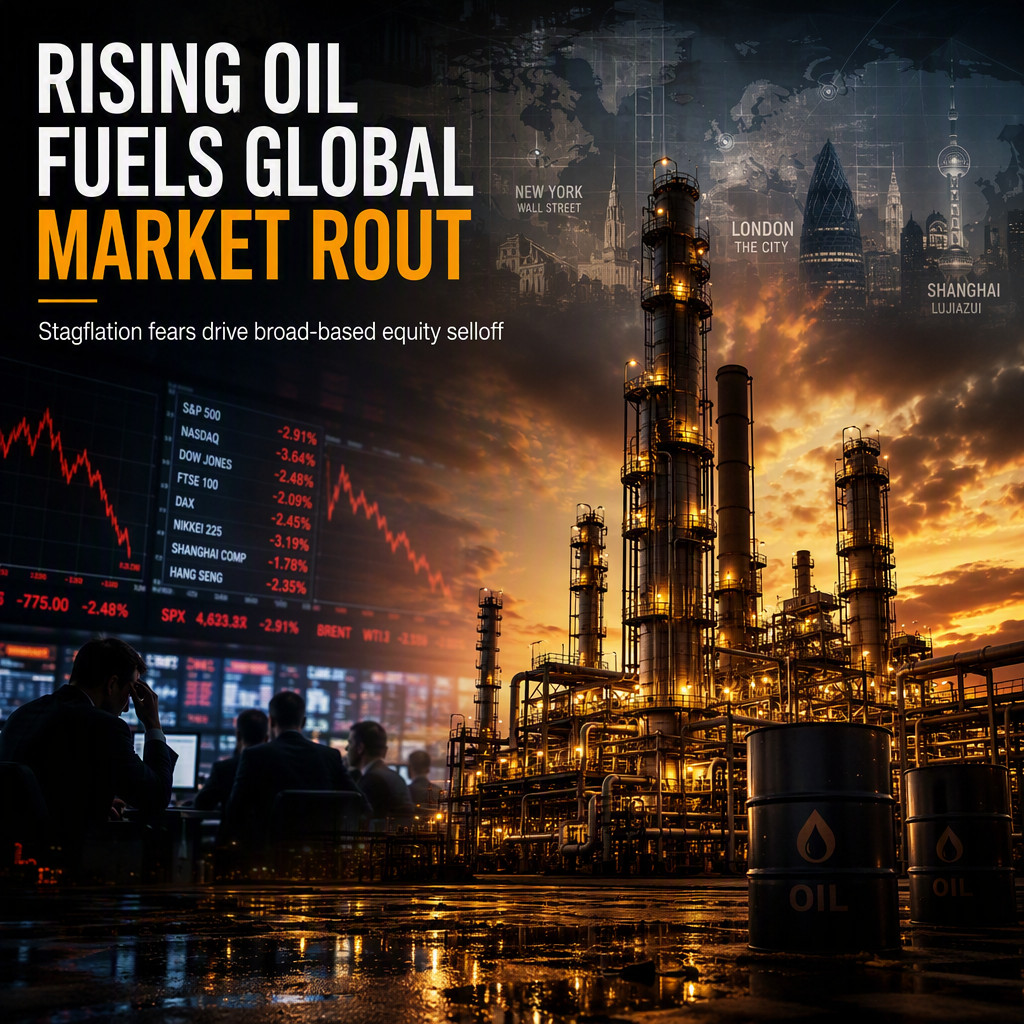
Deutsche Bank strategists report that rising oil prices are intensifying stagflation concerns, leading to widespread declines in global equity markets [1]. Brent crude oil surged by 2.65%, closing above $90 per barrel for the first time in two weeks, and continued to rise by 0.72% to $91.52 per barrel the following morning [1]. This spike in oil prices exerted broad pressure on equities, with the S&P 500 falling 0.52%, marking its worst session of August so far, and futures indicating a further 0.32% decline [1].
The negative sentiment was reflected across all major sector groups in the S&P 500 except energy, and the index saw 367 daily decliners—the highest since early July. The equal-weighted S&P 500 index dropped 0.92%, its worst day in over a month [1]. Notably, chip stocks provided some relief, as the Philly semiconductor index closed up 1.64% on the day [1].
European markets also suffered, with the STOXX 600 declining for the fourth consecutive session (-0.22%), and larger losses recorded for the DAX (-0.38%) and CAC 40 (-0.66%) [1]. The negative momentum extended into Asian markets overnight, with the Nikkei falling 1.64%, KOSPI down 0.60%, Hang Seng off 0.65%, CSI 300 losing 0.79%, and the Shanghai Composite dropping 0.39% [1].
Deutsche Bank strategists attribute these declines to the stagflationary impulse from higher oil prices, which has weighed on equities globally [1].
CONCLUSION
Rising oil prices have triggered renewed stagflation fears, resulting in significant declines across US, European, and Asian equity markets. The broad-based selloff underscores investor concerns about the impact of higher energy costs on economic growth and corporate earnings.