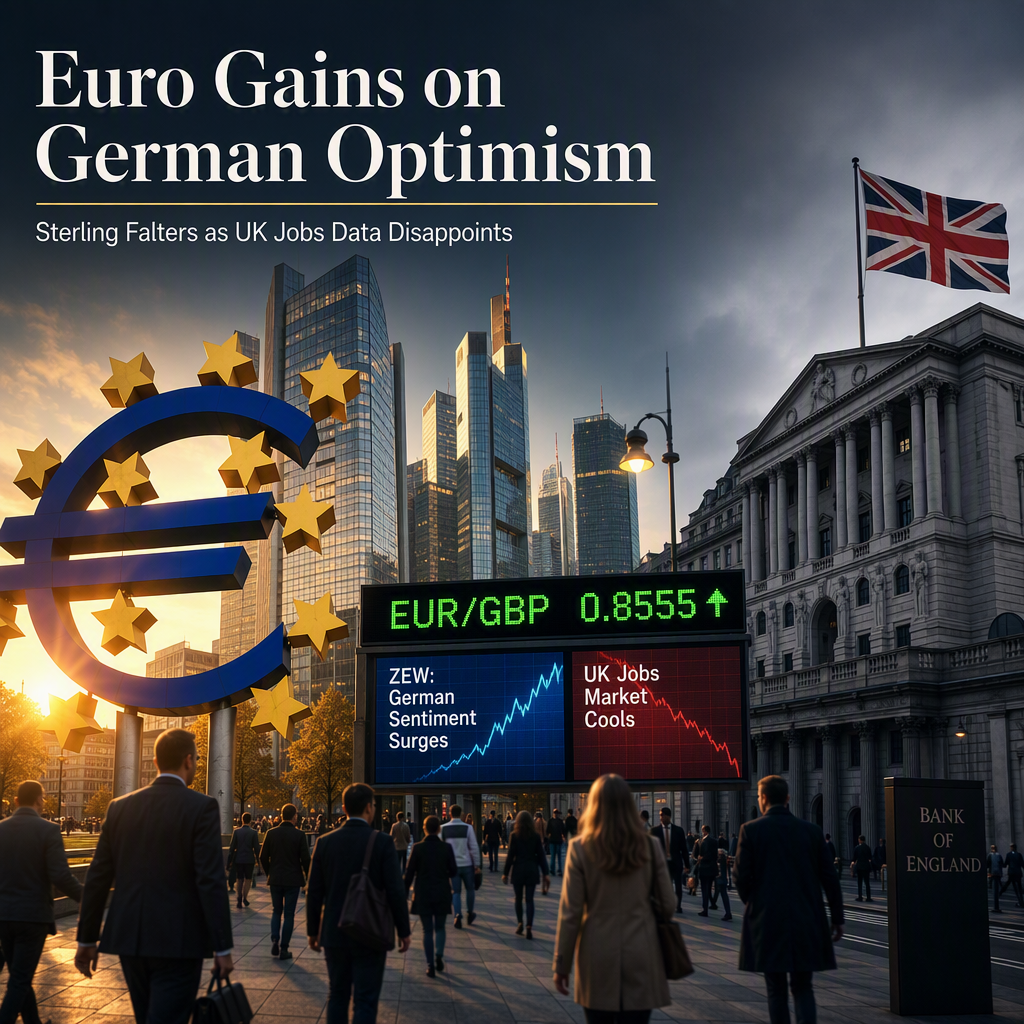
The Euro (EUR) edged higher against the British Pound (GBP) on Tuesday, supported by positive German economic sentiment data, while the Pound was pressured by lackluster UK employment figures [1][3]. The EUR/GBP pair reached session highs at 0.8555, nearing the top of its weekly range around 0.8560 [1]. The ZEW Institute reported that Germany's Economic Sentiment Index rose to 34.2 in August from 26.3 in July, surpassing expectations of 30.0 [1][2]. The Current Situation index improved to -61.1, its best reading since July last year, beating forecasts of -68.8 and the previous -77.6 [1][2]. Eurozone economic sentiment also climbed to 31.4 in August from 23.4 in July, exceeding the consensus of 25.4 [1][2]. However, the ZEW report cautioned that record low water levels in the Rhine pose a threat to economic activity [1].
In the UK, the ILO Unemployment Rate held steady at 4.9% for the three months to June, contrary to expectations for a decline to 4.8% [1]. Employment growth slowed, but a drop in claimant numbers helped cushion the negative impact on the Pound. Wage growth ticked up to 3.5% year-on-year, compared to 3.4% in the previous three months [1]. Analysts at ING described the UK jobs market as 'cool,' noting minimal wage pressures and little impetus for the Bank of England (BoE) to hike rates this year [3]. They highlighted differences across sectors, with government hiring offset by declines in consumer services and stagnation in the private sector [3].
The British Pound traded lower against the US Dollar, down 0.1% to near 1.3530, following the employment data release [3]. Investors are now awaiting UK Consumer Price Index (CPI) data for July, due Wednesday, which could provide further cues for BoE policy [3].
Meanwhile, the Euro remained subdued against the US Dollar, with EUR/USD trading around 1.1570 after three days of gains [2]. The US Dollar held firm amid safe-haven flows driven by geopolitical tensions between the US and Iran, although fading hawkish expectations for the Federal Reserve have reduced the probability of a rate hike at the next meeting to 36.6%, down from 48.4% a week ago [2]. Analysts at MUFG/BTMU noted that US Treasury yields have risen sharply, with the 30-year yield at 5.32%, the highest since 2007, supporting the Dollar [2].
According to [1], the upbeat German ZEW sentiment is seen as bullish for the Euro, while [3] reports that the UK jobs data reinforces a cooling labor market and limited BoE rate hike prospects.
CONCLUSION
Positive German ZEW sentiment has lifted the Euro against the Pound, while subdued UK employment data has weighed on Sterling. Market participants are now focused on upcoming UK inflation data and US Fed policy signals for further direction. Overall, sentiment is mildly positive for the Euro, but broader FX moves remain influenced by global monetary policy and geopolitical developments.