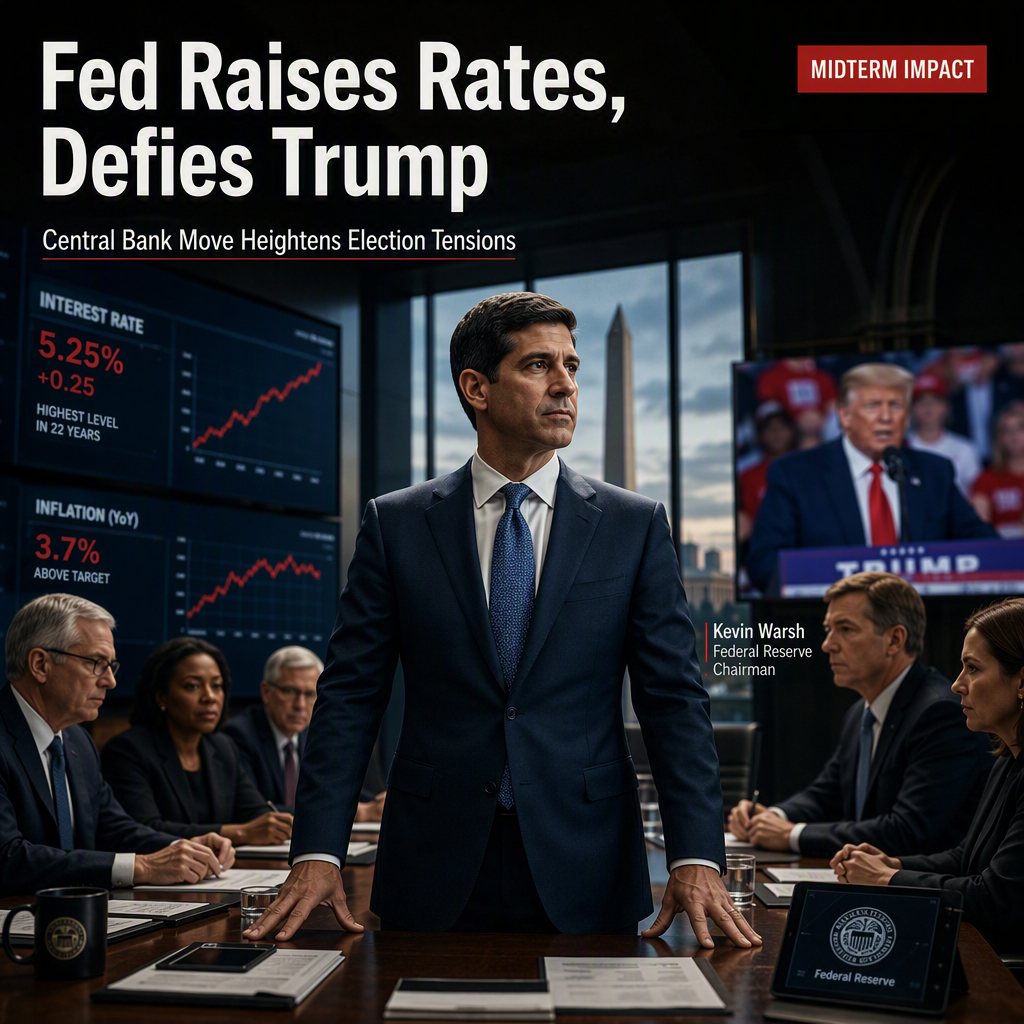
The Federal Reserve, under Chairman Kevin Warsh, raised the federal funds rate by a quarter of a percentage point on Wednesday, bringing it to a range of 3.75% to 4%—the first rate hike in three years [1]. This decision was made despite President Donald Trump's opposition and comes less than two months before the midterm elections, potentially complicating Trump's economic message to voters [1]. The rate increase is intended to combat persistent inflation, which remains above the Fed's 2% target, with higher energy prices and tariffs further pressuring household budgets [1].
The move will make borrowing more expensive for American families, impacting monthly payments on homes and cars, even if the prices of those goods remain unchanged [1]. The Fed's projections suggest that another rate increase could occur later this year if inflation does not subside [1]. This action puts Chairman Warsh, Trump's own nominee to lead the central bank, at odds with the president's repeated calls for lower interest rates to ease the financial burden on households [1].
Warsh emphasized the Fed's independence, stating that the decision was based on the central bank's assessment of employment, economic strength, and the inflation outlook, rather than political considerations [1]. When asked about Trump's opposition, Warsh declined to comment on any discussions with the president [1]. The White House did not immediately respond to requests for comment on the rate hike [1].
The timing of the rate increase is particularly challenging for Trump, who campaigned on improving affordability for American families. The higher rates could undermine his economic promises as voters prepare to decide the balance of power in Congress [1].
CONCLUSION
The Federal Reserve's decision to raise interest rates marks a significant shift in monetary policy and presents a direct challenge to President Trump's economic agenda ahead of the midterms. With borrowing costs set to rise and inflation still above target, the move is likely to have a substantial impact on consumers and the political landscape.