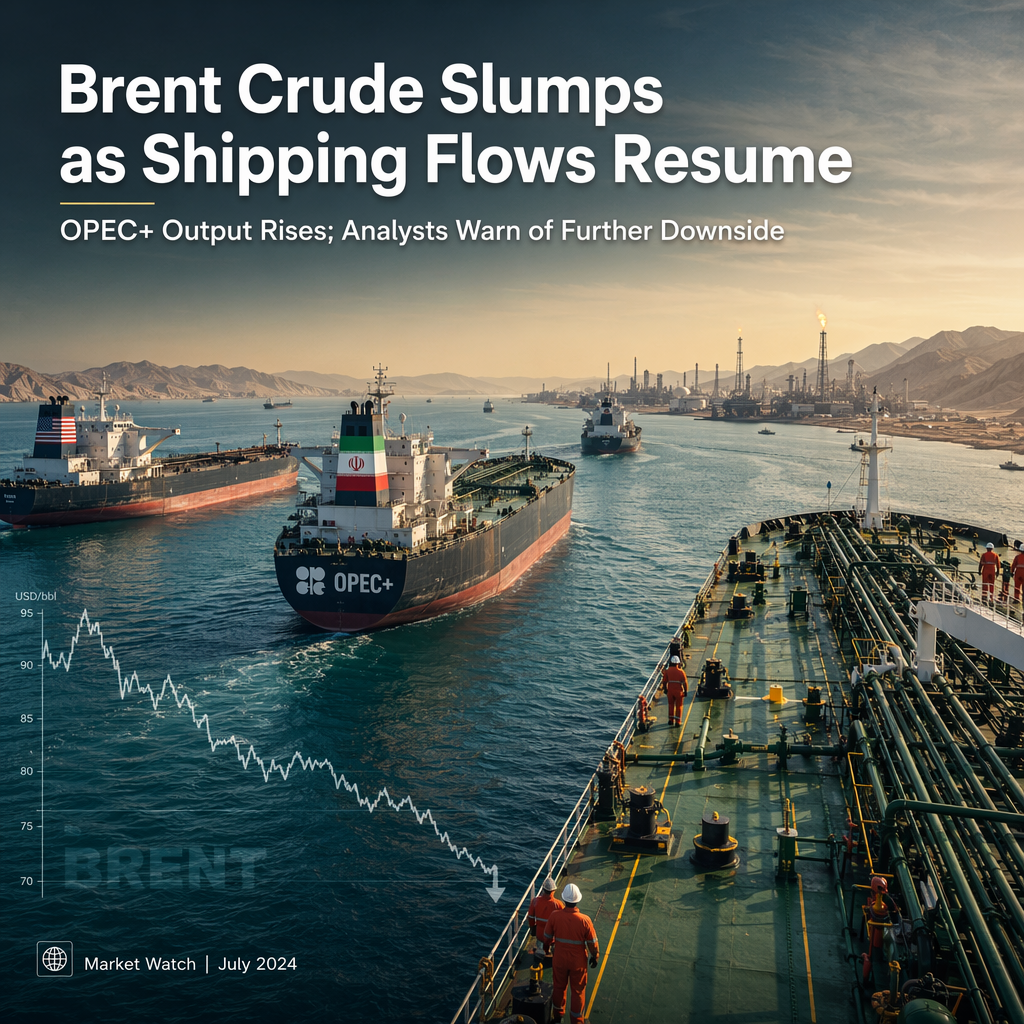
Brent Crude Oil prices have come under renewed pressure, trading near $71.90 during the European session, as increased tanker traffic through the Strait of Hormuz and a ceasefire between the United States and Iran have eased previous supply disruptions. The resumption of shipping through this critical chokepoint, which handles nearly 20% of global energy supply, follows a ceasefire framework reached between Lebanon, Israel, and the US, leading to a significant retreat in oil prices from their earlier rally at the onset of the Middle East conflict in late February [1][2].
Both sources report that OPEC+ and its allies, including Russia, have agreed to raise their output targets by 188,000 barrels per day starting in August, further increasing global oil supply and contributing to downward price pressure [1][2]. Market experts cited in Source 1 suggest that these developments could push Brent prices below pre-war levels, with Citi analysts forecasting a potential slide to $60 by year-end as fundamentals reassert themselves and shipping flows normalize. Goldman Sachs analysts add that while energy prices may fluctuate, the market is likely to trend lower overall, even if occasional headlines cause temporary price jumps [1].
Technical analysis from Source 1 indicates Brent trades at $71.96, maintaining a negative near-term bias, with the Relative Strength Index at 29, signaling oversold conditions but also the possibility of a short-term technical bounce. Key resistance levels are identified at the 20-day EMA ($78.36) and the June 22 high ($81.55), while support lies at the July 2 low ($70.26) and the February 2 low ($65.32), with a further downside target of $60.00 if declines persist [1].
Source 2 highlights that Brent crude posted its first weekly gain in almost a month last week, closing up 0.18% at $72.12/bbl, but this gain was short-lived as the market turned lower on news of resumed tanker flows and the OPEC+ decision. Rabobank’s Benjamin Picton emphasizes that while increased production is significant, the ability to ship oil—especially from the Persian Gulf and Russia—remains a key limiting factor due to ongoing risks, such as Ukrainian strikes on Russian infrastructure [2].
Additionally, Iran has indicated plans to impose 'service fees' on vessels transiting Hormuz through its territorial waters after a 60-day negotiating period following the Iran-US memorandum of understanding. Picton warns this could fragment the oil market into separate geopolitical pricing blocs, with the US and China as prime movers, and Iran aligning with China while the UAE aligns with the US [2].
CONCLUSION
Brent Crude Oil prices are under significant downward pressure due to resumed shipping through Hormuz and OPEC+'s decision to increase output, with analysts forecasting further declines. While technicals suggest oversold conditions, geopolitical developments—such as Iran's proposed shipping fees—could fragment the market and add new risks. The overall market takeaway is bearish, with the potential for further volatility driven by both supply fundamentals and geopolitical shifts.