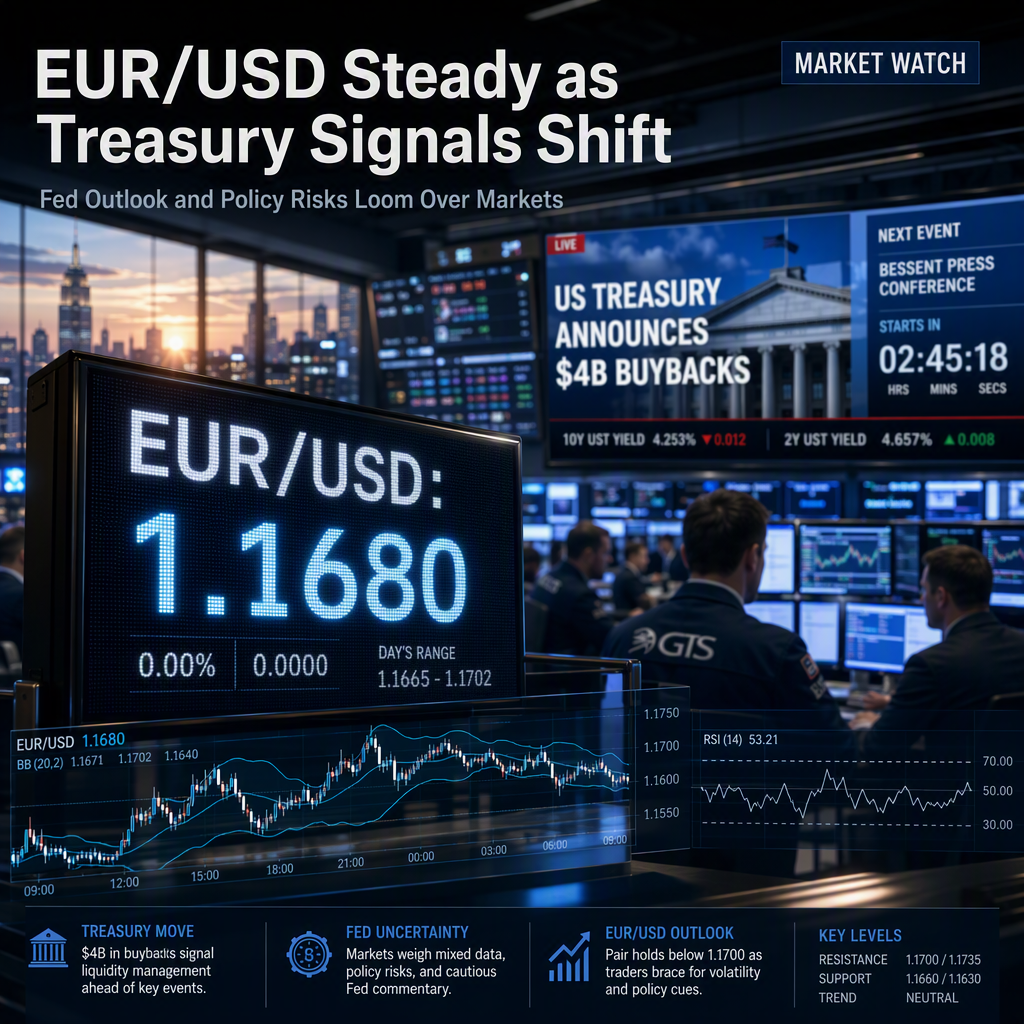
The EUR/USD currency pair remained steady near 1.1680 during early European trading hours on Monday, as overbought momentum limited further gains despite supportive technical signals for the Euro. The US Dollar faced pressure following fiscal interventions by the US Treasury, which announced it would double its long-end bond buybacks to $4 billion per operation in an effort to cap surging 30-year yields. This move, aimed at addressing concerns over the deteriorating US fiscal outlook and uncertainty regarding the Federal Reserve's policy path, contributed to selling pressure on the Greenback [1].
Market participants are closely monitoring upcoming events, including a press conference by US Treasury Secretary Scott Bessent scheduled for Monday at 18:00 GMT. Bessent previously threatened "the toughest sanctions in history" on Iran, with speculation about potential measures targeting China. Iran's Foreign Minister Abbas Araghchi dismissed the threat as a "desperate" ploy, stating that new US sanctions would fail to defeat Tehran, according to Reuters. Ongoing US-Iran tensions could potentially trigger safe-haven flows back into the US Dollar [1].
Attention is also turning to a policy speech by Federal Reserve Chairman Kevin Warsh at Jackson Hole, Wyoming, on Friday. Analysts at Commerzbank highlight that policy communication remains a key driver for EUR/USD in the near term, warning that a more hawkish-than-expected tone from Warsh could unsettle current Dollar sentiment and inject renewed volatility into the Euro-Dollar exchange rate [1].
From a technical perspective, EUR/USD maintains a bullish near-term bias, trading above the 20-day Bollinger middle band and the 100-day simple moving average. However, the Relative Strength Index (RSI) at 73 indicates overbought conditions, which could limit immediate upside. Resistance is noted at the Bollinger upper band at 1.1705, with support at the 100-day SMA near 1.1575 and further at the 20-day Bollinger middle band at 1.1558 [1].
CONCLUSION
EUR/USD is currently supported by US Treasury interventions and technical factors, but overbought conditions and upcoming policy events could limit further gains. Market participants are awaiting clarity from US officials and the Federal Reserve, with potential for increased volatility depending on the tone of upcoming communications.