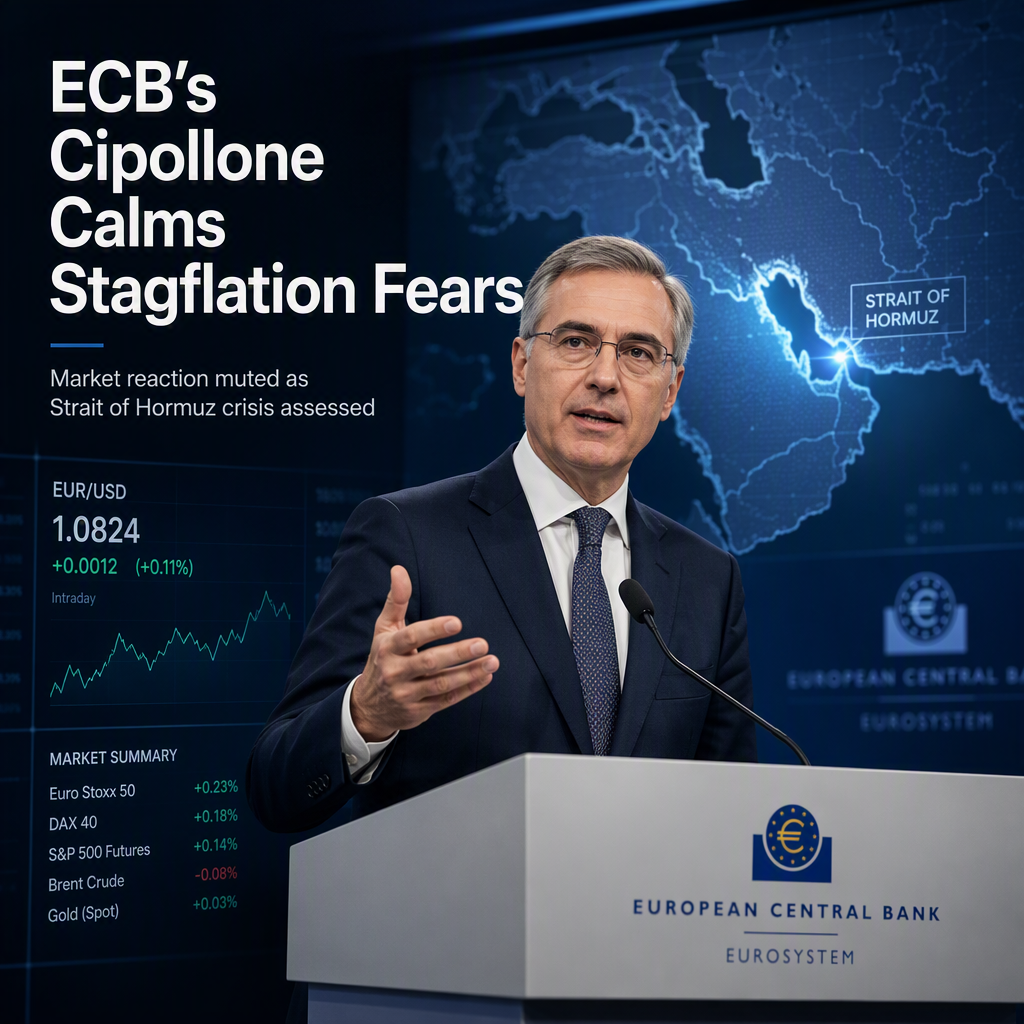
European Central Bank (ECB) Executive Board member Piero Cipollone stated that the risk of economic stagnation and a sharp increase in inflation due to the crisis in the Strait of Hormuz is 'rather remote,' according to a report by Reuters on Monday [1]. Cipollone emphasized that monetary policy needs to be well calibrated and noted that inflation is far from adverse and severe scenarios [1]. He further clarified that there are no signs pointing to a scenario of stagflation, reiterating that the risk of both economic stagnation and a sharp inflation rise remains low [1].
In terms of market reaction, the EUR/USD currency pair was trading 0.04% lower at around 1.1675 at the time of reporting [1]. No additional forward-looking statements or analyst opinions were provided in the source article [1].
CONCLUSION
ECB’s Cipollone reassured markets that the likelihood of stagflation or a sharp inflation spike due to the Strait of Hormuz crisis is minimal. The market response was muted, with only a slight dip in the EUR/USD pair, reflecting limited immediate concern.