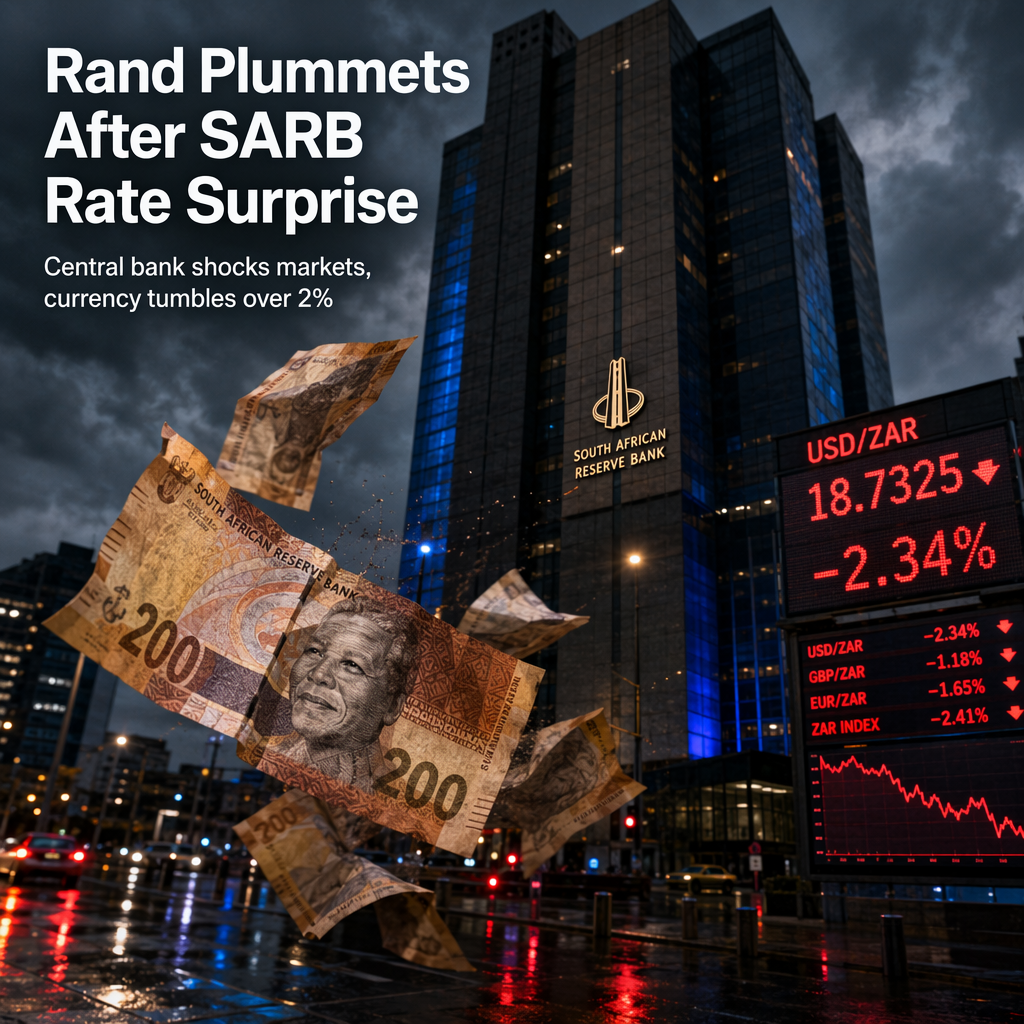
The South African Reserve Bank (SARB) surprised markets by keeping its policy rate unchanged at 7%, despite a recent rise in June inflation and Brent crude oil prices climbing above USD 100 per barrel, according to Commerzbank’s Volkmar Baur [1]. Market consensus, including Commerzbank, had anticipated a rate hike, making the decision a negative surprise for investors [1]. The SARB’s less hawkish policy guidance, which omitted previous references to multiple potential rate hikes in adverse scenarios, contributed to a sharp sell-off in the South African rand [1].
On the day of the announcement, the rand depreciated by more than 2% against the US dollar, marking its weakest performance since March 3, shortly after the onset of the Iran conflict [1]. The market reaction was exacerbated by the SARB’s statement that the inflation outlook had improved since the last meeting, a position that appeared disconnected from the recent 10% surge in oil prices over just two days [1].
Commerzbank’s analysis suggests that the SARB’s decision and accompanying rationale seemed out of step with current economic conditions, especially given the heightened inflation risks from rising oil prices [1]. The bank also noted that, while the previous meeting had mentioned the possibility of three further rate hikes in an adverse scenario, the latest guidance indicated that only one more hike might be needed to bring inflation back to 3% in the medium term, with the base case now being no further hikes at all [1].
Looking ahead, Commerzbank warns that further weakness in the rand remains a risk, as the market may continue to react negatively to the SARB’s unexpectedly dovish stance in the face of mounting inflationary pressures [1].
CONCLUSION
The SARB’s unexpected decision to hold rates steady, despite rising inflation and oil prices, triggered a sharp sell-off in the rand and raised concerns about further currency weakness. Market participants viewed the central bank’s guidance as out of touch with current risks, leading to heightened uncertainty and volatility for the South African currency.