
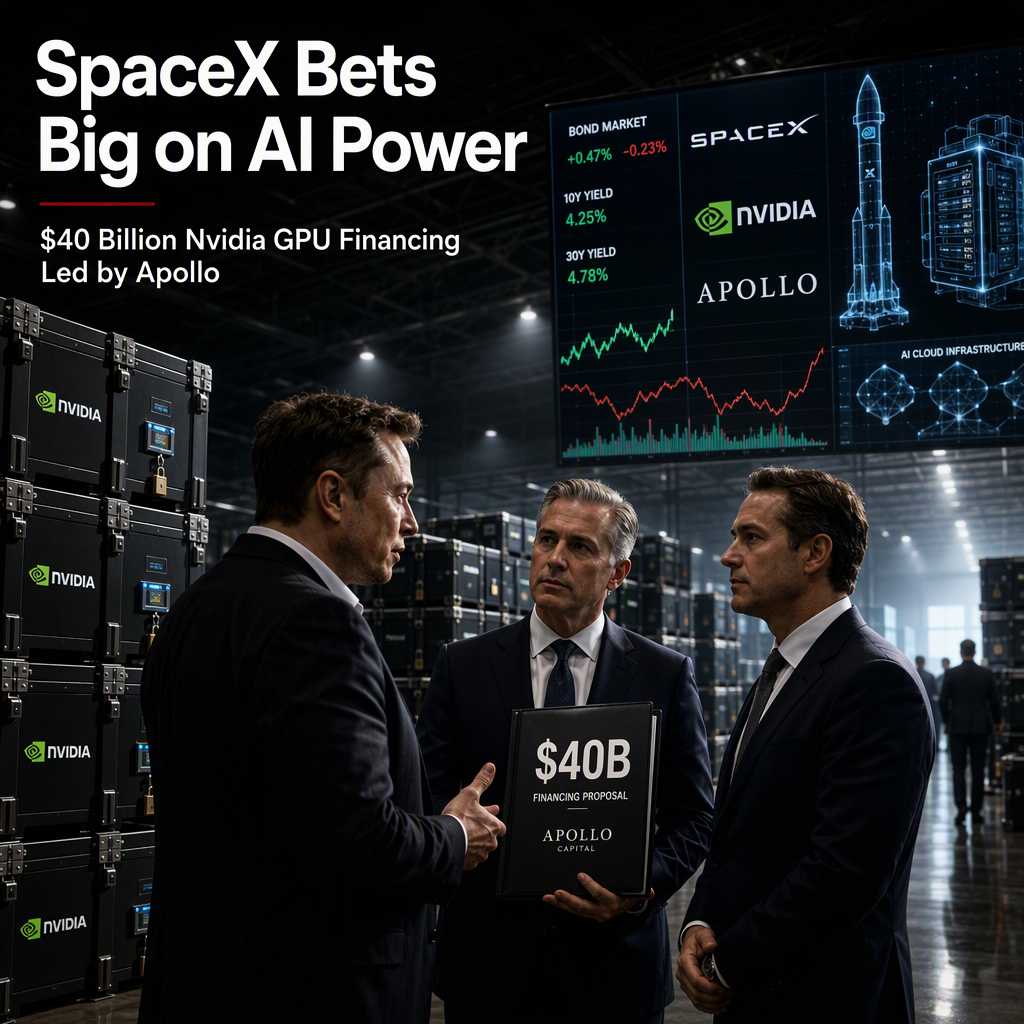
SpaceX is in discussions with Apollo Capital Management and a consortium of banks to secure financing for a $40 billion purchase of Nvidia graphics processing units (GPUs), according to a person familiar with the talks who requested anonymity due to the sensitive nature of the negotiations [1]. The financing is expected to rely primarily on the investment-grade debt market, which SpaceX accessed four months ago following its record-breaking IPO in mid-June, raising $25 billion in bonds across various durations [1]. The previous bond sale saw exceptionally high demand, indicating strong interest from fixed-income investors at the time [1].
However, since SpaceX's last bond issuance, AI-related bonds have experienced a sell-off and credit spreads have widened, reflecting increased selectivity among investors regarding AI exposure [1]. The proposed $40 billion debt deal will likely use the Nvidia GPUs as collateral, with Apollo Capital playing a leading role in facilitating the financing [1]. Neither Apollo nor Nvidia provided comments on the matter [1].
The market currently operates under the assumption that GPUs retain their value for approximately seven years, supported by ongoing scarcity in computing power and a shortage of high-performing GPUs that is not expected to ease soon [1]. This scarcity underpins the value of the assets being used as collateral in the deal [1].
This significant bond deal follows similar issuances from Meta, Amazon, and Google, as the costs associated with AI infrastructure continue to rise. Both sources cited by CNBC anticipate further debt sales, with fixed-income investors demanding higher yields to service the debt, signaling a more cautious approach to AI-related investments [1].
CONCLUSION
SpaceX's pursuit of $40 billion in financing for Nvidia GPUs marks a major move in the AI infrastructure space, with Apollo and banks playing key roles. The deal reflects growing investor selectivity and higher yield demands amid recent volatility in AI-related bonds. The ongoing scarcity of computing power supports the value of the collateral, but market participants remain cautious about future AI debt exposure.