
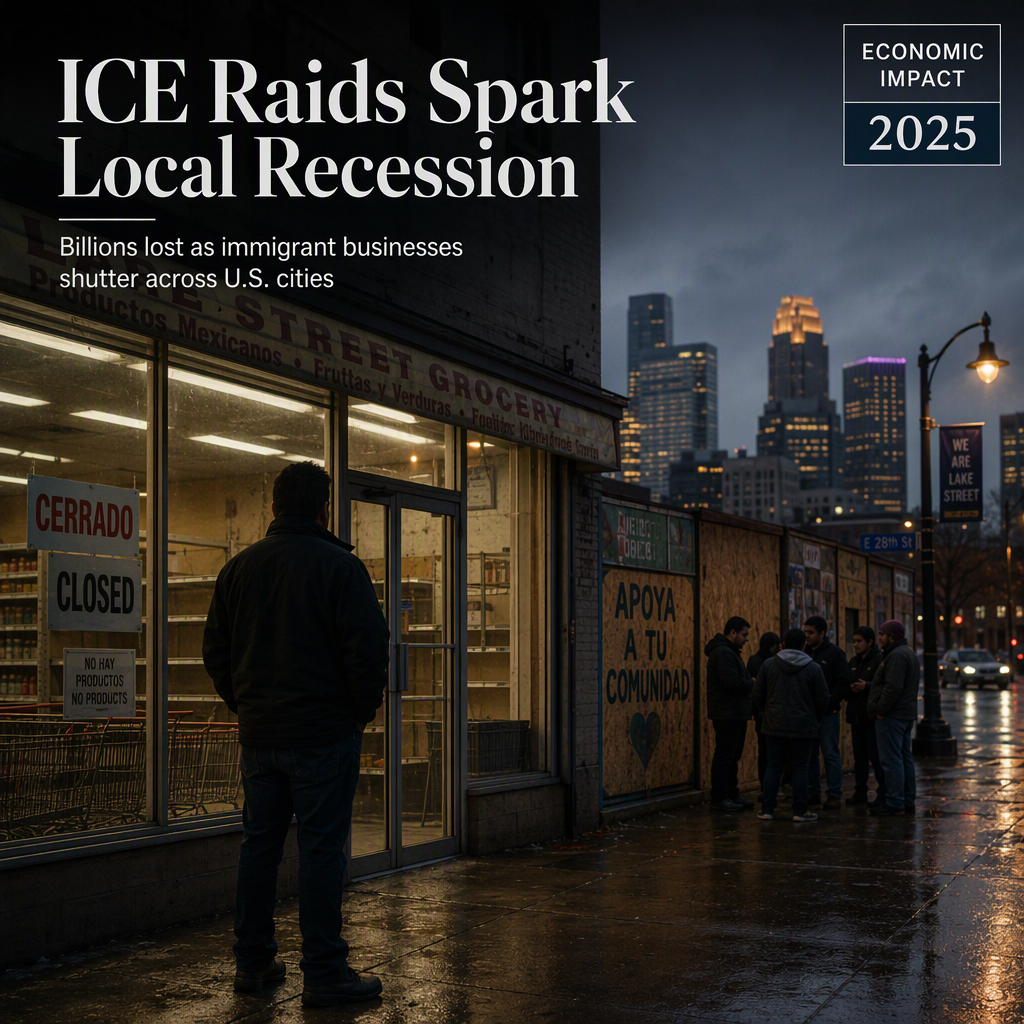
Large-scale immigration enforcement operations, directed by President Donald Trump during his second term, have left significant economic damage in major U.S. cities, according to research and firsthand accounts [1]. Operation Metro Surge, described as the largest-ever immigration enforcement action by the Department of Homeland Security, took place in Minneapolis from early December to mid-February and has had lasting effects on local businesses and communities [1].
Research by University of Pennsylvania professor Zeke Hernandez found that cities targeted by ICE raids in 2025 experienced a nearly 3% decline in weekly foot traffic and a more than 6% reduction in spending, amounting to approximately 8 billion fewer visits and billions of dollars in lost spending that year [1]. Zeke Hernandez characterized the impact as creating "recession-like conditions in targeted neighborhoods" [1].
The financial toll is evident in the experience of Daniel Hernandez, owner of Colonial Market grocery stores in Minneapolis. After his store became associated with ICE activity, customer traffic failed to recover even after the raids ended, leading to a roughly 60% decline in sales and the closure of his Lake Street location, which had been a central part of the city's Hispanic business community [1]. Hernandez reported that he had invested personal savings and borrowed against his house to open the store just two years prior [1].
The Lake Street Council reported that immigrant-owned businesses in the district collectively lost $46 million in December and January alone, and local leaders have been working to help small business owners recover from the economic shock [1]. The article notes that the economic turmoil seen in Minneapolis is being mirrored in communities across the country, with businesses and community leaders still working to recoup losses months after the enforcement actions concluded [1].
CONCLUSION
The ICE raids and subsequent enforcement actions have resulted in significant, lasting economic harm to targeted communities, with billions of dollars in lost spending and localized recession-like conditions. Businesses, particularly immigrant-owned, continue to struggle months after the operations, highlighting the deep and enduring market impact of these policies.