
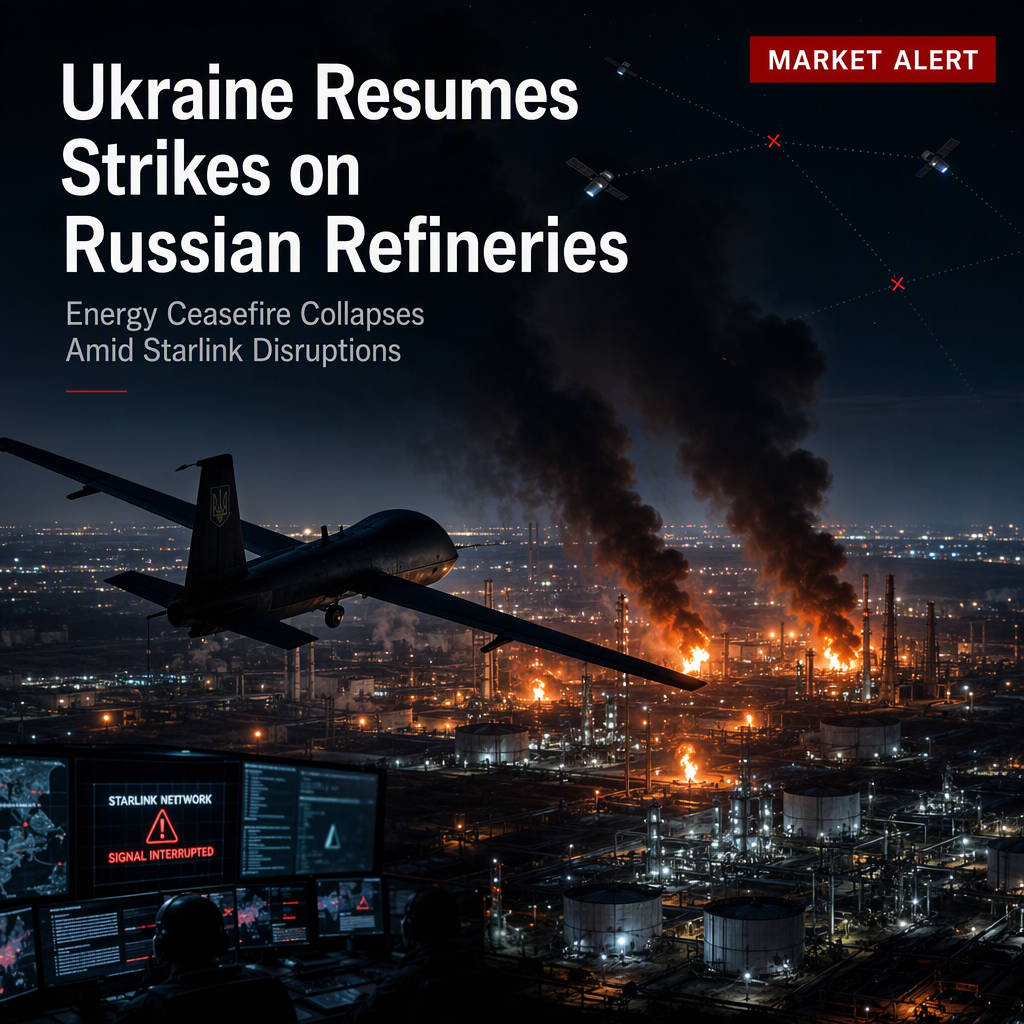
President Volodymyr Zelenskyy announced that Ukraine will resume attacks on Russian energy infrastructure after Moscow failed to uphold its end of an 'energy ceasefire' deal proposed by President Donald Trump [1]. Zelenskyy stated, 'The block [on attacking refineries] is out. We're done,' following a three-day pause in strikes on energy targets at the request of Washington [1]. The ceasefire was intended to halt mutual attacks on power facilities and lower oil and diesel prices ahead of the U.S. midterm elections next month, as announced by Trump on Sunday [1].
Despite Ukraine's compliance with the ceasefire, Kyiv officials reported that the country was stripped of advance warnings of incoming ballistic missiles due to restricted Starlink connectivity services, which disrupted military operations. These restrictions also apply to the Starshield service [1]. Serhii Beskrestnov, an adviser to Zelenskyy on defense technology, stated that SpaceX implemented a speed limit on Starlink terminals in motion without notifying Ukrainian defense forces, suggesting the action was related to the current political situation [1]. SpaceX CEO Elon Musk clarified that the U.S. government is responsible for any curbs on Ukraine's military-grade Starlink network, noting, 'Starshield systems are owned and controlled by the US government,' on X [1].
In an interview with Piers Morgan, Zelenskyy expressed feeling let down by Trump's recent dealings with Vladimir Putin, Russia's attacks on Ukrainian energy infrastructure, and the apparent shutdown of Starlink. He emphasized that Ukraine's survival and its strategic relationship with the U.S. were more important than his personal emotions [1]. Zelenskyy explained that Ukraine honored the ceasefire for three days, refraining from both attacks and retaliation, while Russia launched a massive assault on Ukrainian energy infrastructure, including approximately 40 ballistic missiles [1]. He described the reported Starlink shutdown as 'absolutely crazy' and inconsistent with expected partner behavior [1].
CONCLUSION
Ukraine's decision to resume strikes on Russian refineries marks a significant escalation following the collapse of the proposed energy ceasefire. The disruption of Starlink services and continued Russian attacks on Ukrainian energy infrastructure have heightened tensions, with potential implications for global energy prices and geopolitical stability. Market participants should monitor developments closely as the situation remains volatile.