
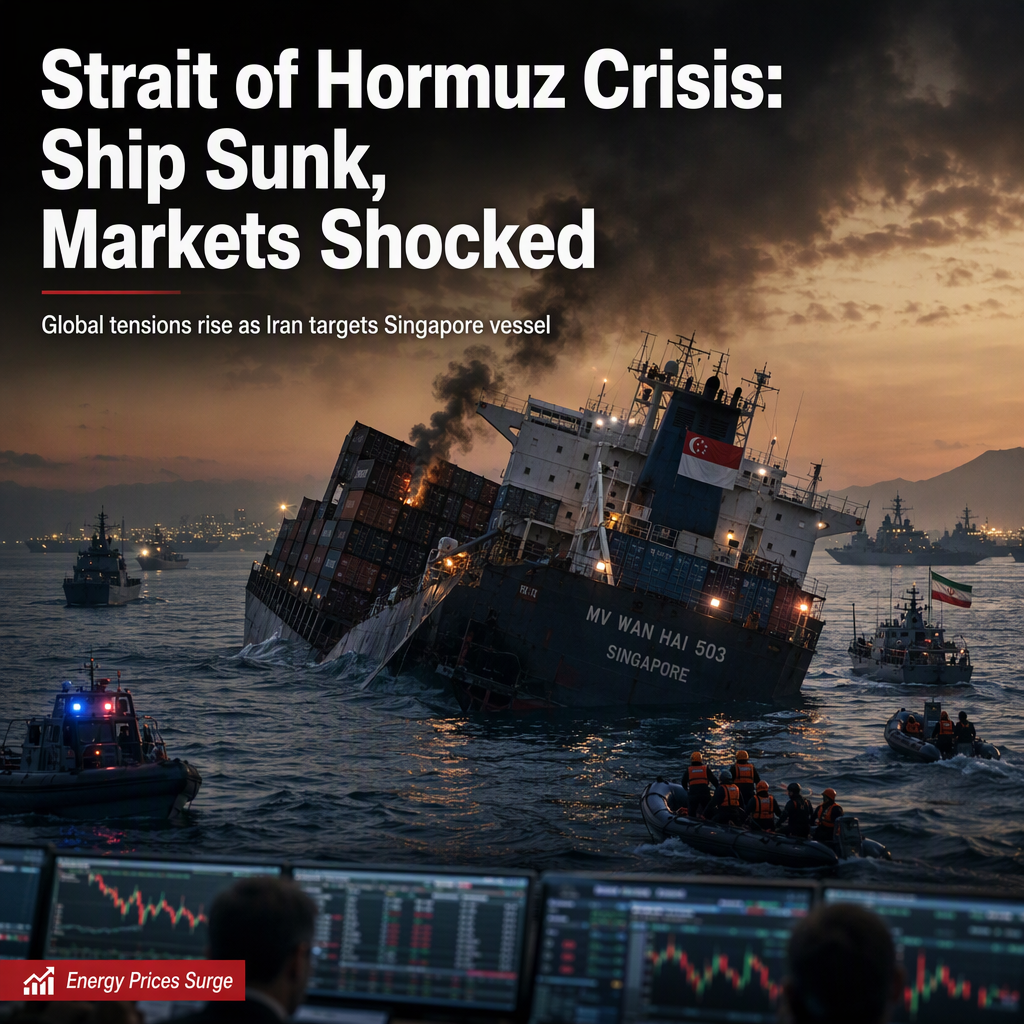
Iran has escalated tensions in the Strait of Hormuz by sinking a Singapore-registered container ship, a critical maritime corridor for global oil and goods transport [1]. The incident, which resulted in the safe evacuation of all crew members and no injuries, was condemned by the Maritime and Port Authority of Singapore as 'unprovoked, unjustifiable and a breach of international law' [1]. A second Singapore-registered vessel, the GFS Giselle, was also struck and sustained hull damage but managed to reach safe anchorage without injuries [1].
Tehran has further threatened to target military assets, with Islamic Revolutionary Guard chief Ali Ozmaei stating the country is 'impatient to sink American warships' and challenging U.S. forces to approach the Strait [1]. In contrast, U.S. Central Command maintains that American forces and their regional partners 'clearly control' the waterway, highlighting a sharp disagreement over control and security in the region [1]. The heightened risk has made commercial transit through the Strait increasingly perilous [1].
The geopolitical turmoil has contributed to elevated energy prices, with the U.S. energy index rising 5.2% and gasoline averaging $4.33 per gallon, up from $3.08 a year earlier [1]. The ongoing Iran conflict is cited as a key factor keeping fuel costs high [1]. U.S. consumer prices rose 3.7% year-on-year in September, surpassing expectations, while core CPI increased 2.6%, also above estimates [1]. These inflationary pressures have weighed heavily on global markets: the S&P 500 fell 1.11%, the Nasdaq Composite dropped 1.88%, and Asian markets were broadly negative, led by the Kospi's 7.26% decline [1].
In response to inflation, U.S. President Donald Trump temporarily eased restrictions on Russian diesel exports to help mitigate price increases, though analysts believe the impact will be limited [1].
CONCLUSION
The sinking of a Singapore ship by Iran in the Strait of Hormuz has sharply raised geopolitical and market risks, driving up energy prices and contributing to global market declines. With both Washington and Tehran claiming control over the waterway and threats of further military escalation, commercial shipping and investor sentiment remain highly vulnerable.