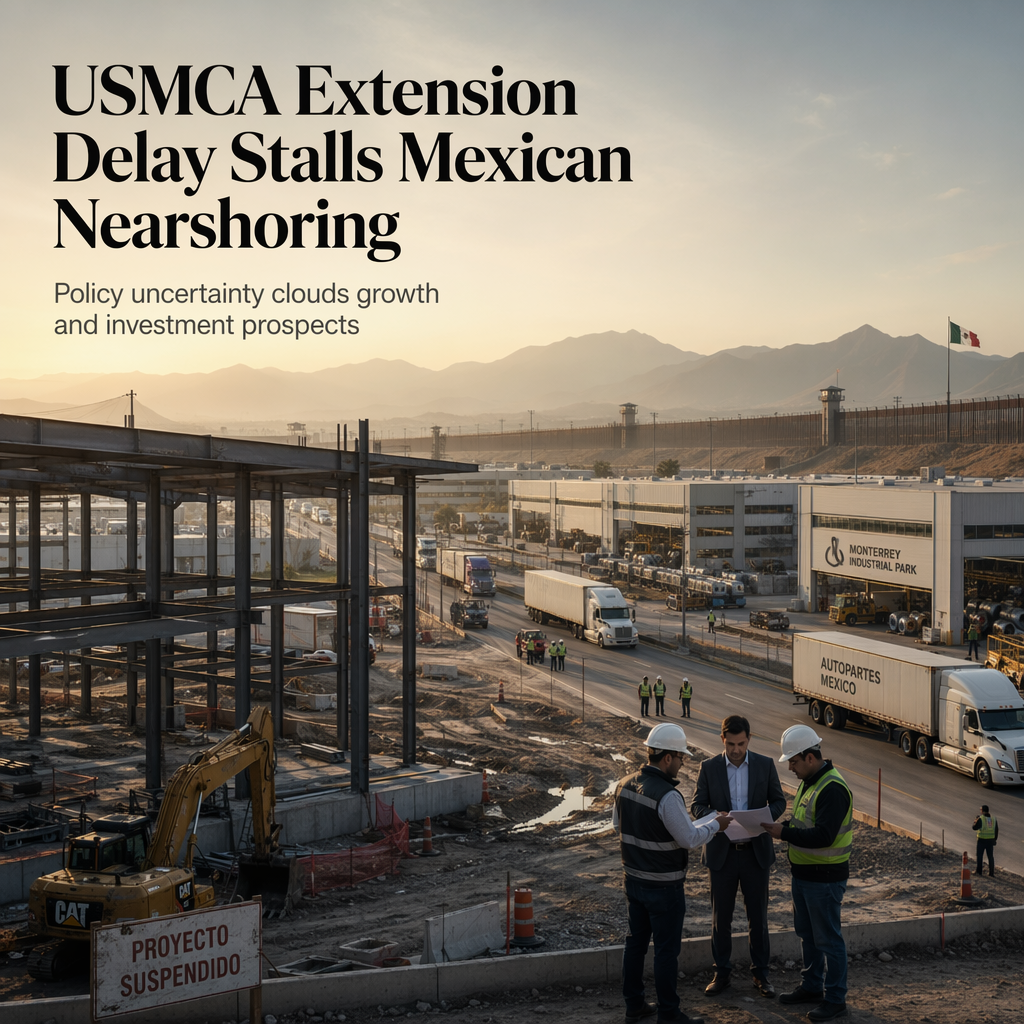
The United States' decision not to proceed with a 16-year extension of the United States-Mexico-Canada Agreement (USMCA), opting instead for annual reviews through 2036, has introduced a new layer of investment uncertainty for Mexico, according to Dev Ashish at Societe Generale [1]. Despite this policy shift, the Mexican Peso (MXN) exhibited relatively muted price action following the announcement, indicating that investors had largely anticipated the outcome [1].
Ashish notes that while the absence of new tariff measures means trade flows and supply chains are expected to remain largely unaffected in the near term, the decision has significant implications for sectors tied to nearshoring, such as autos, metals, and manufacturing [1]. Projects in these industries may face postponements as firms await further clarity on future rules-of-origin requirements and North American content thresholds [1].
The market's muted reaction suggests that the outcome was already priced in, and immediate trade disruptions are not expected [1]. However, the ongoing uncertainty is characterized as an 'investment- and growth-negative uncertainty shock' rather than a trade-crisis shock, with the potential for future tariff threats not entirely ruled out [1].
Overall, the lack of a long-term extension to the USMCA is seen as capping the upside for nearshoring in Mexico, as companies may delay or reconsider investments until there is greater policy clarity [1].
CONCLUSION
The US decision to forgo a long-term USMCA extension has created investment uncertainty for Mexico, particularly impacting nearshoring-related sectors. While immediate trade flows remain stable and the market reaction has been muted, the outlook for growth and new projects is clouded by policy ambiguity.