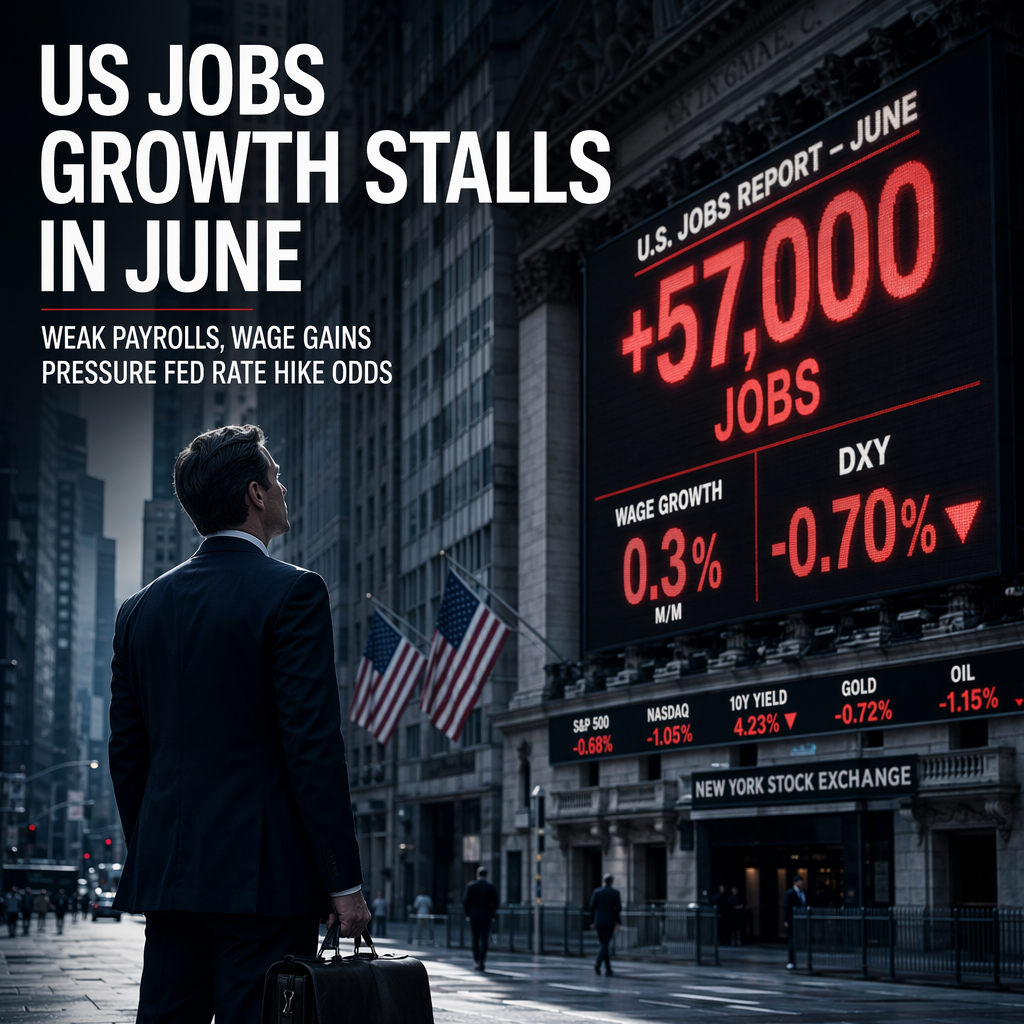
The US labor market showed signs of weakening in June, as nonfarm payrolls increased by just 57,000, significantly below consensus expectations of 110,000 jobs and well under the monthly averages seen in recent years [1][2][5]. Previous months' payrolls were also revised downward by a total of 74,000, with May's figure adjusted to 126,000 from 172,000 [1][2]. Despite the slowdown in hiring, the unemployment rate unexpectedly edged lower to 4.2% from 4.3% in May, reflecting slower labor force growth that has helped prevent a rise in unemployment [1][2][5].
Wage growth remained subdued, with average hourly earnings rising 0.3% month-over-month and 3.5% year-over-year in June, matching market expectations but failing to keep pace with inflation for the third consecutive month [2][5]. This persistent gap between wage growth and inflation has raised concerns among analysts about real income growth and consumer purchasing power, with economists closely monitoring the labor market for further signs of softening [5].
The disappointing jobs data had an immediate impact on financial markets. The US Dollar came under broad selling pressure, with the US Dollar Index (DXY) dropping about 0.70% to 100.70, its lowest level in two weeks [2][3]. The USD/CHF currency pair weakened sharply, falling nearly 0.80% on the day to 0.8029, its lowest since June 18, as traders trimmed expectations for a near-term Federal Reserve rate hike [2]. According to the CME FedWatch Tool, the probability of a rate increase at the September Fed meeting fell to 51% from 63% prior to the employment report [2].
Initial jobless claims for the week ending June 27 dropped to 215,000, below estimates and the previous week's revised figure, while continuing claims rose slightly to 1.814 million [3]. Despite this, the overall market reaction was cautious, with investors digesting the implications of slower job growth and stagnating wages [5]. Commerzbank analysts and other market participants now see little support for a Fed rate hike at the late July meeting, with expectations that the central bank will hold rates steady for the remainder of the year [1][2].
In the broader context, the weak US payrolls report is seen as a crucial data point for global markets, with some analysts noting that labor market resilience has been a key driver for central bank policy decisions on both sides of the Atlantic [4]. The Eurozone, by contrast, has maintained resilient labor markets and improving inflation dynamics, while the US data may signal a shift in asset rotation and monetary policy expectations [4].
CONCLUSION
The US labor market's weaker-than-expected June payrolls and subdued wage growth have dampened expectations for a near-term Fed rate hike, pressuring the US Dollar and prompting cautious market sentiment. With the unemployment rate dipping but real income growth lagging, investors and policymakers are likely to remain vigilant for further signs of economic softening.