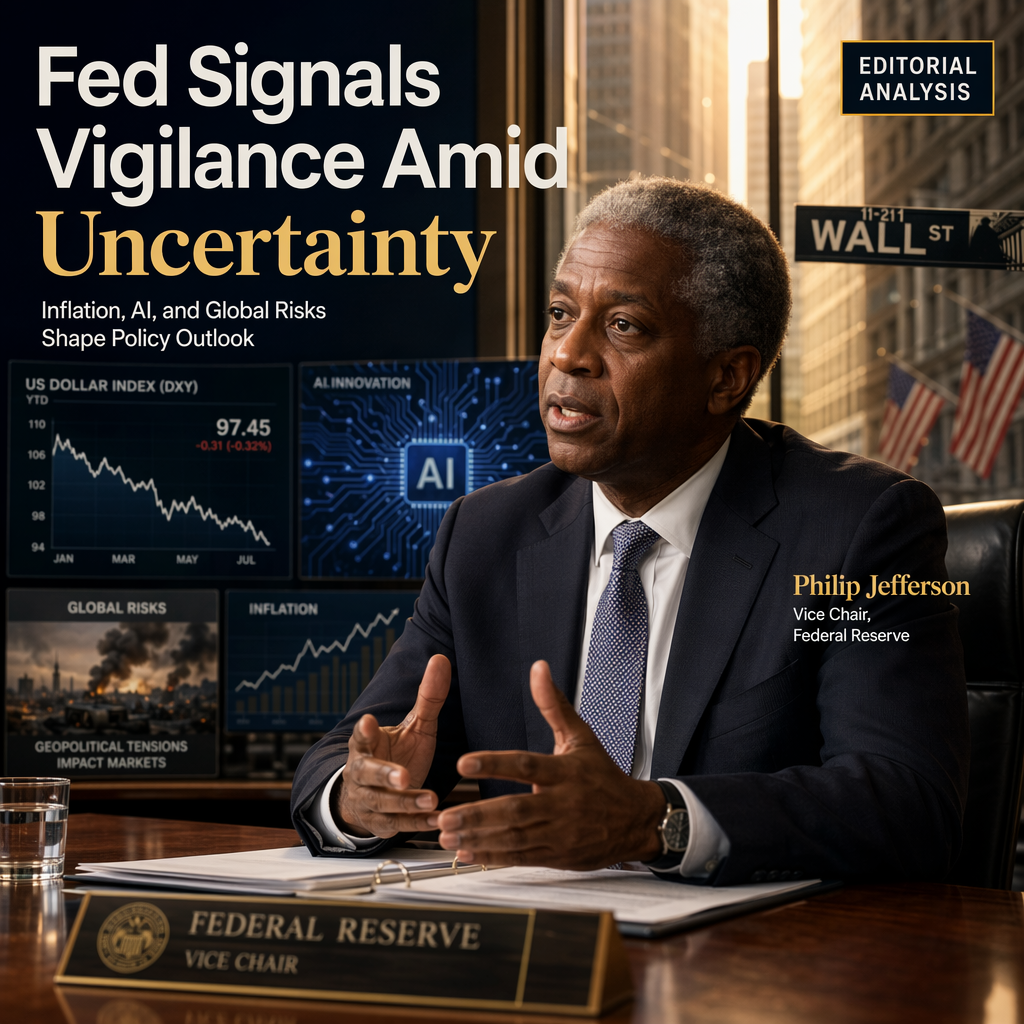
Federal Reserve Vice Chair Philip Jefferson stated that the current policy stance is well positioned to respond to incoming data and evolving economic risks, emphasizing that it should support the job market and allow inflation to resume its decline toward the 2% target as the effects of tariffs and energy prices pass through the economy [1]. Jefferson noted that if inflation does not begin to cool, it may be appropriate to reconsider the policy stance to ensure the Fed delivers on its price stability mandate [1].
Jefferson highlighted two significant developments currently being monitored: the Middle East conflict and the proliferation of artificial intelligence (AI). He expects the Middle East conflict to have muted effects on demand, citing the United States' status as a net oil exporter and a less oil-intensive economy [1]. Regarding AI, Jefferson pointed out that if demand effects from AI buildout and consumption occur before productivity benefits materialize, AI could exert upward pressure on inflation. Conversely, if AI-driven productivity gains reduce production costs sooner, there may be downward pressure on inflation [1].
He described the current scenario as a policy dilemma, with overlapping energy and trade shocks having at least near-term effects on output and prices, and warned that a quick succession of shocks risks inflation becoming entrenched and inflation expectations becoming unanchored [1]. Jefferson reaffirmed the Fed's commitment to returning inflation to the 2% target, consistent with its dual mandate [1].
Market reaction to Jefferson's remarks was measured, with the US Dollar Index (DXY) trading 0.22% higher at around 100.73 as of the report [1]. The FXS Fed Sentiment Index remained unchanged at 126.57, indicating that Jefferson's speech maintained the perceived policy stance and did not signal a decisive hawkish or dovish shift [1].
CONCLUSION
Fed Vice Chair Jefferson's comments reinforce a data-dependent and vigilant policy approach, with no immediate shift in stance but a clear readiness to act if inflation fails to cool. Markets responded with a modest uptick in the US Dollar Index, reflecting steady confidence in the Fed's current positioning. The overall message is one of cautious monitoring amid ongoing economic uncertainties.