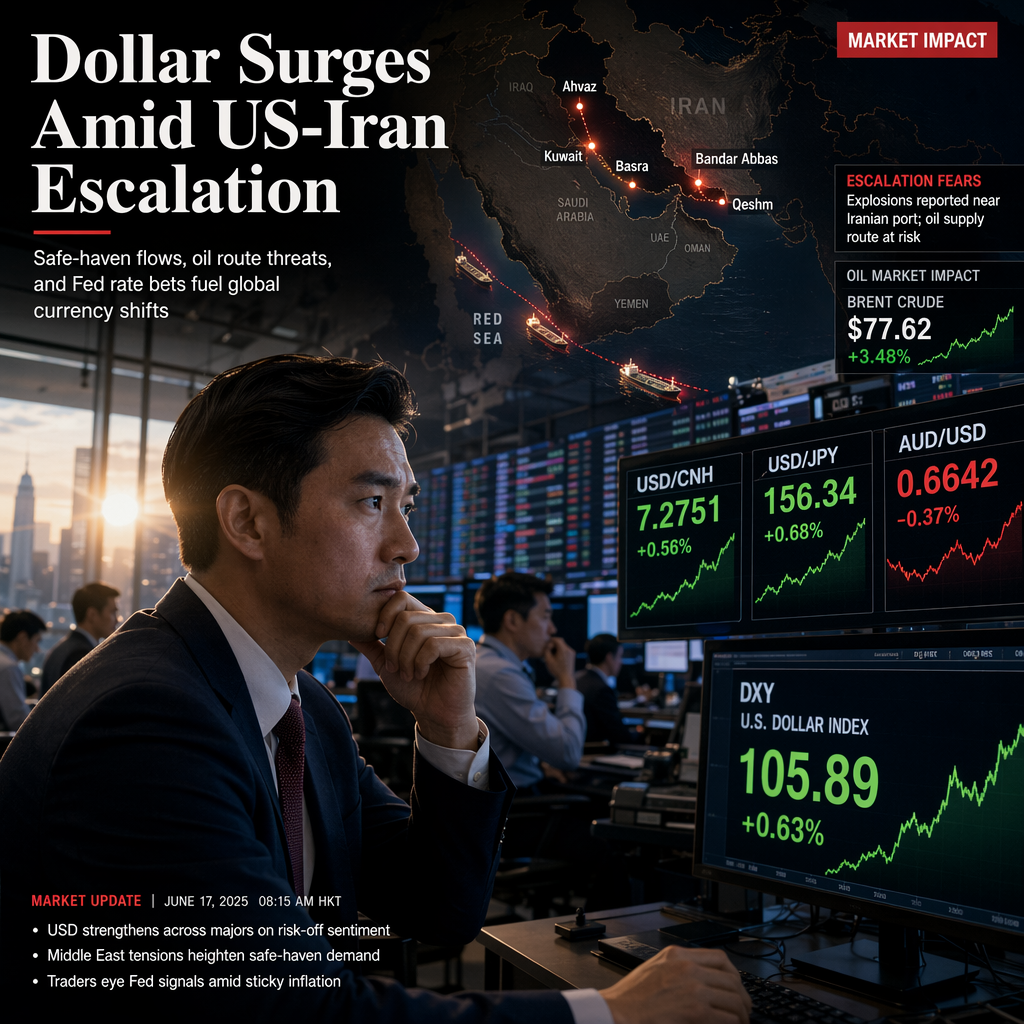
Escalating geopolitical tensions between the United States and Iran have triggered a notable shift in global currency markets, with the US Dollar (USD) strengthening against the Chinese Yuan (USD/CNH), Japanese Yen (USD/JPY), and Australian Dollar (AUD/USD) during Asian trading hours on Friday [1][2][3]. The USD/CNH pair appreciated for the second consecutive day, trading around 6.7760, as safe-haven demand lifted the US Dollar amid reports of explosions in Bandar Abbas, Qeshm, Ahvaz, Kuwait, and Basra, and threats to close the critical Red Sea oil route if the US strikes Iranian power infrastructure [1][3]. The USD/JPY pair posted modest gains near 162.40, supported by the US launching a sixth consecutive night of strikes against Iran, with missiles reportedly striking close to Qeshm, Bandar Abbas, and Bushehr, the site of a nuclear power plant [2][3]. The Japanese government flagged intervention risk, with Finance Minister Satsuki Katayama stating authorities are ready to act on currency moves whenever necessary [2].
The AUD/USD pair slid to the 0.7980 region, moving away from a three-week high, as the US Dollar built on its recovery from a nearly one-month low. The escalation of US-Iran tensions and concerns about energy-driven inflation revived bets for a US Federal Reserve rate hike in 2026, further underpinning the Greenback [3]. Iran's Islamic Revolutionary Guard Corps threatened to expand the conflict by targeting additional regional energy supply routes, and Reuters reported Iran asked Yemen’s Houthis to stand ready to close the Red Sea oil route, posing a new threat to global energy supplies [1][3]. Elevated crude oil prices fueled inflation fears and bolstered expectations for at least one Fed rate hike by year-end, supported by upbeat US Initial Jobless Claims data and the Philly Fed Manufacturing Index [3]. Dallas Fed President Lorie Logan called for modestly higher interest rates, while Fed Vice Chair Philip Jefferson said he would be open to raising rates if inflation does not improve [3].
China is expected to stabilize its economic growth by fast-tracking already-budgeted national infrastructure projects, reducing the likelihood of large-scale fiscal stimulus and maintaining strict control over local government spending [1]. The Reserve Bank of Australia's relatively hawkish stance and steady economic data from China could lend support to the Australian Dollar, warranting caution before aggressive bearish bets on the currency pair [3].
Market reactions have been pronounced, with the US Dollar emerging as the strongest currency against the Australian Dollar today [3]. Traders remain alert for possible intervention from Japanese officials, and the Japanese government will decide "by early August" whether and by how much to cut the 8% consumption tax levied on food [2].
CONCLUSION
Heightened US-Iran tensions have driven safe-haven flows into the US Dollar, resulting in broad gains against the Chinese Yuan, Japanese Yen, and Australian Dollar. Market expectations for higher US interest rates and concerns over energy supply disruptions have further supported the Greenback. Authorities in Japan and China are taking steps to stabilize their economies and currencies, but the immediate market impact remains strongly in favor of the US Dollar.