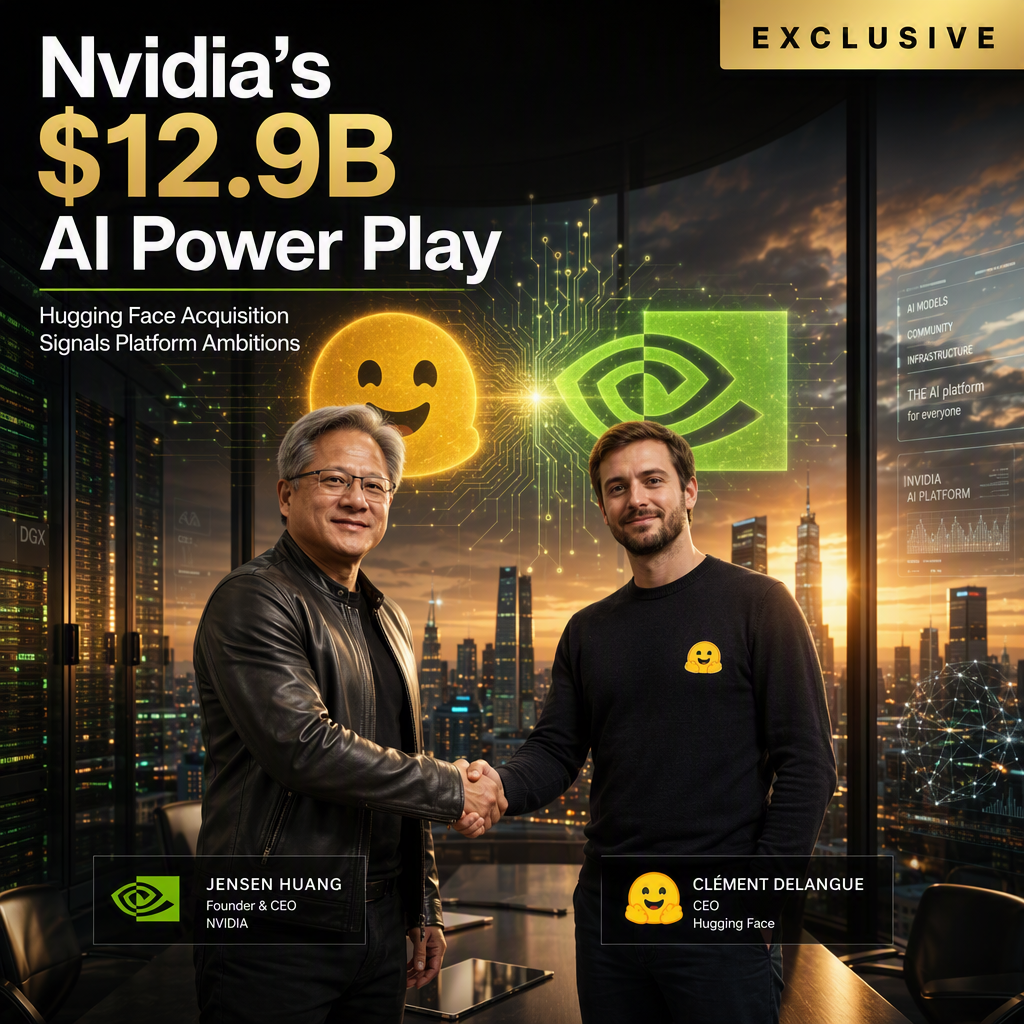
Nvidia has officially agreed to acquire Hugging Face, an open-source artificial intelligence platform, for $12.9 billion as part of its strategy to expand beyond hardware and further up the AI stack [1]. Jensen Huang, Nvidia's CEO, stated in a blog post that the acquisition will enable the company to 'expand access to AI for developers and institutions worldwide,' and that Nvidia will work to scale Hugging Face's platform and strengthen its infrastructure [1].
This deal represents Nvidia's second-largest acquisition to date, following its $20 billion purchase of assets from chipmaker Groq in December, and surpassing its 2019 acquisition of Israeli chipmaker Mellanox for nearly $7 billion [1]. Nvidia's move comes as the company has become the world's most valuable company, driven by high demand for its graphics processing units (GPUs) that have fueled the generative AI boom [1]. The acquisition of Hugging Face signals Nvidia's commitment to being more than just a chip company, making a significant bet on a leading AI platform [1].
Hugging Face was recently involved in a hacking incident that raised concerns about the rapid development of AI and cybersecurity tools. Clément Delangue, CEO of Hugging Face, attributed the breach to engineering mistakes and noted that his company used an Nvidia version of a Chinese open model to address the issue [1]. Jensen Huang expressed his appreciation for Delangue's decision to choose Nvidia as the future home for Hugging Face, its community, and the advancement of open models [1].
Additionally, Jensen Huang spoke at the G20 Innovation Ministerial on September 2, 2026, in Chapel Hill, North Carolina, where he reiterated Nvidia's commitment to advancing AI infrastructure [1].
CONCLUSION
Nvidia's $12.9 billion acquisition of Hugging Face marks a significant step in the company's evolution from a hardware provider to a broader AI platform leader. The deal is expected to enhance Nvidia's AI offerings and expand access for developers and institutions, reinforcing its dominant position in the rapidly growing AI sector.