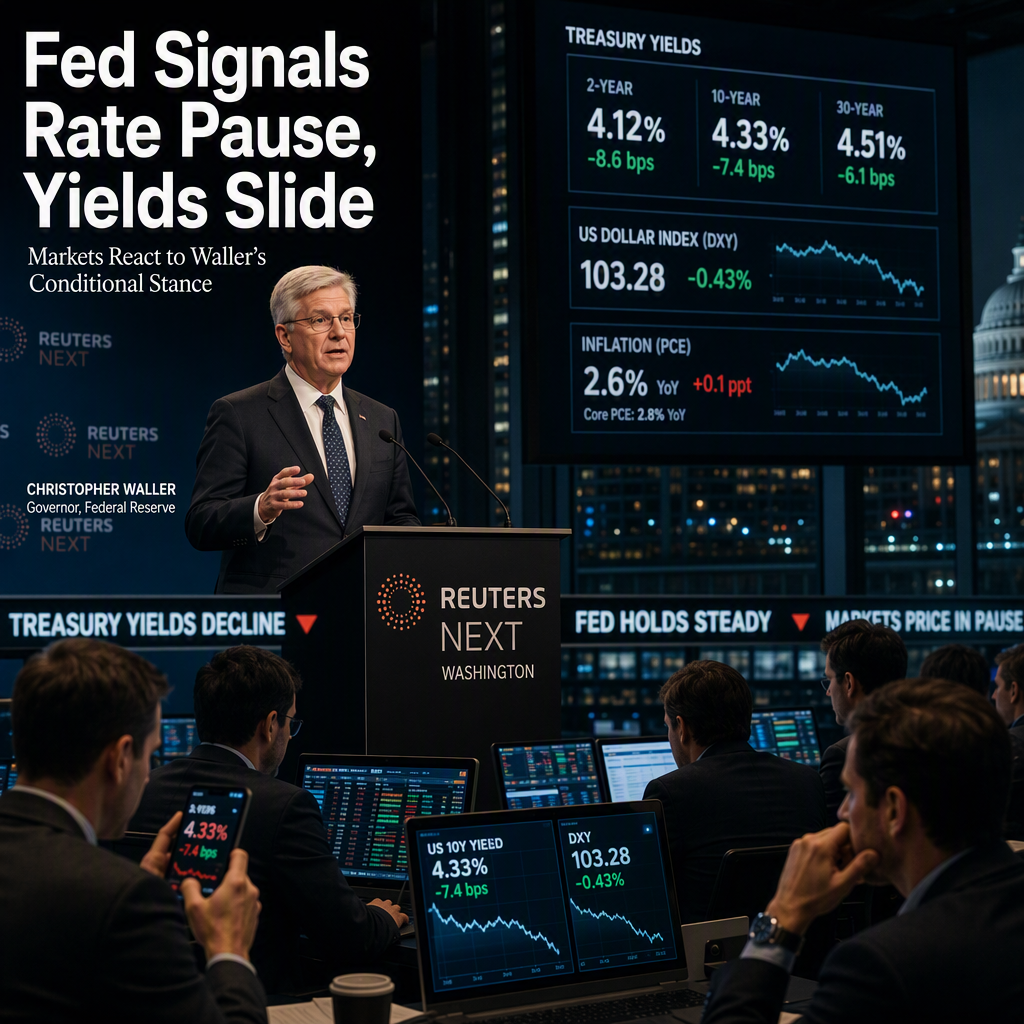
Federal Reserve Governor Christopher Waller indicated on Thursday that he is inclined to support holding the policy rate steady at the upcoming September Federal Open Market Committee (FOMC) meeting, provided that August inflation data continues to show progress in cooling price pressures [1][2]. Waller emphasized a data-dependent approach, stating that a 'hot' inflation print could still prompt a rate hike, but recent signs of disinflation and solid GDP and consumption growth have increased his confidence in maintaining current rates [1][2].
Waller's remarks were delivered at the Reuters NEXT Newsmaker event in Washington and were interpreted as moderately hawkish but with conditional flexibility. The FXS Speechtracker score for his speech was 6.1, slightly below the historical average, reflecting a tone just under the established baseline for hawkishness [1]. The FXS Fed Sentiment Index also fell by 2.06 points to 125.38, indicating a modest pullback in perceived hawkishness, though the index remains well above the neutral threshold, suggesting the Fed is still in restrictive territory [1].
Market reaction was swift: the US Dollar Index fell 0.6% to 99.00, and Treasury yields moved lower across the curve. The 10-year Treasury note yield dropped more than 2 basis points to 4.7680%, the 30-year yield fell to 5.2433%, and the 2-year yield declined to 4.3609% [1][2]. This reversal followed a period of rising yields driven by concerns over debt, inflation, and global energy prices, with yields having touched multi-year highs the previous day [2].
Waller noted that while inflation remains 'significantly elevated' above the Fed's 2% target, recent trends suggest disinflation is taking hold. He downplayed the impact of tariffs and higher energy prices on broader inflation, and highlighted that the labor market remains in satisfactory shape, with expectations for continued solid jobs data in August [1][2]. Investors are now focused on the upcoming nonfarm payrolls report, forecast to show an increase of 58,000 jobs and an unemployment rate holding steady at 4.1%, as well as the ISM services PMI, expected at 54.3 [2].
Geopolitical tensions, particularly in the Middle East, and fluctuations in oil prices were also noted as factors influencing market sentiment, though Waller suggested these have not yet become significant sources of ongoing inflation pressure [1][2].
CONCLUSION
Fed Governor Waller's conditional support for holding rates steady in September, contingent on favorable inflation data, led to a decline in Treasury yields and a weaker US Dollar. Markets are now closely watching upcoming inflation and labor market data for further direction, with the Fed maintaining a cautious but flexible stance.