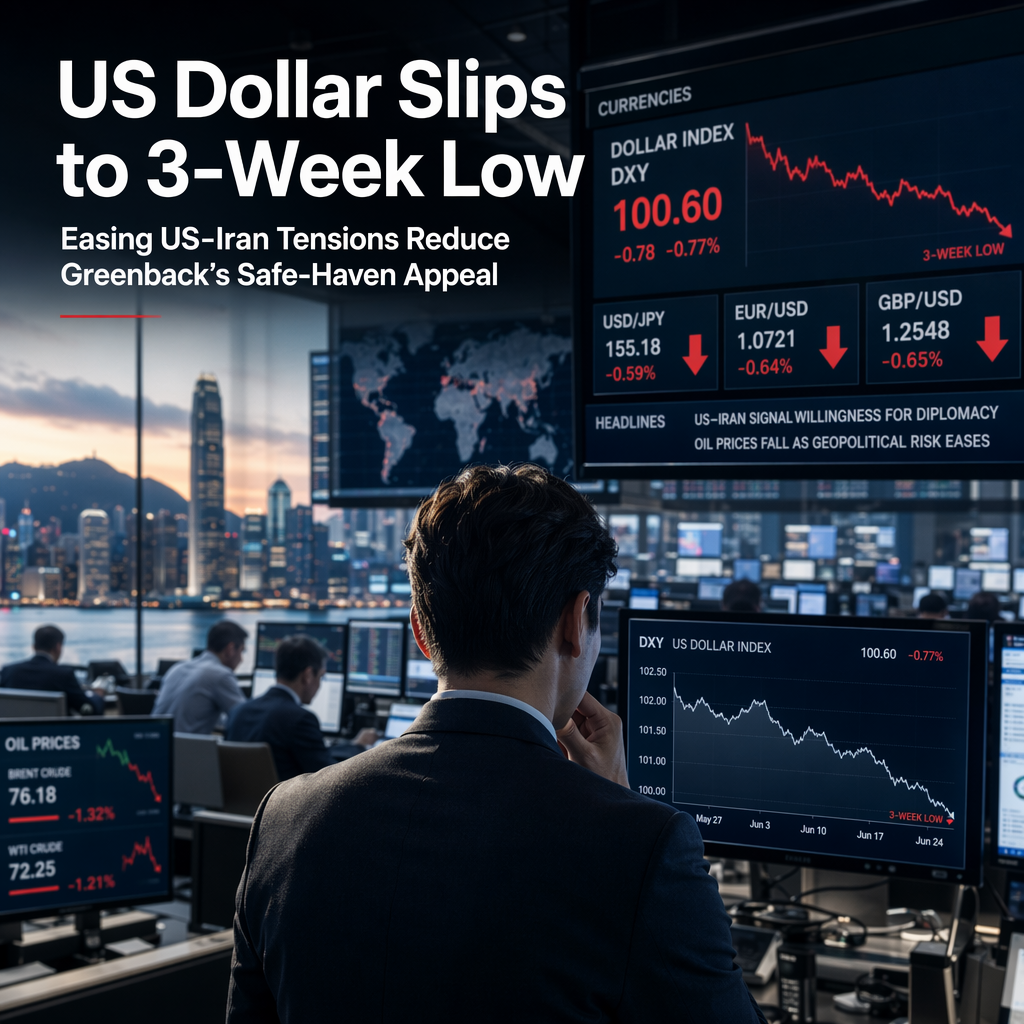
The US Dollar Index (DXY), which measures the Greenback’s value against six major currencies, fell to a three-week low, trading 0.3% lower near 100.60 during the Asian session on Friday [1]. This marks the third consecutive day of losses for the US Dollar, driven by signs of de-escalation in the ongoing conflict between the United States and Iran [1]. According to reports from the Times of Israel, a US official indicated that Washington remains committed to the memorandum of understanding (MoU) with Iran and that technical talks are ongoing, despite US President Donald Trump’s statement that the MoU is over and the recent exchange of attacks between the two countries [1].
The US Dollar was the weakest against the Japanese Yen, declining by 0.57%, and also posted losses against other major currencies: -0.22% versus the Euro, -0.27% versus the British Pound, -0.19% versus the Canadian Dollar, -0.31% versus the Australian Dollar, -0.55% versus the New Zealand Dollar, and -0.40% versus the Swiss Franc [1]. The diminished safe-haven appeal of the US Dollar is attributed to the easing of US-Iran tensions [1].
However, the article notes that higher oil prices, stemming from renewed fears of energy supply disruptions, have pushed inflation projections higher, which could limit further downside for the US Dollar [1]. Elevated inflation expectations may discourage Federal Reserve officials from lowering interest rates in the near term [1]. On the monetary policy front, Fed Chair Kevin Warsh has announced the formation of five task forces, as outlined in the June policy announcement, focusing on communications, balance sheet policy, economic data quality and timeliness, productivity and jobs, and developing inflation frameworks [1].
CONCLUSION
The US Dollar Index has weakened to a three-week low amid signs of easing US-Iran tensions, reducing its safe-haven appeal. However, higher oil prices and inflation expectations may limit further declines, as the Federal Reserve could be less inclined to cut rates. Market participants are closely watching both geopolitical developments and Fed policy signals.