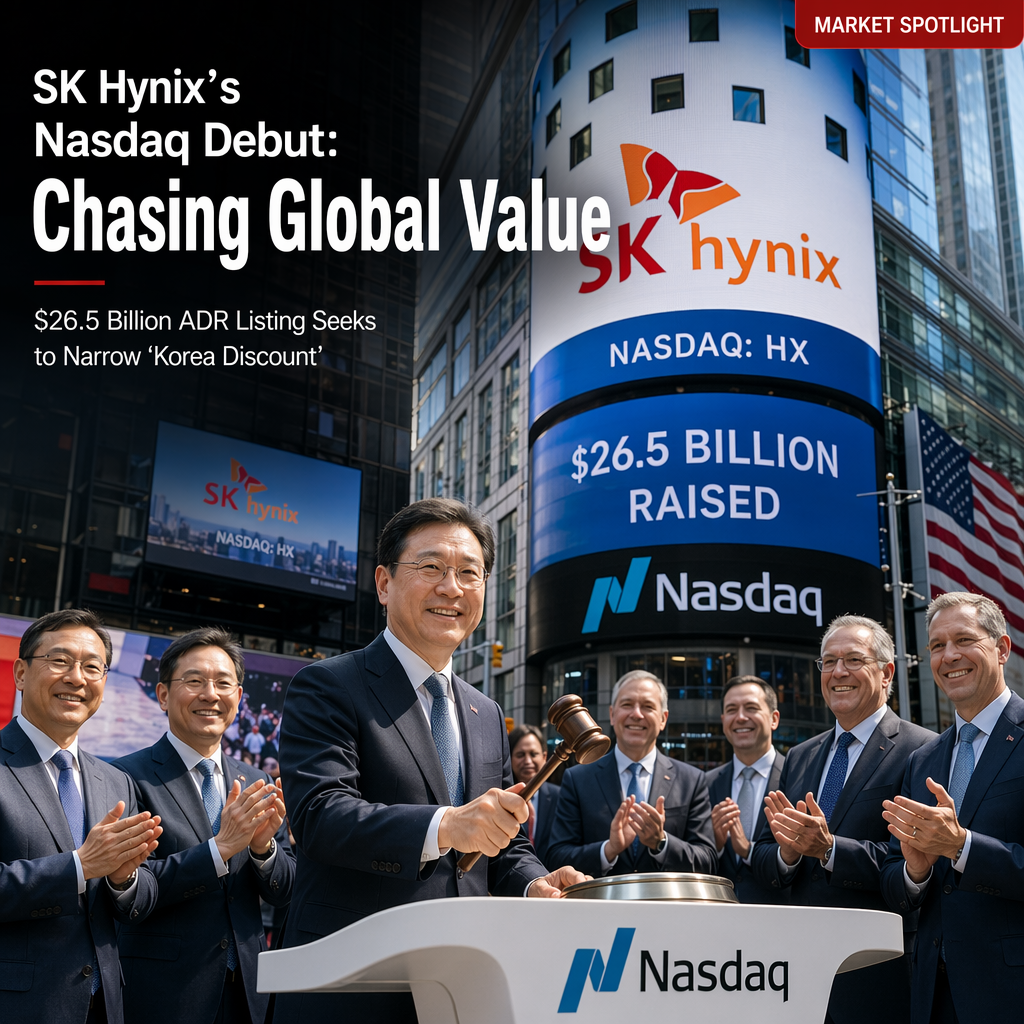
SK Hynix, a global leader in semiconductor manufacturing, made its debut on the Nasdaq on Friday through an American depositary receipt (ADR) listing, a move that analysts believe could help address the persistent 'Korea discount'—the tendency for South Korean companies to trade at lower valuations compared to global peers due to concerns over corporate governance and conglomerate structures [1]. The ADRs are priced at $149 each, and the IPO was oversubscribed, raising approximately $26.5 billion for the company [1].
Despite its leadership in the high-bandwidth memory (HBM) market, SK Hynix trades at just 4.8 times 12-month forward earnings, significantly below the industry median of 29.84 times and U.S. rival Micron Technology's 6.6 times, according to LSEG data [1]. Shares of Micron have surged nearly 250% this year, while SK Hynix has climbed 240% [1]. Market analysts, including Rolf Bulk of Futurum Group and Zavier Wong of eToro, suggest that the Nasdaq listing could help narrow the valuation gap by improving access and familiarity for U.S. investors, though they do not expect the Korea discount to disappear entirely [1].
Peter Kim of KB Financial Group noted that the Nasdaq listing should improve access for overseas investors, who have historically faced hurdles in buying Korean equities, and that meeting Nasdaq's stringent listing requirements could ease some concerns among U.S. investors regarding corporate governance [1]. The listing is also expected to partially support SK Hynix's growing capital expenditures, forecast at 50 trillion to 70 trillion won annually over the next two years, though most funding will come from internal sources, according to Ji Cheong of S&P Global Ratings [1].
Overall, while the ADR listing is seen as a major step toward narrowing the Korea discount and enhancing global investor access, analysts caution that a rise in SK Hynix's stock price does not necessarily equate to a shrinking of the valuation gap with peers like Micron [1].
CONCLUSION
SK Hynix's Nasdaq debut marks a significant move to attract global capital and potentially narrow its valuation gap with international peers. While the listing is expected to improve investor access and address some governance concerns, analysts remain cautious about the extent to which the Korea discount will be reduced. The market response has been positive, but the long-term impact on SK Hynix's valuation remains to be seen.