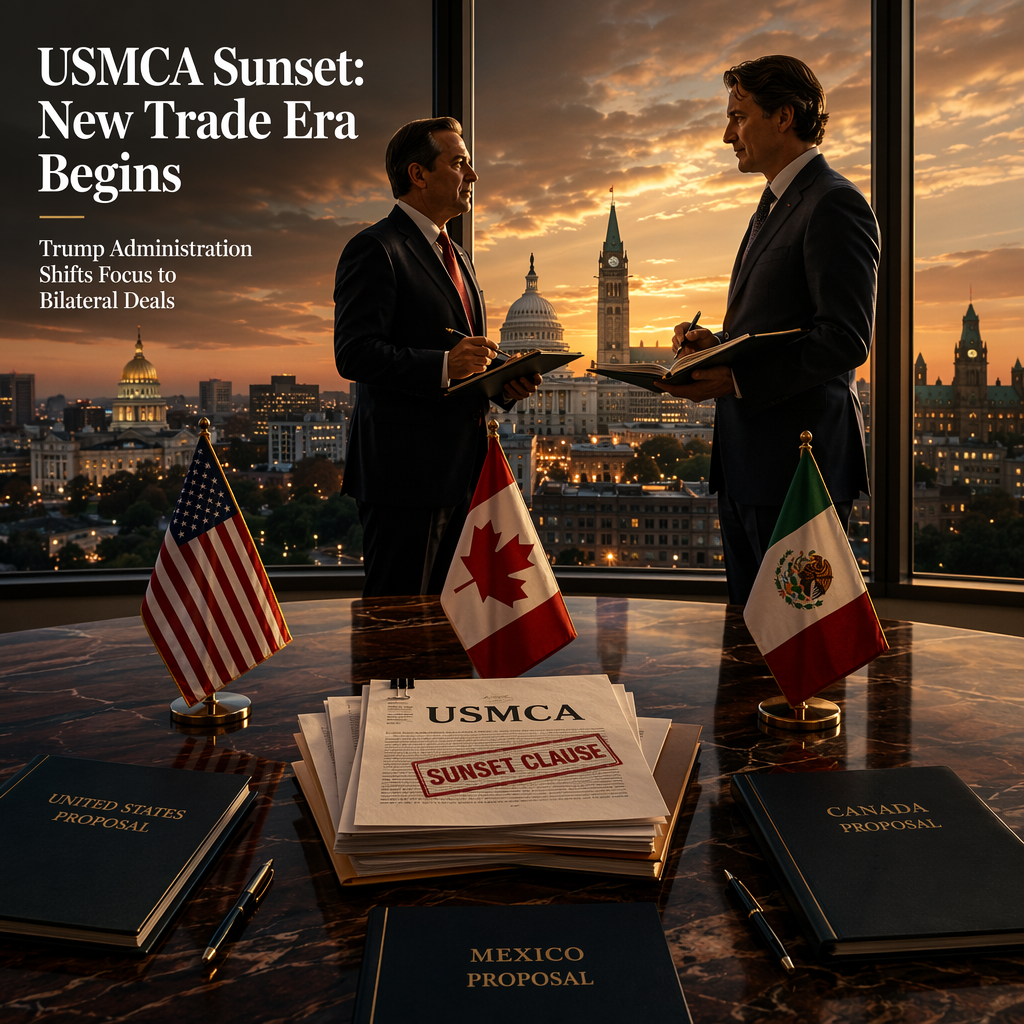
Former President Donald Trump has officially decided not to renew the U.S.-Mexico-Canada Agreement (USMCA), triggering the trade deal's sunset clause and setting the stage for new bilateral negotiations with Canada and Mexico [1]. According to U.S. official Edward Lawrence, the administration will pursue individual agreements with each country for the next 10 years, while the USMCA remains in effect during this period [1].
The decision comes as the USMCA marks its sixth year in effect, a milestone that allowed the administration to either extend the agreement or opt for renegotiation. The Trump administration cited shortcomings in the USMCA, including its failure to adequately control trade deficits and expand market access, specifically referencing Canada's dairy restrictions and Mexico's threats against U.S. corn and corn products [1].
A senior Trump administration official indicated that the U.S. could end up with bilateral protocols with Mexico or Canada within President Trump's term, provided these agreements are focused on reducing trade deficits [1]. The official also noted skepticism about making changes to the USMCA that would keep the trilateral pact intact, but emphasized the importance of continued negotiations for all parties involved [1].
Key issues expected to be addressed in upcoming negotiations include rules of origin, labor obligations, environmental and water quality standards, and intellectual property rights. U.S. trade negotiators are scheduled to meet with their Mexican counterparts on July 20 to discuss these topics and seek progress on strengthening economic security alignment and resolving bilateral issues [1].
CONCLUSION
The Trump administration's decision not to renew the USMCA signals a significant shift toward bilateral trade negotiations with Canada and Mexico. This move introduces uncertainty but also opens the door for targeted agreements aimed at reducing trade deficits and addressing specific market access concerns.