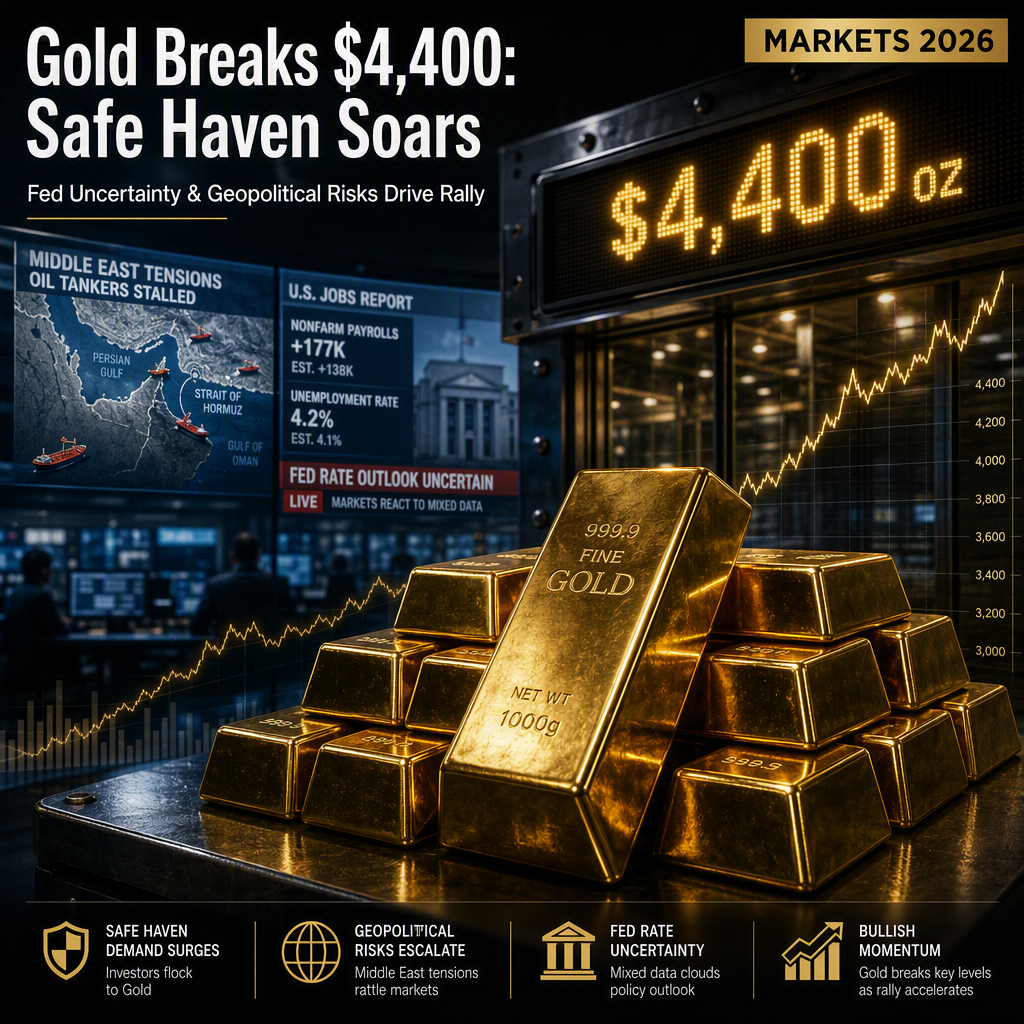
Gold (XAU/USD) has extended its rally, climbing beyond the $4,400 mark to reach its highest level since June 5, 2026, marking a third consecutive day of gains and the fifth positive session in the past six trading days [2]. This surge follows a weak US jobs report released last Friday, which signaled a cooling labor market and reduced expectations for further US Federal Reserve (Fed) rate hikes, thereby boosting demand for non-yielding assets like gold [2][3]. However, persistent inflation risks, fueled by a sharp rise in crude oil prices due to ongoing geopolitical tensions in the Middle East, have kept Fed rate hike bets alive, with traders still pricing in at least one rate hike by the Fed in 2026 [2][3][4].
The geopolitical backdrop remains tense, as US President Donald Trump rejected Iran’s demand for compensation over war damages and held Iran responsible for regional casualties. Iran, in turn, ruled out negotiations with Trump and stated it would wait until his term ends on January 20, 2029, to resume talks, dampening hopes for a swift reopening of the Strait of Hormuz [2][4]. Additionally, shipping traffic through the Bab el-Mandeb Strait remains disrupted due to a naval blockade by Iran-backed Houthis against Saudi Arabia, contributing to the spike in crude oil prices and renewed inflation fears [2][4].
Technical analysis indicates that gold has broken through the 100-day Simple Moving Average (SMA) and the 50% Fibonacci retracement of the April-June decline, suggesting buyers remain in control. Upside targets include the 200-day SMA at $4,498, the 61.8% retracement at $4,515, and the 78.6% level near $4,669. Immediate support is seen at $4,406, with deeper levels at $4,389, $4,297, and $4,162, ahead of the cycle low around $3,945 [1][2].
Market participants are exercising caution ahead of the upcoming US inflation data, with the Consumer Price Index (CPI) and Producer Price Index (PPI) scheduled for release on Wednesday and Thursday, respectively. These reports are expected to provide further guidance on the Fed's policy path and influence both the US Dollar Index (DXY) and gold prices [1][2][4]. The DXY is consolidating below 100.00, reflecting investor hesitation amid the uncertain geopolitical and inflationary environment [4].
Silver (XAG/USD), meanwhile, has slipped to near $66.00 per troy ounce after two days of gains, as rising oil prices and heightened Fed rate hike expectations weigh on the non-yielding metal. Despite these headwinds, strong industrial demand, particularly from China, could provide a floor for silver prices [3].
CONCLUSION
Gold's rally above $4,400 is driven by a combination of softer US labor data, persistent geopolitical risks, and volatile inflation expectations. While technical indicators point to further upside potential, market participants remain cautious ahead of key US inflation data, which will be pivotal in shaping the Fed's next moves and the trajectory of both gold and the US Dollar.