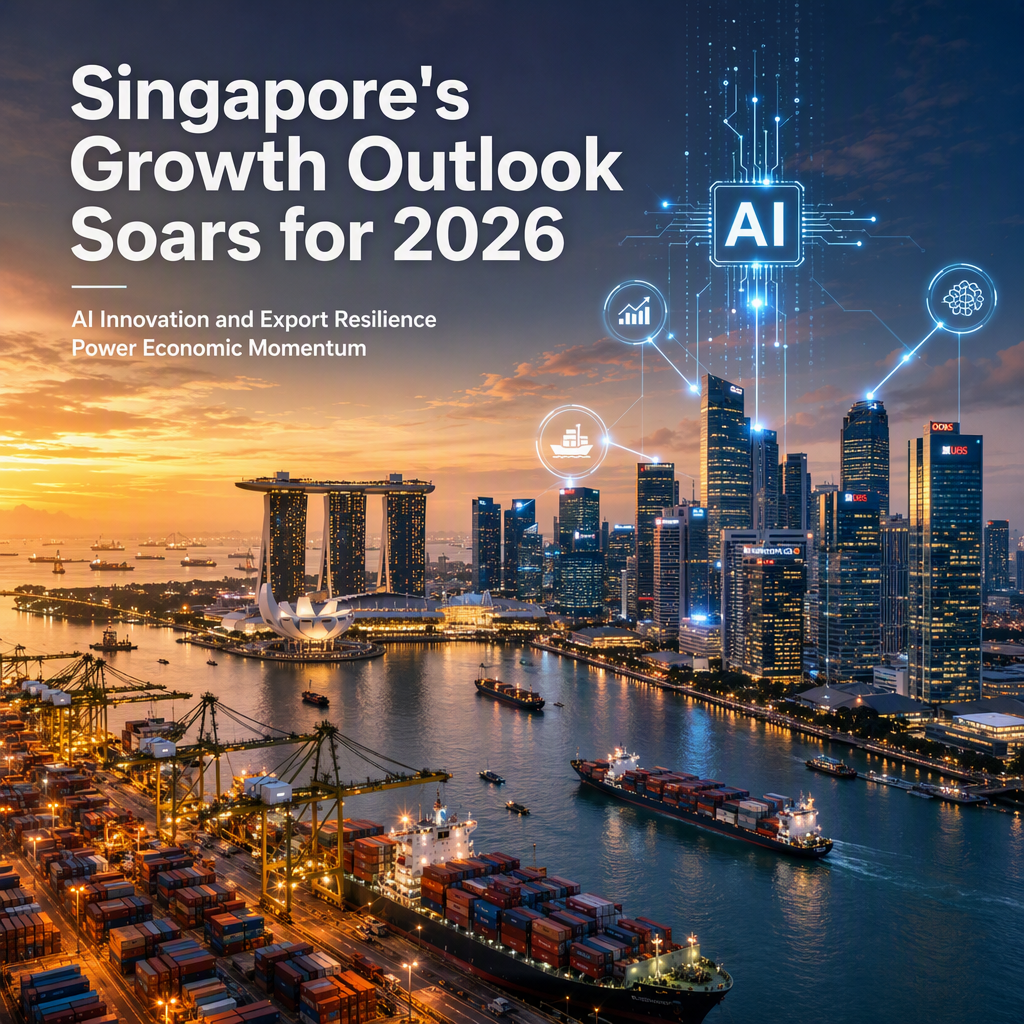
Singapore has significantly revised its full-year GDP outlook for 2026, raising the forecast to 4.5%-5.5% from the earlier estimate of 2%-4% [1]. This marks more than a doubling of the lower end of the previous projection, reflecting robust economic momentum. The Ministry of Trade and Industry (MTI) attributed this upgrade to a boost from artificial intelligence-related activities and resilient export performance, despite ongoing oil market volatility [1].
The city-state's economy expanded by 5.9% in the second quarter, surpassing the advance estimate of 5.7%. Key sectors driving this growth included manufacturing, wholesale trade, and finance and insurance [1]. This is the second time Singapore has upgraded its growth estimates in 2026; at the start of the year, MTI had projected GDP growth at 1%-3% [1].
MTI noted that the economic impact of the U.S.-Iran conflict has been less severe than initially feared. The drawdown of oil inventories and increased substitution to alternative energy sources have helped cap the rise in global energy prices [1].
The strong economic performance is expected to give the Monetary Authority of Singapore (MAS) some flexibility in managing inflation. MAS unexpectedly tightened monetary policy in late July, citing anticipated rises in imported costs due to higher fuel and electronic input prices, as well as adverse weather conditions affecting import sources [1]. Singapore's core inflation rose to 1.6% in June from 1.4% in May, which is near the bottom of MAS' forecast range of 1.5%-2.5% for 2026. Headline inflation stood at 1.9% [1].
CONCLUSION
Singapore's upgraded GDP outlook signals strong economic momentum driven by AI and resilient exports, with inflation remaining within forecasted ranges. The less severe impact of global oil volatility and proactive monetary policy measures by MAS suggest a positive market environment. Overall, the outlook for Singapore's economy in 2026 is notably optimistic.