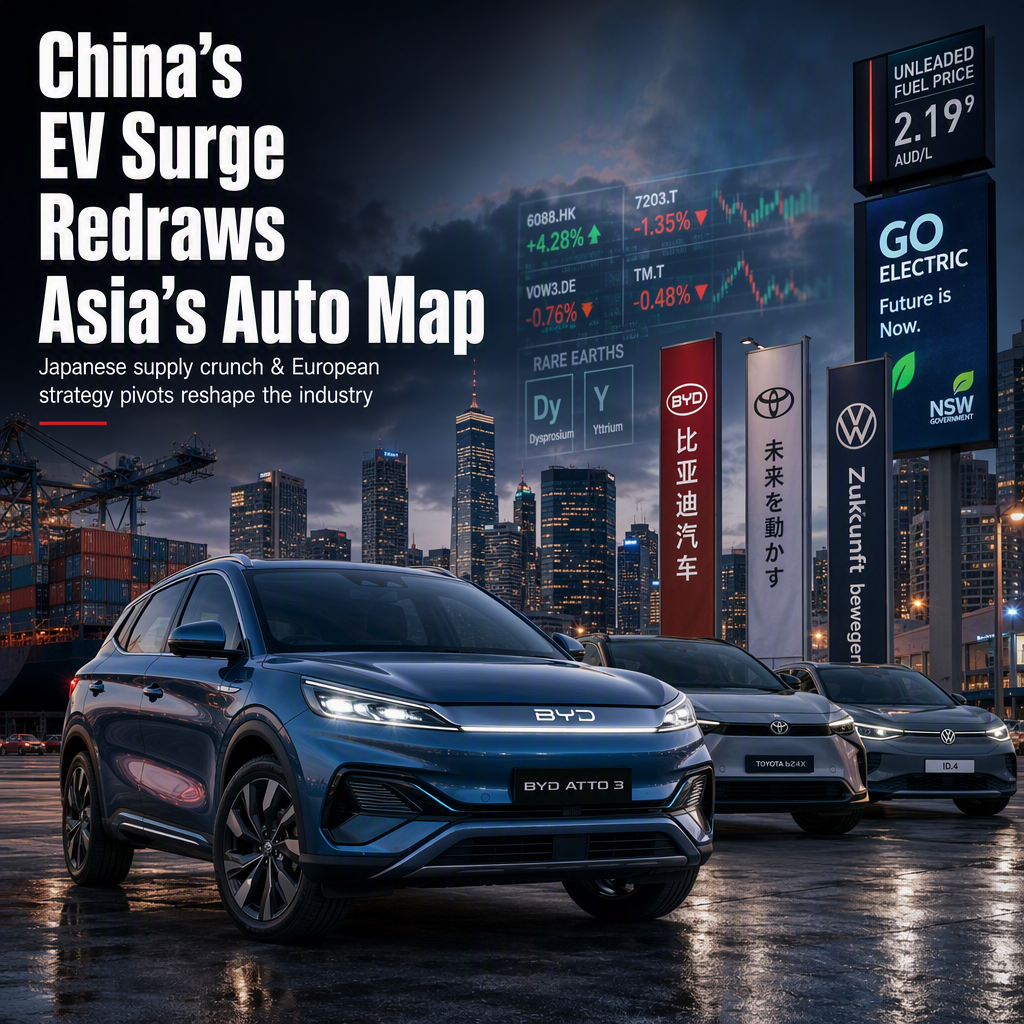
Australia's automotive market is undergoing a significant transformation as electric vehicle (EV) sales surge, driven by rising fuel prices linked to the U.S.-Iran war and favorable government policies. Chinese manufacturers, led by BYD, are leveraging aggressive pricing and an expanding model lineup to capture market share from long-dominant Japanese automakers such as Toyota. Industry analysts highlight that the influx of low-cost Chinese EVs is reshaping consumer preferences and challenging traditional loyalties, with technical analysis indicating strong support for continued EV market growth in Australia [1].
Meanwhile, Japanese materials companies are grappling with a severe supply crunch for rare earths, essential for EV and semiconductor production, due to Chinese trade restrictions. Imports of dysprosium and yttrium have dropped by around 80% compared to two years ago, forcing Japanese firms to draw down inventories and seek alternative sources. Rare-earth costs have surged over 20%, and companies are exploring rare-earth-free technologies and new international partnerships. The sentiment in the Japanese materials market remains cautious, with expectations of continued volatility and potential further supply chain disruptions if Chinese export curbs persist [2].
In China, Volkswagen's efforts to stage a comeback are facing renewed skepticism as sales decline. The German automaker is increasingly reliant on local partners, such as Xpeng, for co-developing EVs like the ID. UNYX 08, while simultaneously considering mass layoffs and capacity reductions in Europe. Analysts attribute Volkswagen’s challenges to the rapid ascent of domestic Chinese brands and their aggressive pricing, which have pressured foreign competitors to adapt their strategies and cost structures [3].
Collectively, these developments underscore a broader shift in the Asia-Pacific automotive landscape, with Chinese EV makers gaining ground in both export and domestic markets, Japanese firms contending with supply chain vulnerabilities, and European automakers like Volkswagen recalibrating their strategies in response to intensifying competition and changing market dynamics.
CONCLUSION
The Asia-Pacific automotive sector is experiencing major upheaval as Chinese EV makers expand aggressively, Japanese companies face rare earth supply challenges, and European automakers like Volkswagen struggle to maintain market share. Rising costs, supply chain disruptions, and shifting consumer preferences are driving rapid change, with market participants closely watching for further volatility and strategic responses.