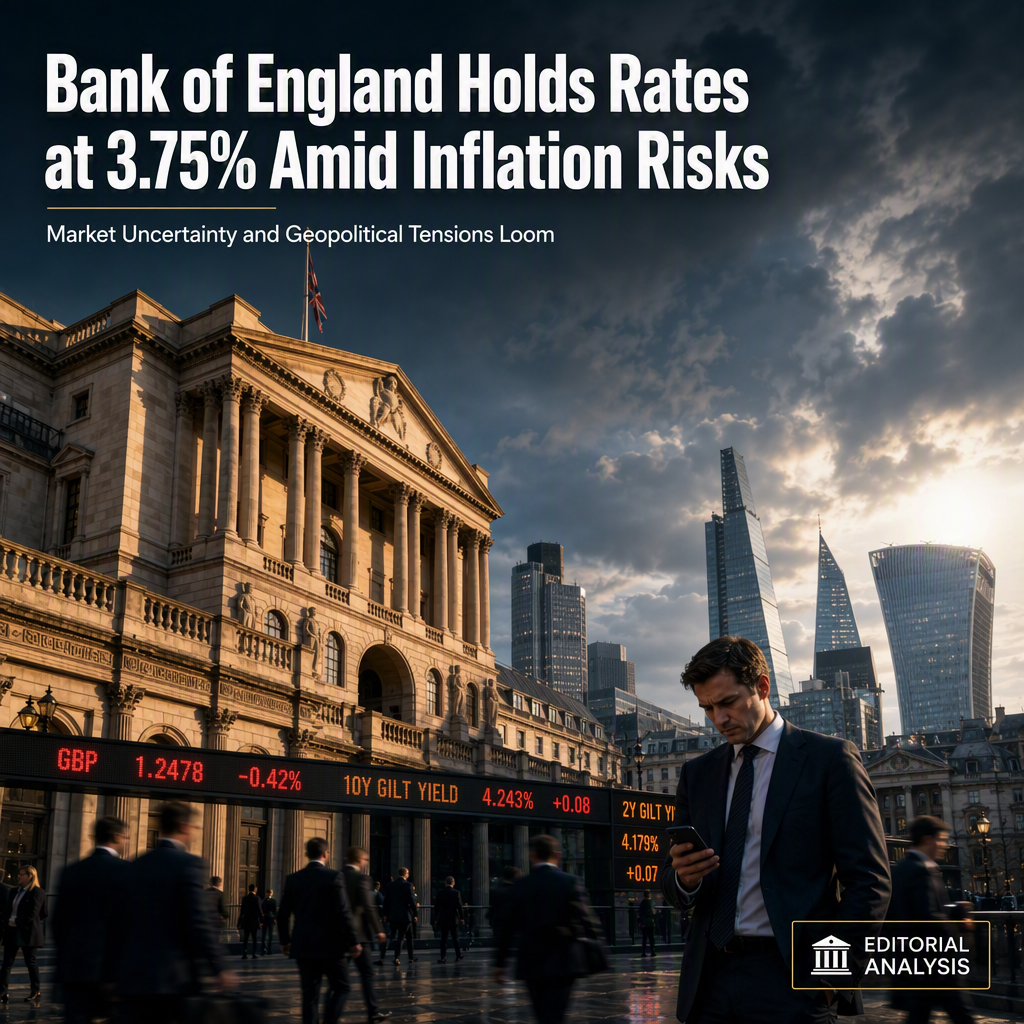
The Bank of England (BoE) maintained its Bank Rate at 3.75% in a 6-3 vote, with dissenting members Megan Greene, Catherine L Mann, and Huw Pill supporting a 25 basis point hike, according to both Rabobank and Brown Brothers Harriman (BBH) analyses [1][2]. The decision marks the sixth consecutive meeting at which the rate has been held steady [2]. The Monetary Policy Committee (MPC) cited limited evidence of material second-round effects in price and wage-setting, with easing UK wage growth and services inflation providing room to keep rates unchanged [2].
However, both sources highlight that the BoE signaled a heightened risk of inflation due to elevated energy prices and ongoing conflict in the Middle East. Governor Andrew Bailey warned that if the Middle East conflict persists and second-round effects emerge, further policy tightening may be necessary [1][2]. Rabobank's Stefan Koopman now expects a 25bp hike to 4.00% at the November meeting, describing it as a 'performative hike' to demonstrate vigilance against inflation risks, especially if energy prices remain high and the situation in Iran does not de-escalate [1].
In addition to the rate decision, the BoE announced a slowdown in the pace of quantitative tightening (QT), planning to reduce gilt holdings by an average of £46bn a year through 2034, including £20bn of annual sales. This is a significant reduction from the previous average of £87.5bn and £32bn of sales over the past four years [2]. The slower QT runoff is expected to support gilts, but BBH notes that elevated energy prices remain the primary driver of gilt yields, which are likely to stay under upward pressure unless energy prices ease sustainably [2].
Market expectations, as reflected in the swaps curve, imply about 100bps of BoE rate hikes over the next twelve months, potentially taking the rate to 4.75% [2]. However, both Rabobank and BBH argue that the UK economy's current slack and restrictive fiscal policy mean the BoE may not need to tighten as much as markets anticipate. Rabobank projects that any further increase in Bank Rate is likely to be temporary, with eventual rate cuts expected in 2027 and 2028 [1]. BBH concludes that the British Pound (GBP) remains vulnerable to a dovish BoE repricing, given the central bank's cautious stance and the UK's economic conditions [2].
CONCLUSION
The Bank of England's decision to hold rates at 3.75% reflects a cautious approach amid rising inflation risks from energy prices and geopolitical tensions. While a rate hike in November is now seen as likely by some analysts, both sources suggest that further tightening may be limited and temporary. The British Pound remains exposed to downside risk if the BoE adopts a more dovish stance than markets currently expect.