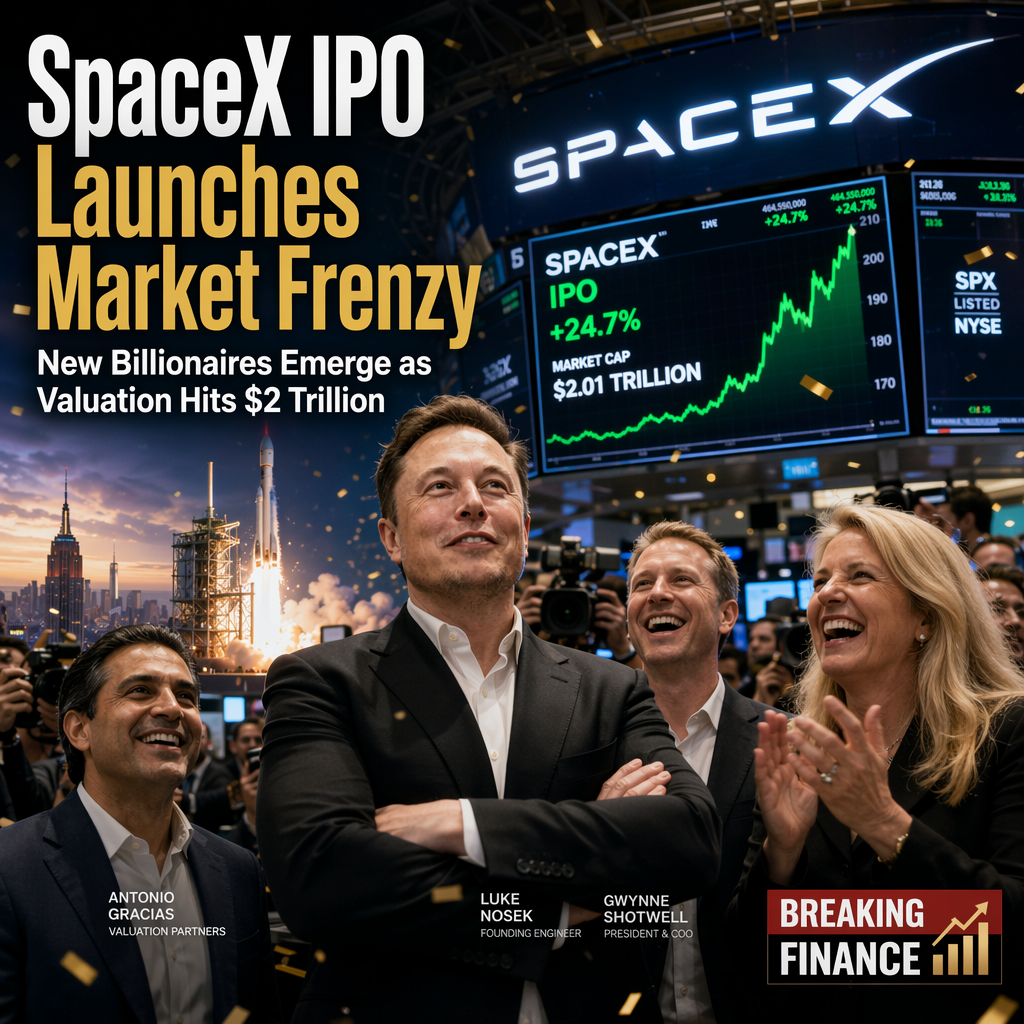
SpaceX, led by founder and CEO Elon Musk, completed a record-breaking initial public offering (IPO) with shares offered at a set price of $135, resulting in a surge of 37% in share price after its debut week on the public markets [1]. The IPO propelled Musk's personal stake in SpaceX to over $1 trillion and created thousands of new millionaires, with several shareholders now holding stakes worth over $1 billion [1].
During its debut week, SpaceX's market capitalization briefly surpassed both Amazon and Microsoft, highlighting intense investor interest. However, following a loss on Thursday, the company's market cap closed at $2.43 trillion, slipping below Amazon but still maintaining significant gains since the IPO [1].
Key shareholders include Valor Equity Partners, whose stake is valued at approximately $96.6 billion, largely on behalf of its clients. Antonio Gracias, Valor's founder and CEO, serves on SpaceX's board and has longstanding ties to Musk [1]. Other notable stakeholders are Luke Nosek, a PayPal cofounder and SpaceX board member since 2008, with a $6.3 billion stake, and Gwynne Shotwell, SpaceX's president and COO, whose stake is valued at $2.4 billion [1].
In an interview on the day of the IPO, Shotwell emphasized her role in managing the company's day-to-day operations, complementing Musk's focus on high-level strategy [1]. The IPO's success has not only elevated the wealth of existing shareholders but also attracted significant market attention, despite some cooling sentiment and a slight pullback in market cap towards the end of the week [1].
CONCLUSION
SpaceX's IPO has had a transformative impact on the market, creating new billionaires and briefly making the company more valuable than Amazon and Microsoft. Despite a slight dip in market cap after initial highs, the company remains up 37% from its IPO price, underscoring strong investor interest and significant market impact.