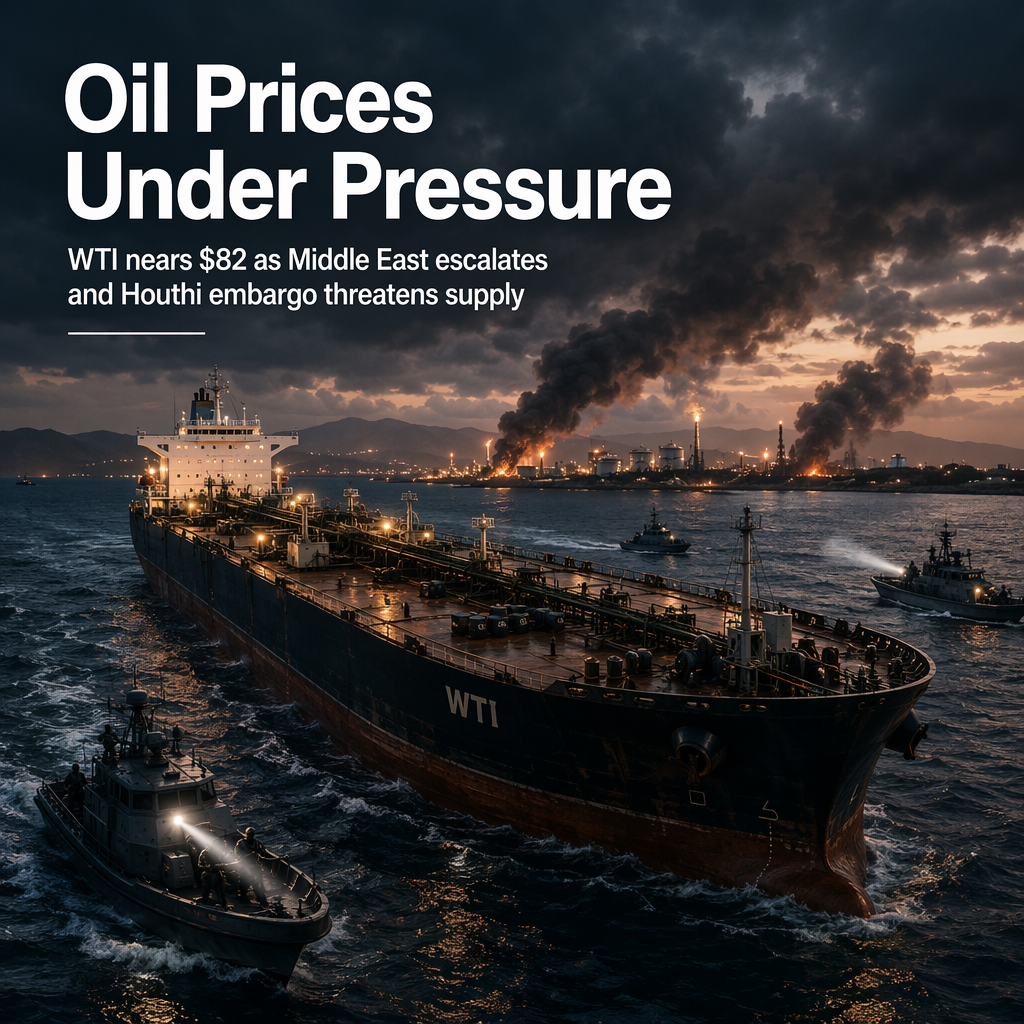
West Texas Intermediate (WTI), the US crude oil benchmark, traded around $82.00 during early European hours on Tuesday, declining but remaining near multi-week highs as traders assessed ongoing US-Iran developments [1]. The market is reacting to the escalation in the region, with US airstrikes on Iran entering their tenth consecutive day following the deaths of three US service members [1]. US President Donald Trump stated on Monday that Iran would pay for the deaths of the three US soldiers, according to CNBC [1].
The Iranian Islamic Revolutionary Guards Corps (IRGC) reported that it struck US military targets, including air defence systems in Bahrain and Kuwait. Specifically, the IRGC claimed to have hit two air defence systems and a radar installation at two different US outposts in Bahrain, as well as missile defence systems, radars, and satellite reception systems in Kuwait [1].
In addition to the US-Iran conflict, Yemen’s Iran-backed Houthi rebels announced a maritime embargo on Saudi Arabia. Houthi military spokesperson Yahya Saree declared the embargo effective immediately, stating it was based on the principle of 'an eye for an eye' [1]. This move has raised fears of oil supply disruption, which could potentially boost WTI prices in the near term [1].
Traders are also awaiting the release of the American Petroleum Institute (API) weekly crude oil report, due later on Tuesday. The report's outcome could influence WTI prices: a larger-than-expected inventory draw would indicate stronger demand and could lift prices, while a bigger build would suggest weaker demand or excess supply, potentially undermining prices [1].
CONCLUSION
WTI oil prices are currently under pressure but remain elevated as geopolitical tensions in the Middle East and new supply risks from the Houthi embargo drive market uncertainty. The upcoming API inventory report is expected to provide further direction for WTI prices in the short term.