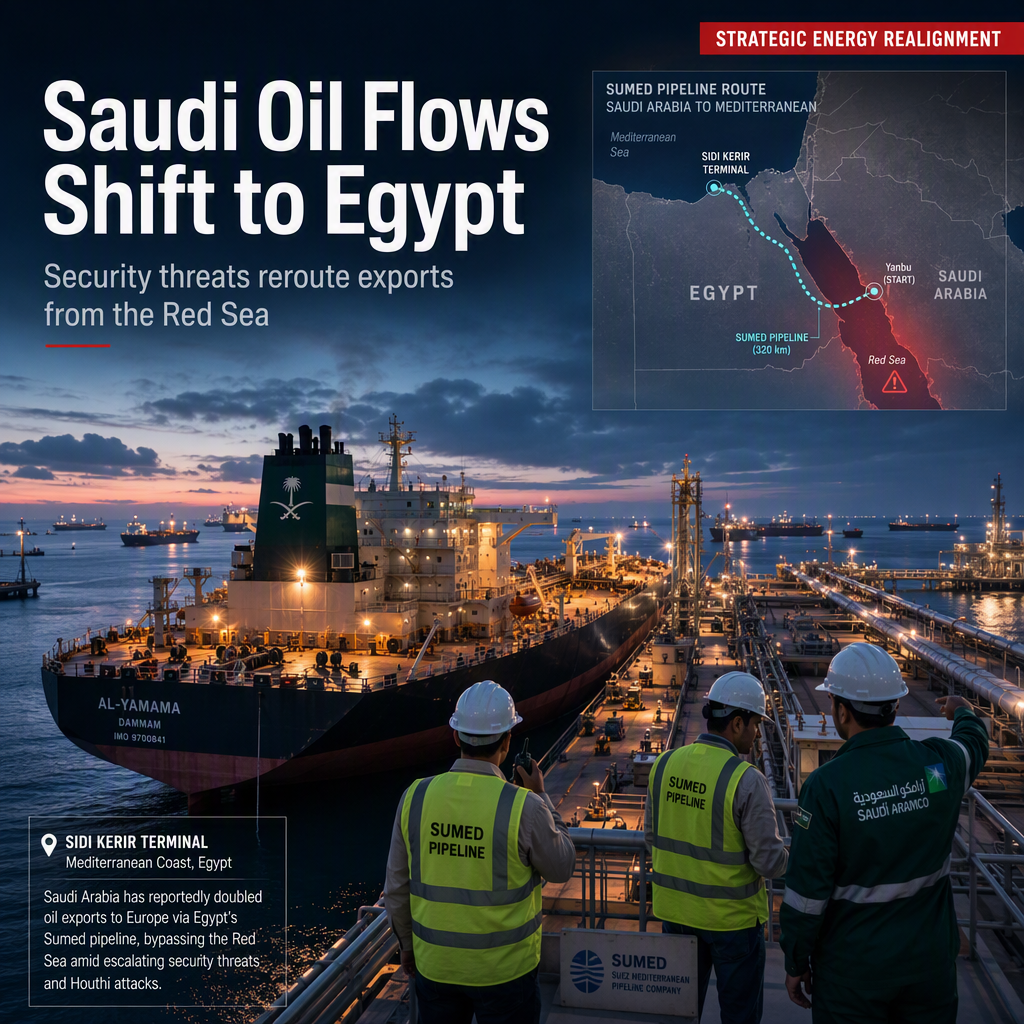
Saudi Arabia has significantly increased its oil exports through the Sumed pipeline, which runs across Egypt to the Mediterranean Sea, in response to escalating security threats in the Red Sea and surrounding key Middle East maritime chokepoints. This strategic shift comes as Houthi militants, backed by Iran, have declared a maritime embargo on Saudi oil and launched attacks on tankers in the Red Sea, forcing Riyadh to seek alternative export routes [1].
According to data from trade intelligence firm Kpler, oil exports from Egypt's Mediterranean port of Sidi Kerir have more than doubled in August to approximately 2.3 million barrels per day, up from around 1 million barrels per day in the previous month. The majority of these exports are Saudi crude, as confirmed by Matt Smith, director of commodity research at Kpler [1]. Smith emphasized, "This isn't a short-term decision. This is a distinct change in strategy or dynamics" [1].
The Sumed pipeline connects the Red Sea port of Ain Sokhna to Sidi Kerir, allowing supertankers to offload part of their cargo for transit through the Suez Canal, which cannot accommodate fully loaded vessels. Meanwhile, Saudi exports from the Red Sea port of Yanbu through the Bab el-Mandeb Strait have plummeted nearly 90%, dropping to 1.3 million barrels during the week of August 3 from 11 million barrels the week of July 20, following the Houthi embargo declaration [1].
Saudi Aramco CEO Amin Nasser stated on the company's August 4 earnings call that Saudi Arabia has "optionality" through multiple access routes, including the Sumed pipeline and the Suez Canal, to mitigate the impact of the Red Sea disruptions [1]. However, rerouting oil to Asia now requires tankers to take a longer and more expensive journey around Africa, increasing logistical costs and potentially impacting delivery times [1].
Market analysts note that this rerouting represents a significant dislocation in global oil flows, with Smith stating, "It's clear that the Saudis are not taking this lightly, and they're expecting it to be a new trend" [1].
CONCLUSION
Saudi Arabia's rapid shift to exporting oil via Egypt's Sumed pipeline underscores the severity of security threats in the Red Sea and the kingdom's determination to maintain export flows. The move has caused a major realignment in oil logistics, with increased costs and longer shipping times likely to impact the market. This development signals a potentially lasting change in Middle East oil export dynamics.