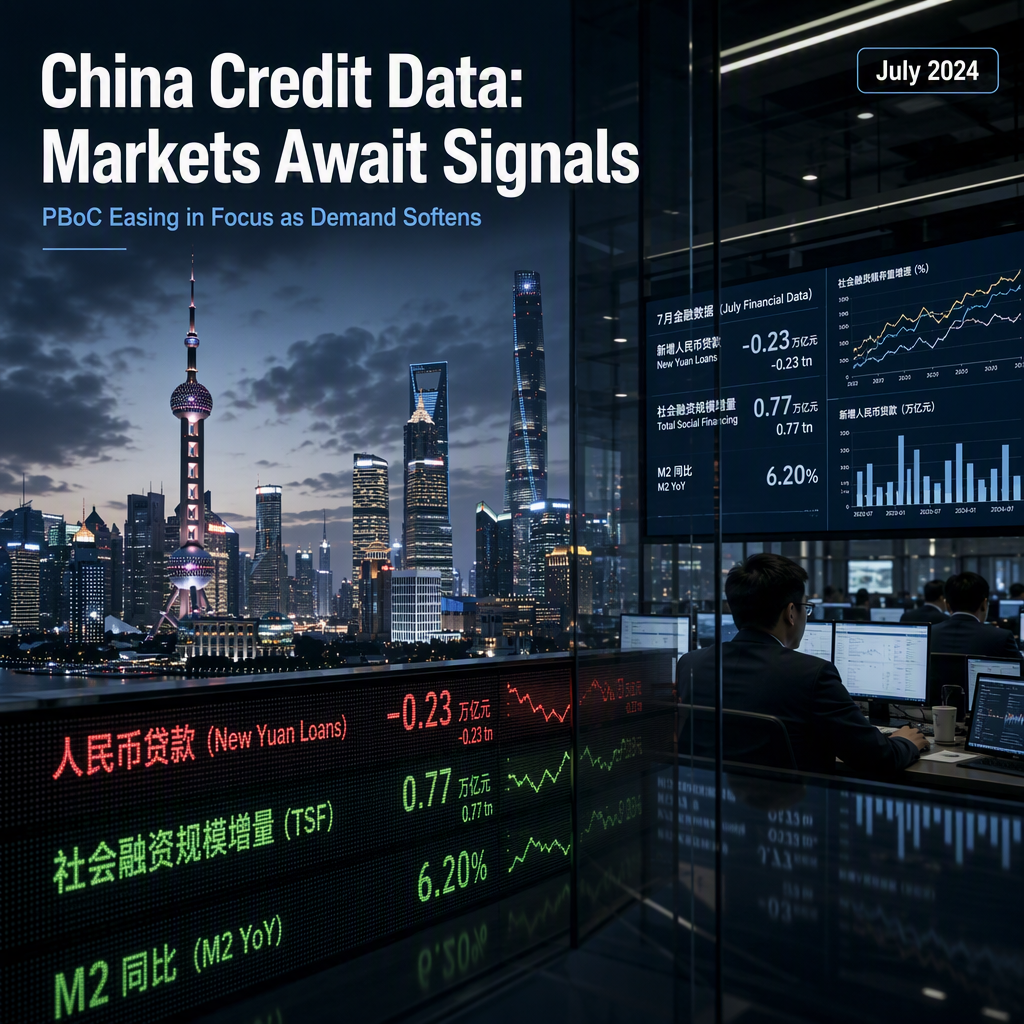
China's July credit and money supply data are set to be released this week, with market participants closely monitoring the figures for indications of domestic demand stabilization following a series of disappointing economic readings [1]. According to Commerzbank analysts Charlie Lay and Dr. Henry Hao, consensus expectations are for M2 money supply growth to ease slightly to 7.9% year-on-year from 8.0% in June, while M1 is forecast to slip to 3.9% from 4.0% [1]. Aggregate financing on a year-to-date basis is projected to rise to CNY21.9 trillion compared to CNY20.8 trillion in June, though new yuan loans outstanding are expected to decrease marginally to CNY10.6 trillion from CNY10.7 trillion previously [1].
Commerzbank notes that a softer-than-expected credit print would reinforce the view that private sector borrowing appetite remains subdued, consistent with June's pattern when aggregate financing missed forecasts [1]. This scenario would likely increase pressure on the People's Bank of China (PBoC) to implement more targeted monetary easing measures [1]. The PBoC has indicated its intention to make monetary policy more targeted and flexible, maintaining the seven-day reverse repo rate as the primary policy anchor [1].
On the fiscal front, China has completed approximately 90% of its 2026 local government debt swap quota, with CNY1.8 trillion of hidden debt refinanced into official bonds [1]. Additionally, new special bond issuance by local governments has reached CNY2.5 trillion, or about 58% of the full-year allowance of CNY4.4 trillion, leaving significant room for acceleration in the second half of the year [1].
In foreign exchange markets, the USD/CNY exchange rate remained stable around 6.75, while the offshore USD/CNH rate rose by 30 pips to 6.75 yesterday [1].
CONCLUSION
Markets are awaiting China's July credit data, with expectations of modest easing. A weak print could prompt further targeted monetary easing by the PBoC, while fiscal measures still have room for expansion in the second half. The yuan remained stable ahead of the data, reflecting cautious market sentiment.