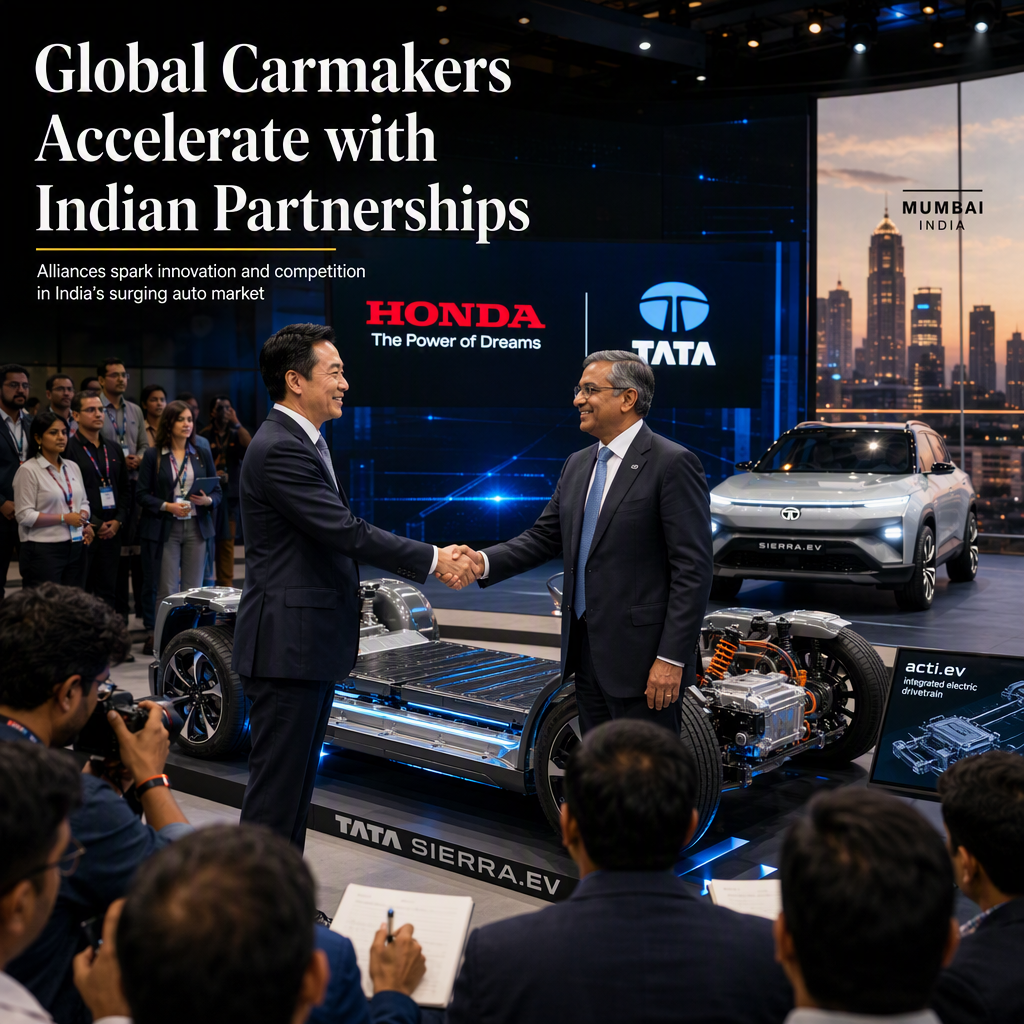
Global automakers are increasingly forming partnerships with local Indian companies to accelerate their expansion in the country's competitive automobile market, following a strategy previously employed in China [1]. A notable example is Honda's recent collaboration with a Tata Group company, which underscores the growing trend of international carmakers seeking local alliances to manage capital expenditure and scale operations efficiently [1].
The partnership was highlighted during a launch event in Mumbai on June 30, 2026, where a deconstructed Tata Sierra.ev vehicle was showcased, emphasizing the focus on electric vehicles and technological innovation [1]. Industry analysts point out that such collaborations enable global brands to leverage local expertise, comply with regulations, reduce costs, and adapt products for the Indian market, much as they did in China [1].
The Indian automobile sector is witnessing rising demand for affordable and technologically advanced vehicles, further incentivizing these alliances. An industry expert noted that capital expenditure management is a key driver, allowing global companies to concentrate on technology upgrades, product localization, and meeting evolving consumer expectations by partnering with established local players like Tata [1].
As competition intensifies, both foreign and domestic automakers are expected to pursue more such alliances to capture a larger share of India's expanding automobile market [1].
CONCLUSION
Global carmakers are replicating their successful China strategy by partnering with local Indian companies to manage costs and accelerate market entry. These alliances are expected to become more common as competition and demand for advanced vehicles grow in India, positioning both foreign and domestic players for future expansion.