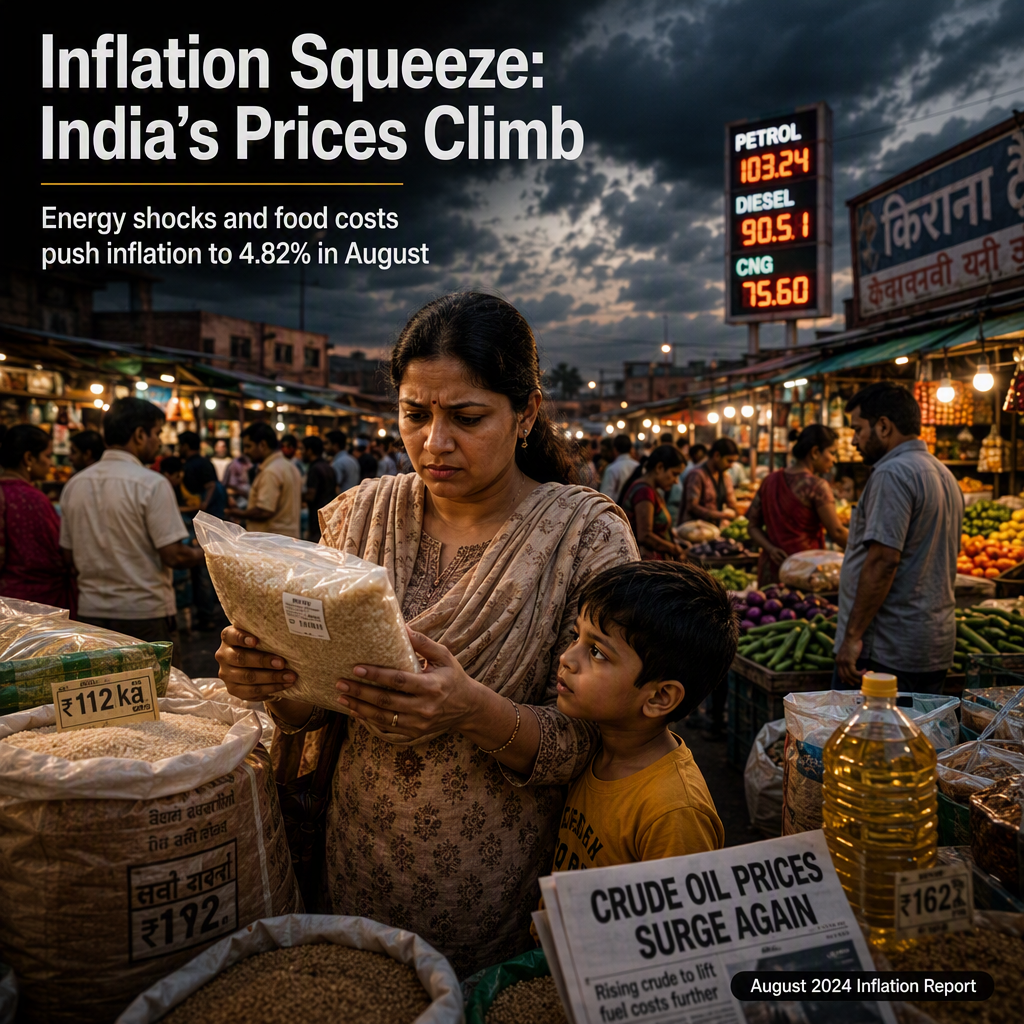
India's consumer price inflation rose to 4.82% in August, up from 4.45% in July, marking the tenth consecutive month of rising inflation in the country [1]. This figure slightly exceeded economists' expectations, which had forecast a 4.80% increase according to a Reuters poll [1]. The persistent rise in inflation is attributed to ongoing energy disruptions, the Iran war, and the El Niño weather pattern, all of which have contributed to higher food and fuel prices [1]. Specifically, food inflation increased to 5.95% in August from 5.52% in July, as reported by India's Ministry of Statistics and Program Implementation [1].
India's vulnerability to global supply disruptions is underscored by its reliance on imports for nearly 85% of its fuel needs, with much of this supply passing through the Strait of Hormuz [1]. Recent events, such as the closure of a key Saudi Arabian energy pipeline following a drone attack, have pushed global oil prices above $100 a barrel, further exacerbating inflationary pressures [1]. Despite these challenges, India's economic growth for the June quarter was robust at 7.8%, surpassing expectations [1].
In response to the strong growth data, global brokerages Morgan Stanley and Citi have raised their economic growth forecasts for India to 7.3% for the 12 months ending March 2027, up from less than 7% previously [1]. However, economists, including those at HSBC, anticipate a slowdown in growth in the second half of the year due to factors such as a high base, reduced public capital expenditure to meet fiscal deficit targets, and the impact of deficient rains on agricultural output [1].
The Reserve Bank of India (RBI) has maintained its focus on core inflation, which has not yet become a major concern, but acknowledges that sustained high food and energy prices could eventually drive up core inflation through increased input and operational costs [1]. The RBI projects headline inflation at 5% and core inflation at 4.3% for the financial year ending March 2027, factoring in risks from El Niño and the Iran war [1]. Notably, the RBI kept benchmark interest rates unchanged in August, diverging from several other Asian central banks that have raised rates to combat inflation [1].
CONCLUSION
India's inflation continues to rise, driven by external shocks to energy and food supplies, though economic growth remains resilient for now. While the RBI has held rates steady, ongoing pressures from global events and weather patterns may challenge this stance in the coming quarters. Analysts expect some moderation in growth, but upgraded forecasts reflect underlying economic strength.