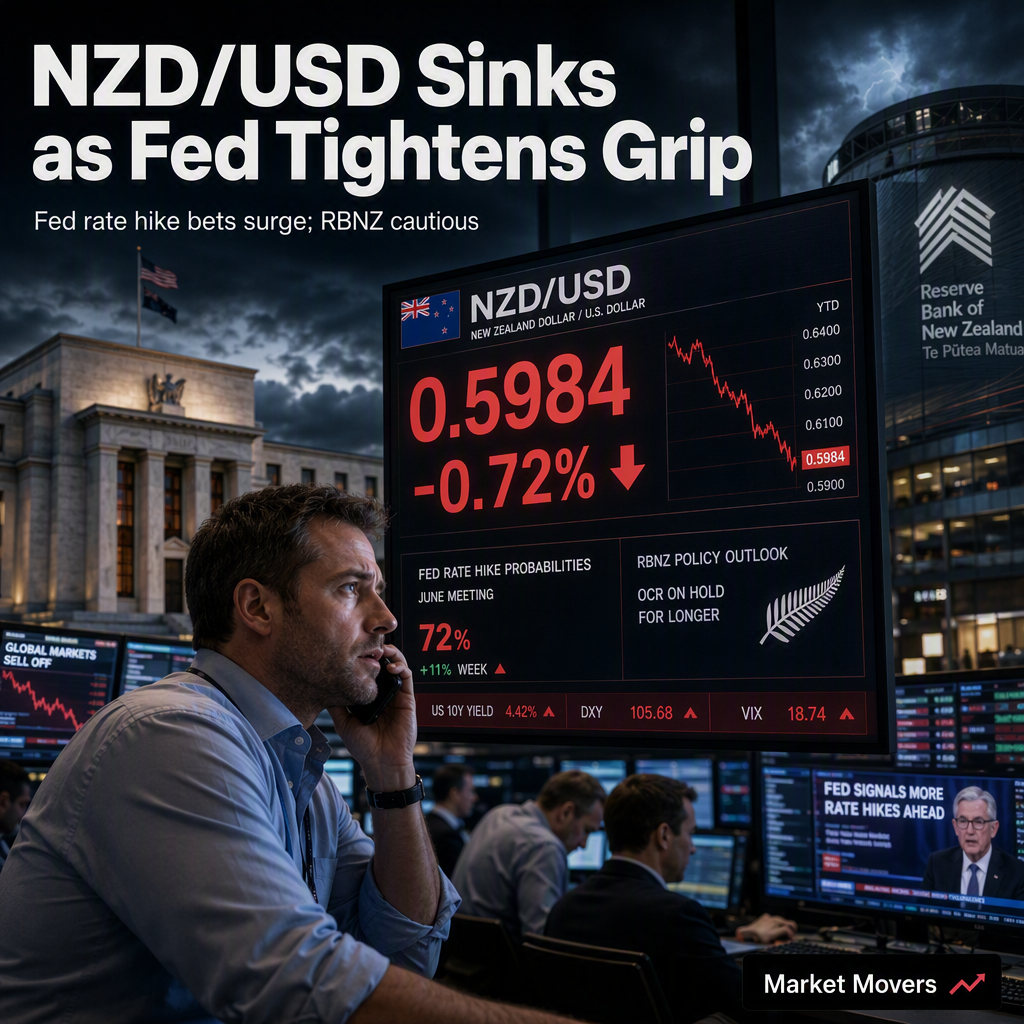
The New Zealand Dollar (NZD) extended its losses against the US Dollar (USD) on Monday, with NZD/USD trading around 0.5770, down 0.72% on the day [1]. This decline is primarily attributed to a stronger US Dollar, as investors increased their bets on another interest rate hike by the Federal Reserve (Fed) at its upcoming monetary policy meeting on Wednesday [1]. The latest US inflation data have reinforced expectations of further monetary tightening, with the CME FedWatch tool indicating that markets are pricing in an 88% chance of a 25-basis-point Fed rate hike this week, up from 59% a week earlier [1]. This shift in expectations has supported the US Dollar and exerted downward pressure on NZD/USD [1].
The Fed meeting is seen as the main catalyst for the currency pair this week, with investors also closely watching Fed Chair Kevin Warsh's press conference for guidance on the future path of US interest rates [1]. A continued restrictive policy stance from the Fed could further bolster the US Dollar [1].
On the domestic front, New Zealand's latest economic data show some improvement, with the BusinessNZ Performance of Services Index (PSI) rising to 51.2 in August, marking its third consecutive month of expansion and the highest level since September 2023 [1]. However, the recovery remains uneven, as three of the five sub-indices are still below the 50 threshold, according to BusinessNZ Chief Executive Katherine Rich [1]. The Reserve Bank of New Zealand (RBNZ) recently raised the Official Cash Rate (OCR) by 25 basis points to 2.75% but maintains a cautious stance, viewing the current rate as still accommodative and favoring a gradual withdrawal of monetary stimulus [1]. This moderate approach limits expectations for aggressive tightening in New Zealand, contrasting with the Fed's anticipated actions and keeping NZD/USD under pressure [1].
Analysts at Brown Brothers Harriman (BBH) expect New Zealand's Q2 real GDP to show a sharp loss of momentum, projecting production-based real GDP at 0.1% quarter-on-quarter (RBNZ projection: 0%) versus 0.8% in Q1, citing weaker household purchasing power and reduced domestic spending due to higher fuel prices, uncertainty, and declining house prices [1]. However, BBH also notes that leading indicators suggest a potential recovery in Q3 [1].
CONCLUSION
The New Zealand Dollar remains under significant pressure as expectations for a Fed rate hike strengthen the US Dollar, while the RBNZ's cautious stance limits support for the Kiwi. Although New Zealand's services sector shows tentative signs of improvement, economic momentum has slowed, and the market focus remains on the upcoming Fed decision. The outlook for NZD/USD will likely hinge on the Fed's policy signals and subsequent market reactions.