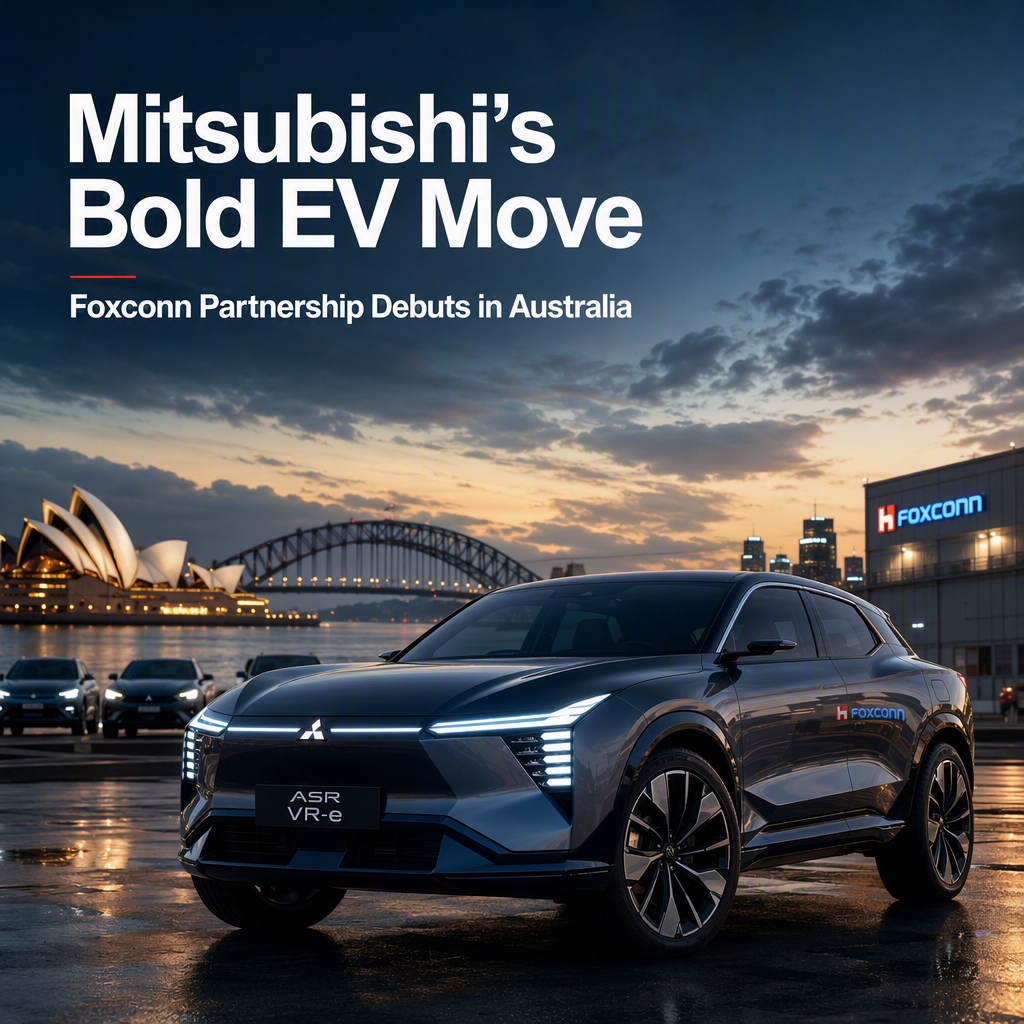
Mitsubishi Motors has announced plans to release a new electric vehicle, the ASR VR-e, in Australia and New Zealand this year. The vehicle will be manufactured by Foxtron Vehicle Technologies, the automotive arm of Taiwan's Foxconn group, marking the first time a Japanese automaker has partnered with the Taiwanese assembler for EV production [1]. This strategic collaboration reflects a significant shift in the automotive supply chain and comes as Japanese automakers face intensifying competition in the Australian market, particularly from Chinese EV manufacturers such as BYD [1].
The ASR VR-e is based on a design by Foxtron Vehicle Technologies. Mitsubishi's decision to work with Foxconn is seen as a direct response to the growing presence of low-cost Chinese electric vehicles and evolving consumer preferences toward sustainable transportation options [1]. The launch is expected to bolster Mitsubishi's market position in Australia and New Zealand, where government initiatives and increasing demand are accelerating EV adoption [1].
While Mitsubishi has not disclosed pricing details or production volumes for the ASR VR-e, industry observers anticipate that the company will pursue aggressive pricing strategies to compete with Chinese rivals. The technical specifications and market positioning of the ASR VR-e are expected to be closely monitored for their potential impact on local EV sales and Mitsubishi's market share [1].
A Mitsubishi spokesperson stated, "We are excited to bring this innovative EV to Australia and New Zealand, utilizing Foxconn's advanced manufacturing capabilities." Market analysts suggest that this partnership could indicate a broader trend of Japanese automakers seeking international collaborations to remain competitive in the global EV market [1].
CONCLUSION
Mitsubishi Motors' partnership with Foxconn to launch the ASR VR-e in Australia and New Zealand signals a strategic response to rising competition from Chinese EV makers. The move is expected to strengthen Mitsubishi's regional presence and may set a precedent for further international collaborations among Japanese automakers. Market observers will be watching closely for the vehicle's pricing, specifications, and impact on Mitsubishi's market share.