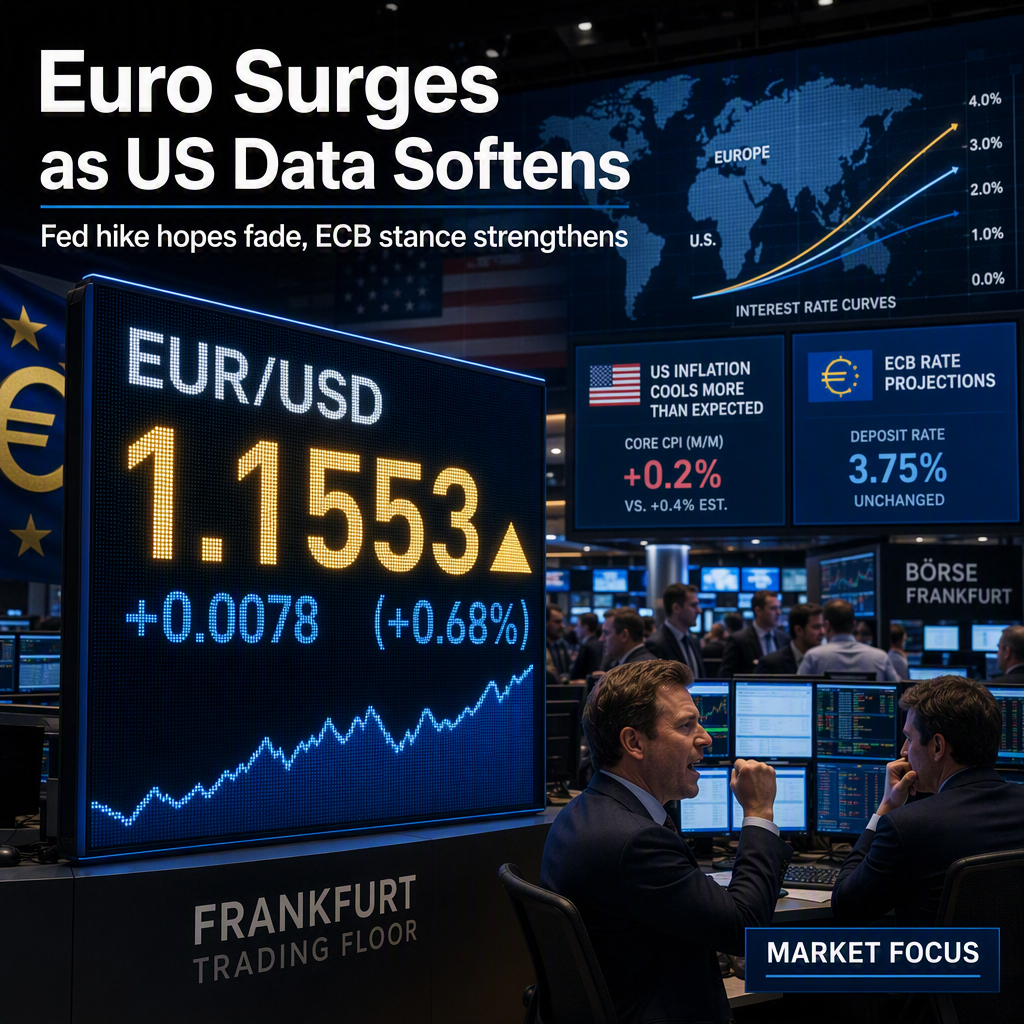
The EUR/USD pair traded with mild gains near 1.1580 during the early Asian session on Wednesday, as the US Dollar softened against the Euro following softer US inflation data that reduced expectations for tighter Federal Reserve (Fed) policy [1]. According to a Reuters poll cited in the article, most economists now anticipate the Fed will keep its key interest rate unchanged at the upcoming September policy meeting and through year-end. Market pricing for a September quarter-point hike shifted to nearly a 65% probability of a Fed hold after unexpected job losses in July, softer consumer price inflation, and weaker Retail Sales data [1].
Meanwhile, the ongoing US-Iran conflict, now in its sixth month, was highlighted by US President Donald Trump's statement that there are no talks or scheduled conversations with Iran, and that the naval blockade remains in effect. The article notes that signs of a prolonged conflict in the Middle East could boost safe-haven demand for the US Dollar, potentially acting as a headwind for the EUR/USD pair [1].
In Europe, financial markets are pricing in a continuation of the European Central Bank (ECB) hiking cycle, with the ECB Watch Tool indicating a 90% to 94% chance of a 25 basis points hike to 2.50% at the next policy meeting on September 9. ECB chief economist Philip Lane stated that Eurozone inflation at 3% remains too high, despite being lower than previous levels [1].
Strategists at Scotiabank observed that the Euro remains 'resilient, but little changed on the session,' supported by better-than-expected German survey data. The August ZEW Expectations component rose to 34, surpassing the consensus forecast of 30 and July’s 26.3, indicating a more constructive outlook among analysts [1]. However, Lane’s cautious optimism and a FXS Speechtracker score of 5.4/10 (below his historic 6.4/10 average) suggest a softer tone, with the ECB emphasizing data-dependent, meeting-by-meeting decisions and a more reactive policy stance. This has limited immediate upside for the Euro, as markets see less urgency for aggressive tightening [1].
CONCLUSION
The Euro's recent gains are driven by softer US data and diminished Fed rate hike expectations, while the ECB is seen as likely to continue its hiking cycle. However, cautious ECB communication and ongoing geopolitical risks may limit further upside for the Euro in the near term.