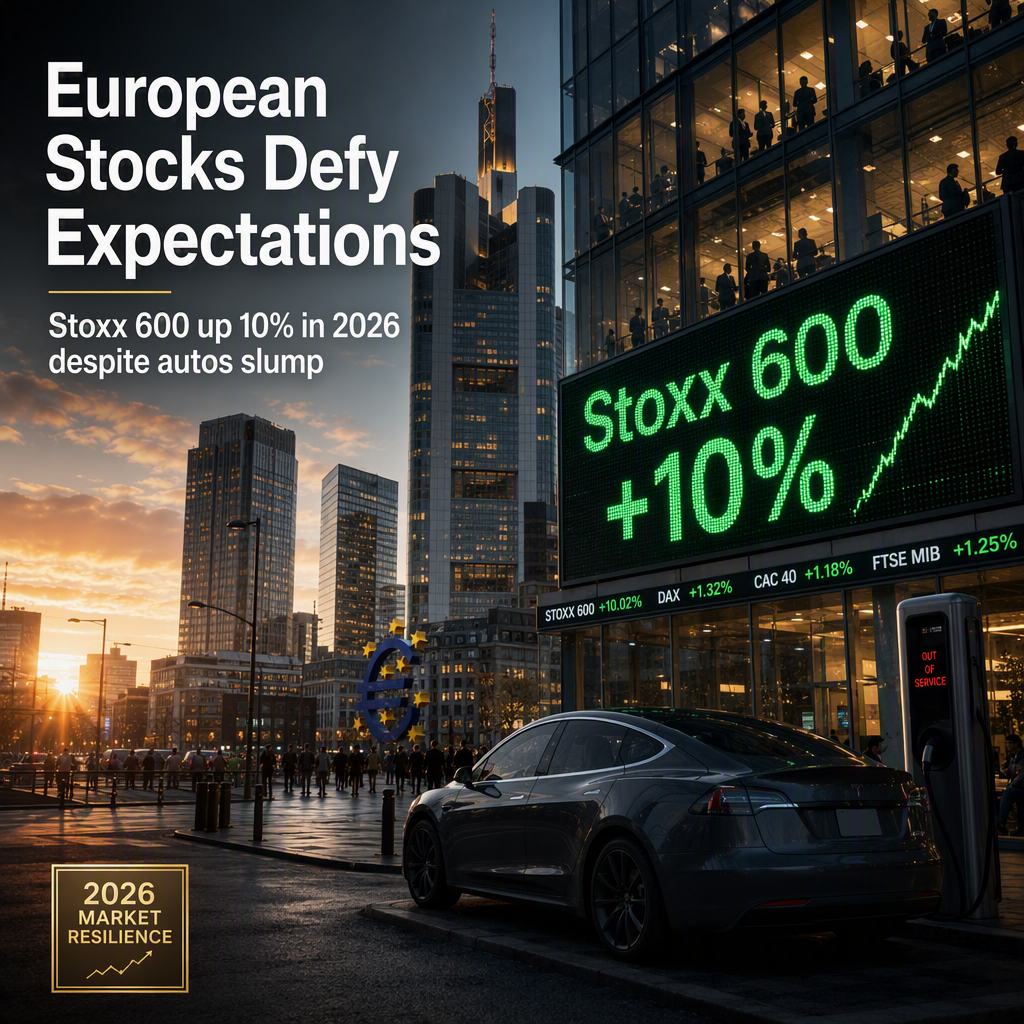
European equities have historically lagged behind U.S. and Asian markets in terms of investor enthusiasm, largely due to fewer high-growth companies and shallower capital markets [1]. However, a surge in government fiscal spending at the start of 2025 revitalized the market, and in 2026, the pan-European Stoxx 600 index has demonstrated notable resilience, rising 10% year-to-date. This performance is slightly behind the S&P 500, which has returned 13.5% over the same period [1].
Goldman Sachs analysts, in an August 10 note, challenged prevailing 'myths' about European stocks, highlighting that performance has been more mixed than commonly perceived. Since 2022, European banks have outperformed the Magnificent 7, and since early 2025, the Stoxx 600 has outperformed the S&P 500 despite tariff shocks and an energy supply crisis [1]. Goldman also noted that the largest sectors in Europe—financials, pharma, tech, energy, utilities, telecoms, aerospace, and defense—are not particularly exposed to Chinese competition, with autos representing only 1% of Europe's market capitalization [1].
The European autos sector, however, continues to struggle. The Stoxx Autos index is down 16% year-to-date, with Volkswagen AG and Stellantis among the worst performers, falling 27.6% and 51.9%, respectively. This decline is attributed to slowing electric vehicle demand, lost market share to Chinese competitors, and higher borrowing costs, resulting in sales volumes remaining well below pre-pandemic levels [1].
Looking ahead, BNP Paribas suggests that Europe may benefit from AI adoption, particularly in the autos sector. Sophie Huynh, portfolio manager and strategist at BNP Paribas Asset Management, remarked that the sector's current valuation is so low that investors are not considering its potential upside, indicating that deep value sectors may require patience before market sentiment shifts [1].
CONCLUSION
Despite ongoing challenges in the autos sector, European equities have shown resilience in 2026, with the Stoxx 600 up 10%. Analysts from Goldman Sachs and BNP Paribas highlight mixed sector performance and potential future benefits from AI adoption. The market takeaway is cautiously optimistic, with deep value opportunities emerging for patient investors.