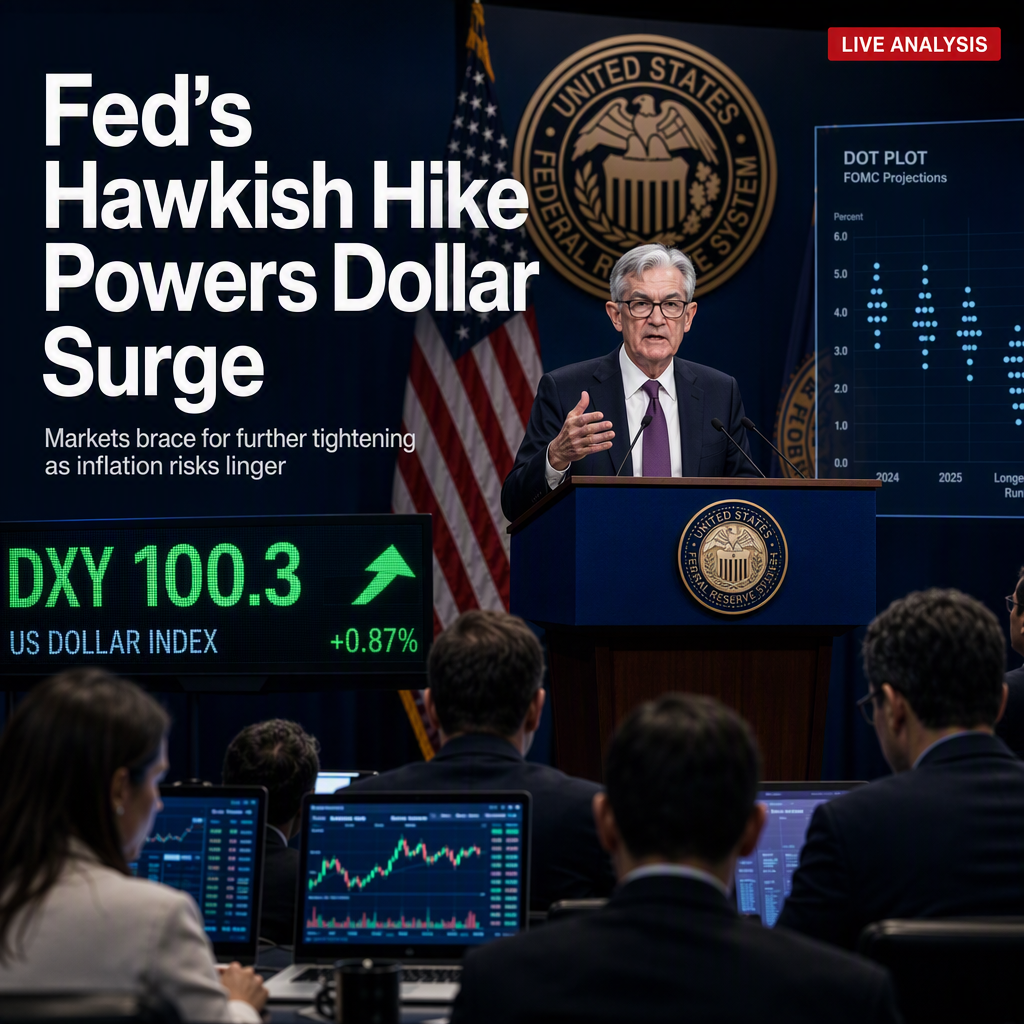
The Federal Reserve unanimously raised its Fed funds target range by 25 basis points to 3.75–4.00%, marking its first increase since 2023 and signaling a continued hawkish stance to combat persistent inflation [1][2]. The updated dot plot revealed that the median Fed funds projection for end-2026 rose to 4.125% from 3.75% in June, with sixteen of eighteen officials expecting at least one further increase this year [1]. Projections for end-2027 and end-2028 also moved higher, to 4.125% and 3.875% respectively, compared to previous estimates [1]. Fed funds futures are now pricing in a 51% probability of a 25bp hike in October and a total hike of 33bp by year-end, with two meetings remaining: October 27-28 and December 8-9 [1]. Commerzbank expects another rate hike in December [1].
OCBC strategist Christopher Wong highlighted that the Fed’s 25bp hike and upward shift in the dot plot extended the US Dollar Index (DXY) rebound, with DXY trading around 100.3 following the decision [2]. Wong noted that Fed Chair Warsh emphasized inflation concerns, citing little improvement in underlying trends, a strengthened economy, and a labor market near full employment. Warsh described the rate increase as 'removing a dose of accommodation' [2]. Despite substantial tightening already priced in, the modest repricing in UST yields suggests the Fed did not materially exceed market expectations for longer-term rates [2].
Market implications include continued support for the US Dollar in the near term, as front-end yields remain elevated and the Fed validates its hawkish policy path [2]. However, both sources note that with substantial tightening expectations already embedded, any moderation in economic activity, labor-market conditions, or inflation could prompt unwinding of rate expectations and reopen downside risk for the USD [2].
The main driver behind the rate hike was likely tight conditions in the bond market, which made maintaining the status quo too risky, according to Commerzbank [1].
CONCLUSION
The Federal Reserve’s hawkish rate hike and upward revision of future rate projections have reinforced near-term support for the US Dollar and elevated yields, with markets pricing in further tightening. However, both analysts caution that softer US economic data could shift expectations and potentially weaken the Dollar. Investors are now closely watching upcoming Fed meetings and economic indicators for signs of policy adjustment.