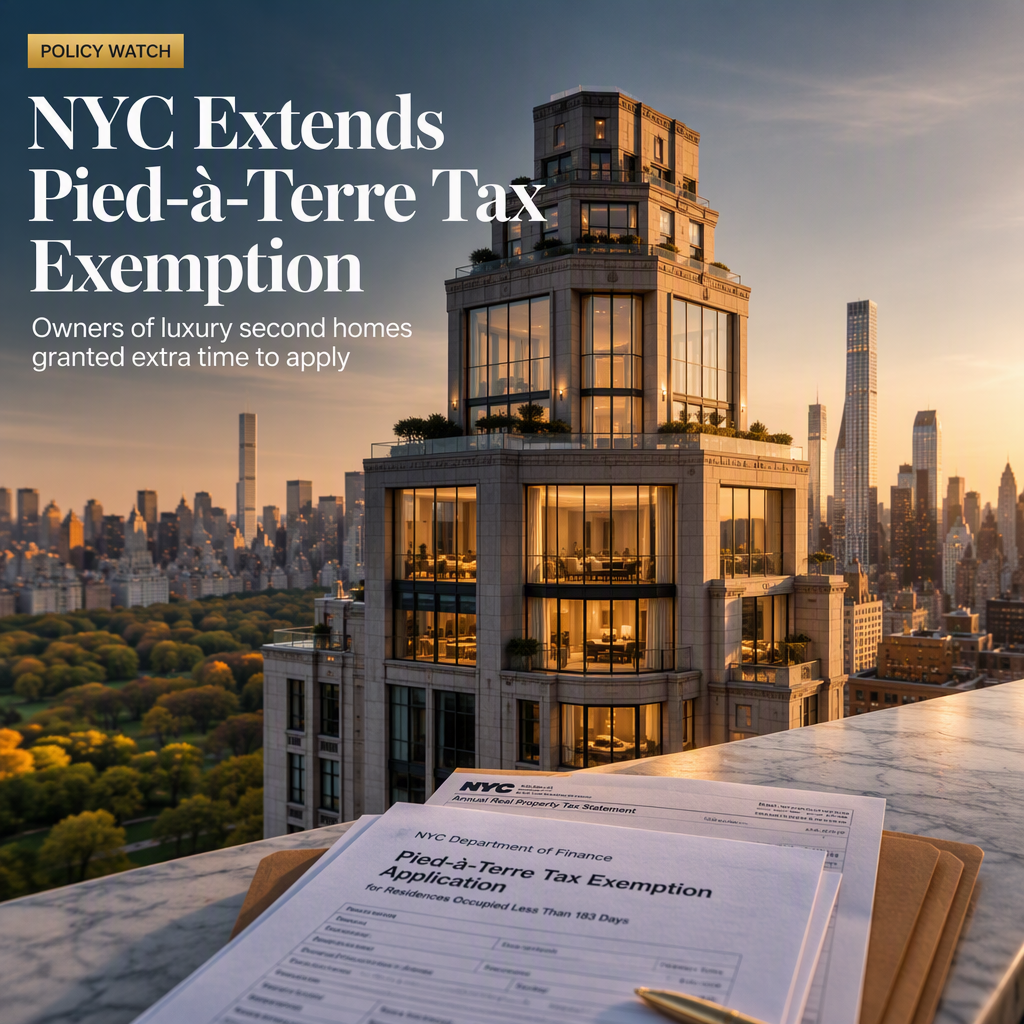
Mayor Zohran Mamdani has extended the deadline for New York City homeowners to apply for an exemption from the newly implemented pied-à-terre tax, which took effect on July 1. Homeowners who believe they qualify for an exemption now have until September 18 to submit their applications, a change from the previous deadline of August 21, according to City Hall [1]. The extension is intended to provide additional time for homeowners to prove their property is their primary residence, thereby exempting them from the tax [1].
The pied-à-terre tax, passed by the New York State Legislature in May and signed into law by Governor Kathy Hochul on May 28, imposes an annual surcharge on certain high-value New York City homes that are not the owner's primary residence. Specifically, the tax targets secondary residences valued at more than $5 million, including one-, two-, and three-family properties, as well as individual condo and co-op units valued at $1 million or more. The tax will be applied during the 2026-27 and 2027-28 property-tax years [1].
Initial confusion arose when the city published a supplemental market value roll listing over 900,000 properties, without clarifying that most would not be subject to the new tax. The Department of Finance later clarified that only 17,000 homeowners received official surcharge notifications and need to consider applying for an exemption [1].
The tax has been controversial, with real-estate and business leaders warning it could drive investment out of the city. Mayor Mamdani announced the levy in a video outside Ken Griffin’s $238 million penthouse, explicitly naming the hedge fund manager as an example of the wealthy second-home owners targeted by the tax. Griffin criticized the video as "creepy and weird" during a public discussion on May 6 [1].
CONCLUSION
The extension of the exemption deadline aims to address confusion and ensure only eligible homeowners are impacted by the new pied-à-terre tax. While the tax is designed to target high-value secondary residences, it has sparked debate among business leaders and property owners about its potential effects on investment in New York City. The market impact is medium, as the policy targets a specific segment of the real estate market and has generated notable public and industry reaction.