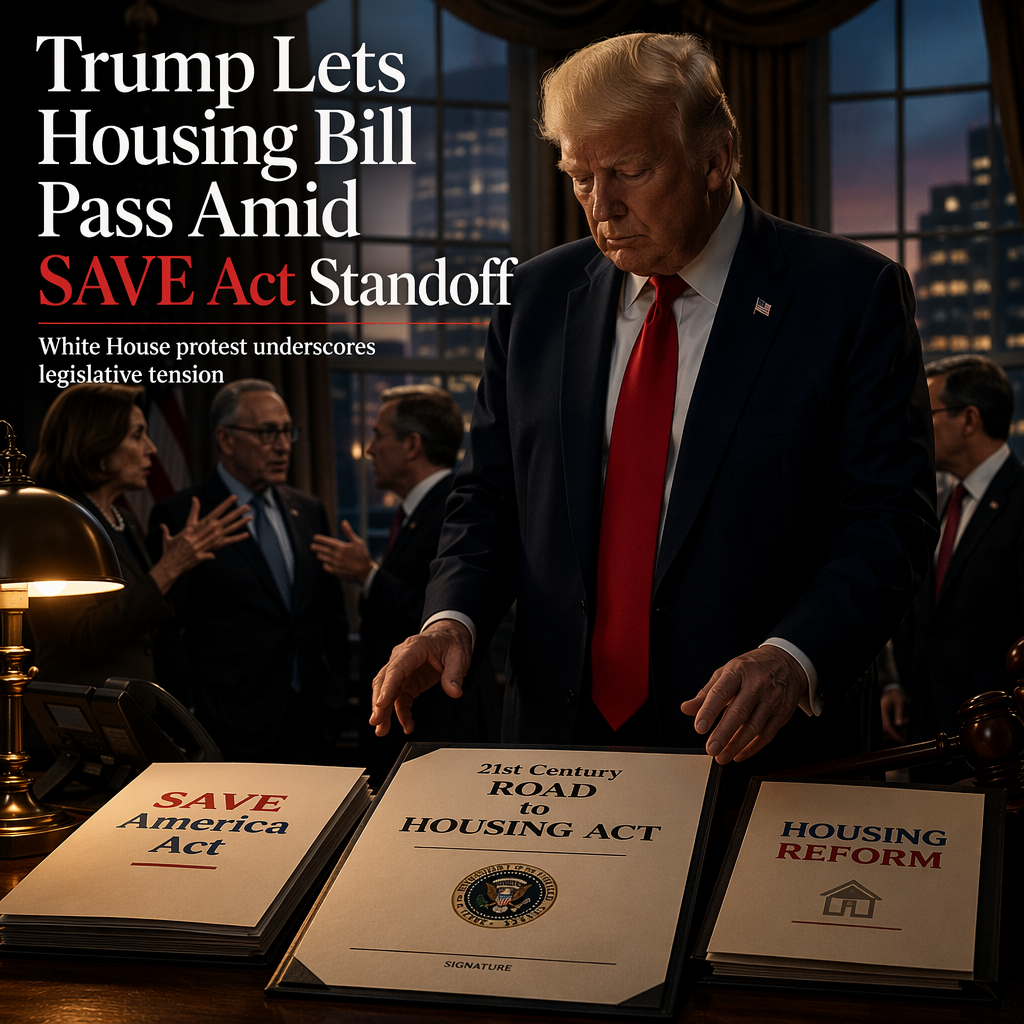
President Donald Trump allowed the 21st Century ROAD to Housing Act, a bipartisan bill aimed at expanding the nation’s housing stock and lowering costs, to become law without his signature after declining to sign or veto the measure by the constitutional deadline [1]. Trump’s decision followed weeks of speculation over whether he would veto the bill, as he sought to pressure Congress to pass the SAVE America Act, an election reform measure he strongly supports [1].
The housing bill passed both chambers of Congress with overwhelming majorities, exceeding the two-thirds threshold required to override a potential veto [1]. Despite this, Trump criticized the bill, calling it "a yawn" compared to the SAVE America Act, which he described as essential for "saving America from crooked elections" [1]. He also expressed reservations about a provision in the housing bill restricting Wall Street investors from purchasing single-family homes, a policy he had previously proposed but later appeared to question its impact on current homeowners [1].
Trump’s refusal to sign the bill was framed as a protest against the Senate’s inability to pass the SAVE America Act, which includes requirements for proof of citizenship to vote in federal elections and voter ID, as well as proposed restrictions on mail-in voting and participation in women’s sports by men [1]. The SAVE America Act has struggled to clear the Senate’s 60-vote threshold, and the House has not passed a version with Trump’s preferred provisions [1].
Market implications of the housing bill include potential changes in the housing market due to the restriction on Wall Street investors, which Trump argued could benefit individual homebuyers over private equity firms [1]. However, Trump also voiced concern about unintended consequences for current homeowners [1]. No specific market reactions or analyst opinions were provided in the article.
CONCLUSION
President Trump’s decision to let the bipartisan housing bill become law without his signature highlights ongoing tensions between the White House and Congress over legislative priorities. While the housing bill aims to address affordability and investor activity, Trump’s focus remains on advancing the SAVE America Act, leaving uncertainty around future legislative negotiations.